


Engineers, computer programmers and children tinker with self-made radio-controlled toy cars and robotic arms in China’s southern city of Shenzhen, home to “makers” who belie the country’s reputation as a hub for technology copycats.
The group works in a special space inside a high-rise in a city considered a nerve center for the “maker movement” of tech whizzes who invent, design and make their own gadgets and devices from scratch.
China is trying to shed its notoriety as a hub for counterfeit goods, a battleground in an ongoing trade dispute with the US, which is threatening to hit Chinese electronics and other high-end industry with steep tariffs for the “theft” of intellectual property.
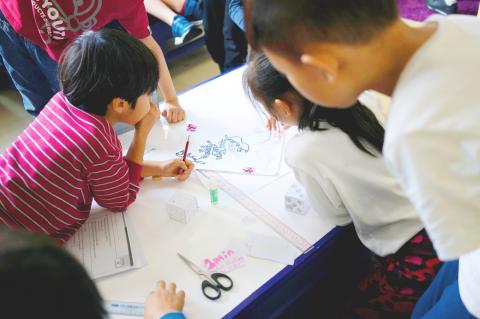
Photo: AFP
Shenzhen’s government has doled out US$145 million in grants to lure thousands of Chinese and foreign entrepreneurs, and tens of millions more to fund “maker spaces” and activities to encourage innovation.
At MG Space, a wall is covered by shelves with meticulously labeled bins containing assorted pieces of wood and foam, circuit boards, wires, soldering kits, plastic parts and joiners for communal use.
“I’m designing a pulley system that can support a lot of weight,” 11-year-old Li Zhonghan said, without taking his eyes off a 3D modeling program on his computer.
Once their blueprints are ready, the makers send their plans to a 3D printer and laser cutter to make their designs a reality.
It is important to give children and youth opportunities to collaborate on projects with professionals, said Yue Lingyu (岳凌宇), vice manager of MG Space, which is privately funded.
“The tutors here don’t see the kids as their students — they view each other as colleagues,” she told reporters.
Makers pride themselves on coming up with new ideas and they expect fellow makers to give them due credit for inventions.
This is a departure from the so-called shanzhai (山寨, “mountain forts”) culture in China, where counterfeiters produce increasingly high-quality replicas of everything from computers and handbags to famous paintings.
Eight years ago, two brothers in Shenzhen invented the Apple Peel, a set of attachments that convert an iPod Touch into a fully functional iPhone that can make calls and send text messages.
China has slowly evolved from shanzhai to gray areas like Apple Peel and original technologies such as dockless shared bicycles.
Shenzhen went from being a manufacturing hub for mainly foreign firms to making mobile phones, drones and other gadgets for Chinese firms and start-ups.
However, a survey of US businesses by the American Chamber of Commerce said that intellectual property (IP) infringement continues to be a top challenge for some in China, citing inadequate laws and difficulty prosecuting cases.
Intellectual property issues have vexed Chinese companies, too. New intellectual property rights courts have been created to stop theft.
“In China, trends spring up and companies copy each other. Especially for cases where the ideas require a low level of technology, it’s hard to say who came up with it first,” said Wu Nan (巫楠), founder of AllTechAsia, which tracks Chinese technology trends.
There are too many obstacles to taking cases to court, said Matthew Murphy, managing partner at Beijing-based law firm MMLC Group, which specializes in intellectual property rights.
“The laws are fine, but many innovators look at how much trouble and cost may be involved in IP enforcement and they get concerned. The requirement of notarized/legalized powers of attorney and other documents adds a level of cost and slows things down a lot,” Murphy told reporters.
Another problem is that the wealth of government subsidies available can lead to a concentration of start-ups in areas where there is not enough demand, critics have said.
Christopher Balding, an economics professor at Peking University’s satellite campus in Shenzhen, has observed entrepreneurs making decisions based on what subsidies are available, regardless of whether the company actually intended to bring their proposed products to market.
“For example, the government decided that robots were a big thing and there was a lot of funding, so everyone began making robots. While there is significant new robot adoption in China, Beijing is investing vastly more than needed,” Balding said.
Some have said public funds for makers are not being wisely spent.
“Maker spaces get so much money from the government and they’re competing with each other for members, but there are so many that some are completely empty,” Wu said.
James Simpson, founder of the private Steamhead makers’ education hub in Shenzhen, said there are enough maker spaces now and the priority should be to get people to use them.
“In China there is huge interest and an increasing number of resources to turn creative skills into a sustainable business, but not so many chances for people to have interactions to access new experiences and learn from others,” Simpson said.
However, the satisfied parents and kids at MG Space are more optimistic about China’s innovative skills.
“China has come a long way from rote learning in all the schools, especially here in Shenzhen, where teachers really want to give kids practical skills,” said Yang Hong, a mother of two.
“I like to make stuff,” said her daughter, eight-year-old Yao Xirou. “I don’t know the job I want yet, but I just want to have fun.”

Taiwan’s foreign exchange reserves fell below the US$600 billion mark at the end of last month, with the central bank reporting a total of US$596.89 billion — a decline of US$8.6 billion from February — ending a three-month streak of increases. The central bank attributed the drop to a combination of factors such as outflows by foreign institutional investors, currency fluctuations and its own market interventions. “The large-scale outflows disrupted the balance of supply and demand in the foreign exchange market, prompting the central bank to intervene repeatedly by selling US dollars to stabilize the local currency,” Department of Foreign

Intel Corp is joining Elon Musk’s long-shot effort to develop semiconductors for Tesla Inc, Space Exploration Technologies Corp and xAI, marking a surprising twist in the chipmaker’s comeback bid. Intel would help the Terafab project “refactor” the technology in a chip factory, the company said on Tuesday in a post on X, Musk’s social media platform. That is a stage in the development process that typically helps make chips more powerful or reliable. The chipmaker’s shares jumped 4.2 percent to US$52.91 in New York trading on Tuesday. The Terafab project is a grand plan by Musk to eventually manufacture his own chips for
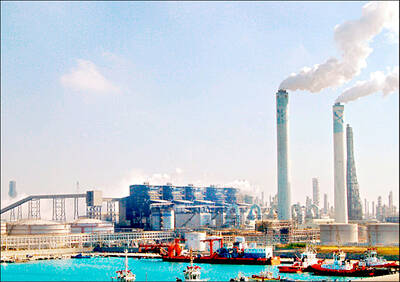
Taiwan Power Co (Taipower, 台電) yesterday said it plans to resume operations at two coal-fired power generators for three months to boost security of electricity supply as liquefied natural gas (LNG) supply risks are running high due to the Middle East conflict. The two coal-fired power generators are at Mailiao Power Plant in Yunlin County’s Mailiao Township (麥寮). The plant, operated by Formosa Plastics Group (台塑集團), supplied electricity to Taipower’s power grid until the end of last year. Taipower’s decision came about one month after Minister of Economic Affairs Kung Ming-hsin (龔明鑫) on March 10 said that the nation had no imminent

Some robotaxi passengers were left stranded in the middle of fast-moving traffic in a major Chinese city after their driverless vehicles stopped running, according to police and media reports on Wednesday. A preliminary investigation indicates more than 100 robotaxis came to a halt because of a “system malfunction,” police in the city of Wuhan said in a statement, without elaborating. No injuries were reported. One passenger told Chinese media that their robotaxi stopped after turning a corner. An instruction on a screen read: “Driving system malfunction. Staff are expected to arrive in 5 minutes.” After no one showed up, the passenger pushed


 RSS
RSS