


Taiwan Paiho Ltd (台灣百和) on Friday reported that first-quarter net profit attributable to the parent company declined 13.1 percent annually and 1.77 quarterly to NT$355.38 million (US$12.13 million).
Operating profit dropped 10.6 percent year-on-year to NT$589.51 million, and earnings per share (EPS) fell from NT$1.37 to NT$1.19, the shoelace and elastic band and fastener manufacturer said in a filing with the Taiwan Stock Exchange.
The bottom-line figures were another disappointing data release this month from Taiwan Paiho, following its report last week that first quarter consolidated sales rose by grew by a weaker-than-expected 3.4 percent year-on-year to NT$2.89 billion, due to low shipments in four-way stretchable elastic bands and one-piece fabrics.
At a quarterly meeting with analysts on Friday, Taiwan Paiho maintained its full-year revenue growth forecast of 10 to 15 percent, with gross margin expected to remain flat at 40 percent and an operating margin between 20 and 23 percent, KGI Securities Investment Advisory Co (凱基投顧) said in a client note later in the day.
Taiwan Paiho has budgeted about NT$2.8 billion for capital spending this year, including funding for new plants in Vietnam and new office buildings in Taiwan, the KGI note said.
The 33-year-old company earmarked NT$3 billion for capital spending last year.
Its products are accessories used in ready-to-wear apparel and footwear such as webbing, touch fasteners, elastic tapes, molded hooks and shoelaces, and its customers include well-known brands such as Adidas, Nike, Under Armour, New Balance and Puma.
Analysts said that while Taiwan Paiho has made notable investments in its products, especially four-way stretch bands and one-piece fabrics, its sluggish revenue growth suggests that it faces slower demand from its customers, or has encountered increased competition from its regional peers.
Either way, the company’s margin outlook faces risks, they said.
“With lowered sales growth, we believe there will be further pressure on Taiwan Paiho’s margins, given lower utilization of its newly deployed machines for four-way stretch and one-piece fabrics that cannot offset rising depreciation and amortization,” Morgan Stanley Taiwan Ltd analyst Terence Cheng (程世維) wrote in a note on Monday last week.
However, KGI said that demand for Taiwan Paiho’s four-way stretch bands, one-piece fabrics and mesh fabrics is likely to recover in the second half of this year, as the firm still enjoys a leading position in accessories supply chains.
In addition, as Taiwan Paiho continues to expand its customer base from its current concentration in the sports apparel and footwear accessories sectors to those in the medical and aerospace sectors, its revenue could increase 10.2 percent year-on-year to NT$12.94 billion this year, while its net income is predicted to grow 9 percent to NT$1.77 billion, KGI analyst Lai Chien-an (賴建安) said.
Shares in Taiwan Paiho on Friday rose 0.14 percent in Taipei trading to NT$73.4, down 47.38 percent from its most recent high of NT$139.5 on Sept. 29 last year.
In their respective notes, KGI cut its target price for the firm’s shares from NT$166 to NT$101, valuing the stock at 17 times its estimated EPS of NT$5.92 this year, while Morgan Stanley lowered its target price to NT$67, based on 12.5 times its estimated EPS of NT$5.36.

The domestic unit of the Chinese-owned, Dutch-headquartered chipmaker Nexperia BV will soon be able to produce semiconductors locally within China, according to two company sources. Nexperia is at the center of a global tug-of-war over critical semiconductor technology, with a Dutch court in February ordering a probe into alleged mismanagement at the company. The geopolitical tussle has disrupted supply chains, with some carmakers reportedly forced to cut production due to chip shortages. Local production would allow Nexperia’s domestic arm, Nexperia Semiconductors (China) Ltd (安世半導體中國), to bypass restrictions in place since October on the supply of silicon wafers — etched with tiny components to

Singapore-based ride-hailing and delivery giant Grab Holdings Ltd has applied for regulatory approval to acquire the Taiwan operations of Germany-based Delivery Hero SE's Foodpanda in a deal valued at about US$600 million. Grab submitted the filing to the Fair Trade Commission on Friday last week, with the transaction subject to regulatory review and approval, the company said in a statement yesterday. Its independent governance structure would help foster a healthy and competitive market in Taiwan if the deal is approved, Grab said. Grab, which is listed on the NASDAQ, said in the filing that US-based Uber Technologies Inc holds about 13 percent of
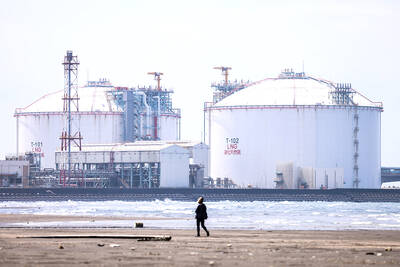
Taiwan is open to joining a global liquefied natural gas (LNG) program if one is created, but on the condition that countries provide delivery even in a scenario where there is a conflict with China, an energy department official said yesterday. While Taiwan’s priority is to have enough LNG at home, the nation is open to exploring potential strategic reserves in other countries such as Japan or South Korea, Energy Administration Deputy Director-General Chen Chung-hsien (陳崇憲) said. While the LNG market does not have a global reserve for emergencies like that of oil, the concept has been raised a few times —

Taiwan Semiconductor Manufacturing Co (TSMC, 台積電) yesterday received government approval to deploy its advanced 3-nanometer (3nm) process at its second fab currently under construction in Japan, the Ministry of Economic Affairs said in a news release. The ministry green-lit the plan for the facility in Kumamoto, which is scheduled to start installing equipment and come online in 2028 with a monthly production capacity of 15,000 12-inch wafers, the ministry said. The Department of Investment Review in June 2024 authorized a US$5.26 billion investment for the facility, slated to manufacture 6- to 12nm chips, significantly less advanced than 3nm process. At a meeting with


 RSS
RSS