


Yang Ming Marine Transport Corp (陽明海運) on Monday gave a conservative outlook on its earnings this year amid sluggish demand in the global container shipping sector.
While the company expects its bottom line to have returned to the black at the end of last year, prospects are not likely to improve significantly until next year, Yang Ming Marine chairman Bronson Hsieh (謝志堅) said.
Prospects remain unclear for the global container shipping sector this year and earnings would depend on market conditions and the oil price, he said.
While Alphaliner expects supply growth to continue to outpace demand growth this year at 5.9 percent against 5.1 percent, the sector could outperform the forecast if factors such as capacity disruptions from China’s holiday seasons in May and October are included, Hsieh said, adding that an upward revision of global economic growth could also create demand.
In addition to the US and Europe, robust economic growth is expected in central and south America, as well as India, he said.
The company is also expecting growth in Southeast Asia as its commitment to the government’s New Southbound Policy begins to bear fruit, with shipping in the region seeing a 15 percent rise to 1.3 million twenty-foot-equivalent units last year.
However, a rising oil price, which is expected to be 20 percent higher than last year at between US$60 and US$65 per barrel, would translate into higher fuel costs, he added.
Yang Ming Marine has not yet released its results for the final quarter of last year.
The company recorded net income of NT$1.26 billion (US$43.1 million) in the third quarter of last year, or earnings per share of NT$0.73, its first profitable quarter since 2013.
Cumulative losses stood at NT$82 million at the end of the third quarter, or losses per share of NT$0.05.
Separately, SinoPac Securities Investment Service Corp (永豐投顧) is upbeat on the nation’s dry bulk carriers on expectations of higher freight prices next month as post-holiday inventory restocking begins.
The Baltic Dry Index — which tracks the costs of transporting dry commodities such as coal, iron ore and grain on 20 shipping routes — last week posted a 4.7 percent rebound to 1,146 points, SinoPac Securities said in a report published on Friday last week.
The index could climb as high as 2,000 points this year as fewer new bulk shippers are being added to global capacity, the report said.

CHIP RACE: Three years of overbroad export controls drove foreign competitors to pursue their own AI chips, and ‘cost US taxpayers billions of dollars,’ Nvidia said China has figured out the US strategy for allowing it to buy Nvidia Corp’s H200s and is rejecting the artificial intelligence (AI) chip in favor of domestically developed semiconductors, White House AI adviser David Sacks said, citing news reports. US President Donald Trump on Monday said that he would allow shipments of Nvidia’s H200 chips to China, part of an administration effort backed by Sacks to challenge Chinese tech champions such as Huawei Technologies Co (華為) by bringing US competition to their home market. On Friday, Sacks signaled that he was uncertain about whether that approach would work. “They’re rejecting our chips,” Sacks

It is challenging to build infrastructure in much of Europe. Constrained budgets and polarized politics tend to undermine long-term projects, forcing officials to react to emergencies rather than plan for the future. Not in Austria. Today, the country is to officially open its Koralmbahn tunnel, the 5.9 billion euro (US$6.9 billion) centerpiece of a groundbreaking new railway that will eventually run from Poland’s Baltic coast to the Adriatic Sea, transforming travel within Austria and positioning the Alpine nation at the forefront of logistics in Europe. “It is Austria’s biggest socio-economic experiment in over a century,” said Eric Kirschner, an economist at Graz-based Joanneum

BUBBLE? Only a handful of companies are seeing rapid revenue growth and higher valuations, and it is not enough to call the AI trend a transformation, an analyst said Artificial intelligence (AI) is entering a more challenging phase next year as companies move beyond experimentation and begin demanding clear financial returns from a technology that has delivered big gains to only a small group of early adopters, PricewaterhouseCoopers (PwC) Taiwan said yesterday. Most organizations have been able to justify AI investments through cost recovery or modest efficiency gains, but few have achieved meaningful revenue growth or long-term competitive advantage, the consultancy said in its 2026 AI Business Predictions report. This growing performance gap is forcing executives to reconsider how AI is deployed across their organizations, it said. “Many companies
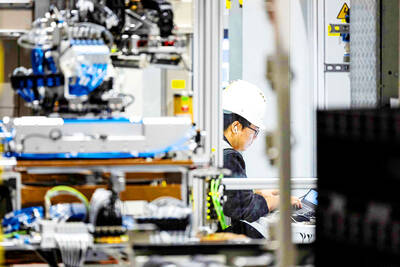
France is developing domestic production of electric vehicle (EV) batteries with an eye on industrial independence, but Asian experts are proving key in launching operations. In the Verkor factory outside the northern city of Dunkirk, which was inaugurated on Thursday, foreign specialists, notably from South Korea and Malaysia, are training the local staff. Verkor is the third battery gigafactory to open in northern France in a region that has become known as “Battery Valley.” At the Automotive Energy Supply Corp (AESC) factory near the city of Douai, where production has been under way for several months, Chinese engineers and technicians supervise French recruits. “They


 RSS
RSS