


With technology and business insiders predicting that this year will be the year of artificial intelligence (AI), CNA sat down with Ethan Tu (杜奕瑾), founder of Taiwan AI Labs (台灣人工智慧實驗室), last month to talk about the potential for AI development in the country.
According to Tu, who leads a team of 30 at the labs, Taiwan is well-positioned to be what he calls the “AI island of the world.”
He said Taiwan has several advantages when it comes to software and big data, and can utilize them to put AI to good use.
Using the healthcare system as an example, Tu said that Taiwan has the most comprehensive national health insurance system in the world and is a world leader in digitalizing hospital records.
This network and data provide a foundation that researchers and scientists can work on to incorporate AI technologies and create a smarter, automated healthcare system, he said.
As Tu explains, AI is a tool that cuts costs and maximizes efficiency, but a tool nonetheless that requires someone with an idea of how to put it to use.
The challenge for Taiwan, with its abundance of big data, the largest information and communication technology industry in the world and a strong Internet of Things network, is cultivating and retaining talent.
Tu, an engineer who founded the popular PTT online bulletin board system, said that current working conditions in Taiwan, especially in the tech industry, stifle innovation.
“Once people are bogged down by work, they lose their creativity,” he said, pointing to the long hours, low wages and hierarchical structure at many Taiwanese companies that prevent people from having real-life experiences which are the key to being inspired to create software.
Furthermore, Taiwan’s education system does not foster innovation, Tu said, adding that such a system emphasizes the right, standard answer instead of being more critical and asking questions.
Therefore, most of the engineers he has seen at local companies are rigid, afraid to voice their opinions and do whatever their bosses tell them to do.
With no time to sleep, there is no time to think, which means even less time to innovate, Tu said.
This stands in sharp contrast to engineers working at foreign companies who do not spend all their time in the office, but instead go outside and explore in order to get inspired to innovate.
Taiwan has a vast amount of resources in both software and hardware to make advances in AI, so what it really comes down to is innovation, because that is where value comes from, Tu said.
As Tu continues to grow his Taiwan AI Labs, with the goal of having a staff of 60 by the end of the year, he plans to focus on developing medical treatment, smart cities and human machine interfaces, in all of which AI plays an important role and offers practical benefits for society at large.

INTERGRATION: Jensen Huang said that every Nvidia department and function of the company should be using AI, after reportedly saying staff were ‘insane’ not to Nvidia Corp is in a “unique” position in the market, despite facing intensifying competition, chief executive officer Jensen Huang (黃仁勳) said during a brief visit to Taiwan yesterday amid a potentially growing challenge from Google for the artificial intelligence (AI) chip market. Huang told reporters that the AI market is “extremely large” and that while there is a lot of competition, Nvidia’s “condition is very strong and our position is very unique.” Huang, who arrived in Taipei on Thursday, was responding to questions about the possible threat posed by Google. According to a report in The Information on Tuesday, Meta has been in
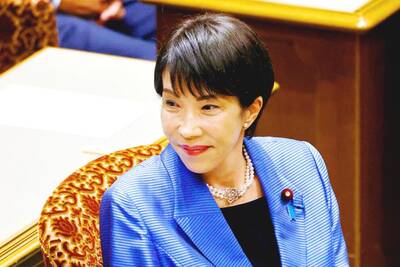
Charming US President Donald Trump one week, angering China the next, Japanese Prime Minister Sanae Takaichi has had a busy start and is riding high in the polls, all on a few hours of sleep a night. However, the honeymoon might end soon for the Margaret Thatcher-admiring leader if a spat with China escalates further and she fails to keep inflation in check. “I believe Prime Minister Takaichi will surely do what she needs to do, so I trust her,” Kozue Otsuka, 50, told reporters at a festival this week for business owners seeking good fortune. While buying a lucky kumade rake featuring
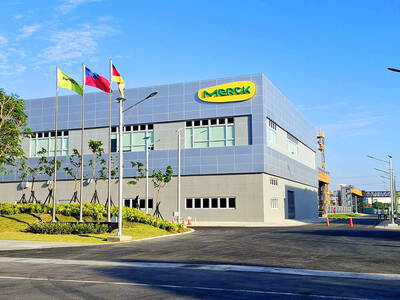
INSULATED: The company said it is less exposed to global complications, as it has built a strong footprint worldwide, and has multiple sources of rare earths and raw minerals Merck Group yesterday said it would ramp up production next year at its new flagship facility in Kaohsiung’s Lujhu District (路竹) to satisfy growing demand for advanced semiconductor materials and specialty gases, and to address supply resilience issues amid mounting geopolitical risks. Merck made the remarks during a news conference before the inauguration of its 500 million euros (US$582.1 million) facility, which is also to supply other markets in the Asia-Pacific region, it said. Merck executive board deputy chair and electronics CEO Kai Beckmann told reporters the company adopted a “local-for-local” strategy about seven years ago to address the cycle time of
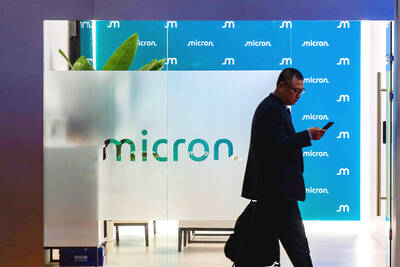
RIDING THE WAVE: The race to build AI infrastructure has lifted the valuations of top memory makers, such as Micron, amid dwindling inventories and supply challenges Micron Technology Inc is to spend ¥1.5 trillion (US$9.6 billion) to build a plant in western Japan to make memory chips for artificial intelligence (AI) applications, the Nikkei reported on Saturday. The move comes as Micron seeks to diversify advanced chip production outside of Taiwan, the Nikkei article said, citing people familiar with the matter. The new factory will manufacture high-bandwidth memory (HBM) chips, a key component for working with AI processors such as those made by Nvidia Corp, the report said. Micron would build the facility within the compound of its Hiroshima plant, starting in May next year, with plans to launch


 RSS
RSS