


Hon Hai Precision Industry Co (鴻海精密) chairman Terry Gou (郭台銘) yesterday mapped out the company’s corporate transformation plan, with an initial focus on developing industrial Internet-focused technologies and then growing Internet-based “smart” healthcare and security solutions.
“The public continues to see Hon Hai as a contract electronics maker... We are transforming from a traditional hardware manufacturing firm into a company that provides platforms and solutions,” Gou told a provisional shareholders’ meeting at the company’s headquarters in New Taipei City’s Tucheng District (土城).
Shareholders approved Hon Hai’s proposal to seek an initial public offering (IPO) for its newly established subsidiary, Foxconn Industrial Internet Co Ltd (FII, 富士康工業互聯網), on the Shanghai Stock Exchange.
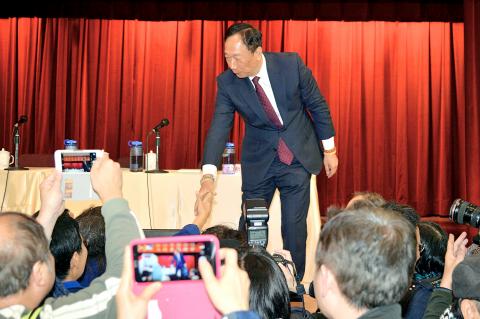
Photo: CNA
About 10 percent of Shenzhen, China-based FII’s shares are to be converted to floating stock, and Hon Hai will maintain an about 85 percent stake, Hon Hai said.
The pricing and timeline of FII’s IPO have not yet been determined, it added.
FII, which has a paid-in capital of 17.72 billion yuan (US$2.82 billion), is to collect, process and analyze industrial data generated by Hon Hai’s more than 1 million employees and millions of pieces of equipment worldwide every day, Gou said.
Hon Hai’s massive supply of industrial data is the foundation for the development of artificial intelligence, machine-to-machine communication and deep learning for “smart” manufacturing, he said.
The firm’s factories that run around the clock rely heavily on industrial Internet-driven technologies, which helped raise its production efficiency by 30 percent and pushed its production yield to nearly 99 percent, Gou said.
FII is to open up Hon Hai’s industrial data to small and medium-sized enterprises to help them implement corporate transformations, he said.
Hon Hai is to set up industrial Internet-focused and artificial intelligence research and development centers in Taiwan, Japan, the US and China to explore more applications for the technologies, Gou said, adding that it would hold a news conference tomorrow in Taipei to provide more details.
The company also plans to increase the number of robots it has deployed in manufacturing from 60,000 to 200,000 over the next few years, Hon Hai said.
In the second phase of Hon Hai’s long-term operating strategy, the firm is to focus on the development of healthcare solutions, including precision medicine, based on big data-driven technologies, Gou said, adding that a healthcare-focused subsidiary would be established in two years.
The next step would be to develop Internet-based security solutions to protect data flow in the healthcare, industrial and financial sectors, including blockchain technology for Hon Hai’s massive supply chains, he said.

Taiwan’s foreign exchange reserves fell below the US$600 billion mark at the end of last month, with the central bank reporting a total of US$596.89 billion — a decline of US$8.6 billion from February — ending a three-month streak of increases. The central bank attributed the drop to a combination of factors such as outflows by foreign institutional investors, currency fluctuations and its own market interventions. “The large-scale outflows disrupted the balance of supply and demand in the foreign exchange market, prompting the central bank to intervene repeatedly by selling US dollars to stabilize the local currency,” Department of Foreign

ENERGY ISSUES: The TSIA urged the government to increase natural gas and helium reserves to reduce the impact of the Middle East war on semiconductor supply stability Chip testing and packaging service provider ASE Technology Holding Co (日月光投控) yesterday said it planned to invest more than NT$100 billion (US$3.15 billion) in building a new advanced chip testing facility in Kaohsiung to keep up with customer demand driven by the artificial intelligence (AI) boom. That would be included in the company’s capital expenditure budget next year, ASE said. There is also room to raise this year’s capital spending budget from a record-high US$7 billion estimated three months ago, it added. ASE would have six factories under construction this year, another record-breaking number, ASE chief operating officer Tien Wu

Intel Corp is joining Elon Musk’s long-shot effort to develop semiconductors for Tesla Inc, Space Exploration Technologies Corp and xAI, marking a surprising twist in the chipmaker’s comeback bid. Intel would help the Terafab project “refactor” the technology in a chip factory, the company said on Tuesday in a post on X, Musk’s social media platform. That is a stage in the development process that typically helps make chips more powerful or reliable. The chipmaker’s shares jumped 4.2 percent to US$52.91 in New York trading on Tuesday. The Terafab project is a grand plan by Musk to eventually manufacture his own chips for

For weeks now, the global tech industry has been waiting for a major artificial intelligence (AI) launch from DeepSeek (深度求索), seen as a benchmark for China’s progress in the fast-moving field. More than a year has passed since the start-up put Chinese AI on the map in early last year with a low-cost chatbot that performed at a similar level to US rivals. However, despite reports and rumors about its imminent release, DeepSeek’s next-generation “V4” model is nowhere in sight. Speculation is also swirling over the geopolitical implications of which computer chips were chosen to train and power the new


 RSS
RSS