


Goldman Sachs Group Inc expects South Korean mergers and acquisitions (M&A) to increase further after rising 60 percent this year as dealmakers flush with cash look for targets that are key parts of the global supply chain.
M&As involving South Korean companies have totaled US$92 billion so far this year, from US$58 billion a year earlier, Bloomberg-compiled data show.
Deals include Unilever PLC’s US$2.7 billion purchase last month of Carver Korea Co, the maker of AHC skincare products, and SK Hynix Inc’s participation in a group that acquired Toshiba Corp in an US$18 billion transaction.
“When assets around the world come up for sale, we receive numerous inquiries as to potential interest from [South] Korean buyers,” said David Chung, the head of South Korea investment banking at Goldman Sachs, the top adviser on South Korean M&As. “With the growth of its multinational conglomerates, interest from global and homegrown private equity funds and large sovereign wealth funds, the positive momentum around [South] Korea-related M&A looks to continue.”
There is plenty of cash to go around, with private equity managers sitting on more than US$900 billion of “dry powder,” as they call money raised but not yet invested.
South Korean suppliers of finished products, such as ships and smartphones, along with vital components like displays and semiconductors are key targets.
South Korean firms have lots of money to make acquisitions themselves, with companies in the KOSPI holding the equivalent of US$220 billion of cash and cash equivalents on their balance sheets, Bloomberg-compiled data show.
South Korea’s chipmakers, including industry leaders Samsung Electronics Co and SK Hynix, produce nearly two-thirds of the world’s memory semiconductors.
About 17 percent of Apple Inc’s suppliers are from South Korea, according to the data.
“Even if you look at solely the global IT sector, whether it be the likes of semiconductor chips and OLED screens, [South] Korean firms are a vital part of the global manufacturing and supply food chain,” Chung said.
Goldman Sachs arranged deals with a total value of US$25 billion this year, while Morgan Stanley ranked second with about US$22 billion, Bloomberg-compiled data show.
The deals Goldman Sachs arranged include those involving Carver Korea, Toshiba and Deasung Industrial Gases Co.
Unilever in September agreed to buy Carver Korea from shareholders, including Goldman Sachs and Bain Capital Private Equity. Carver sells cosmetics products in countries such as South Korea, China, Japan and the US.
The pipeline for deals is healthy. Lotte Shopping Co is selling its Lotte Mart discount stores in China, while Korea Development Bank plans to receive initial bids by Nov. 13 to sell a 50.75 percent stake in Daewoo Engineering & Construction Co.
Cash committed to private equity funds in South Korea has been increasing, coming to about 62.2 trillion won (US$55 billion) as of the end of last year, from 20 trillion won at the end of 2009, according to the South Korean Financial Supervisory Service.
There will likely be plenty of funds in the market seeking investment targets as the nation’s population ages — the South Korean National Pension Service, the nation’s biggest retirement fund, manages more than 600 trillion won.
There have also been more so-called secondary buyouts, which are sales of companies from one private equity firm to another.
An example is the purchase by South Korea’s biggest buyout firm MBK Partners Ltd of Daesung Industrial Gases this year from a consortium, including Daesung Group Holdings Co and Goldman Sachs, in a US$1.6 billion deal.
South Korea’s fundamentals also look good. The economy grew at the fastest pace since 2010 in the third quarter of this year, despite tensions on the Korean Peninsula, buoyed by exports and the government’s supplementary budget.
The KOSPI rose to a record high while the won was the best-performing currency among Asian nations last month.
Samsung Electronics yesterday posted its second straight quarter of record profit on a revived smartphone business and strong sales of chip and display components.
“Despite tensions, market indicators have held up reasonably well,” Chung said. “Over the past few years, we have seen a deepening of the [South] Korean capital markets. This is evidenced by activities symbolizing further maturity of a market, such as more secondary buyouts and the emergence of asset securitization.”
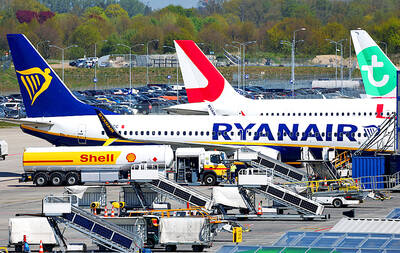
Ryanair, Transavia, Volotea and other low-cost airlines are feeling the financial pain from high jet fuel prices as a result of the Middle East war and are cutting flights. The closure of the Strait of Hormuz has taken a huge chunk of oil supplies off the market, sending the price of jet fuel soaring and triggering fears of shortages that could force airlines to cancel flights. Airlines are not waiting for a lack of supplies to react. “Travel alert: Airlines are cutting thousands of flights right now,” Travel Therapy host Karen Schaler said in an Instagram reel this past weekend.
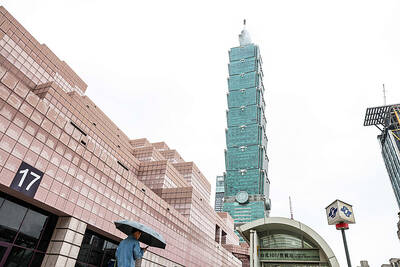
MANAGING RISKS: Taiwan has secured LNG sufficient to cover 95 percent of electricity demand for next month, UBS said, describing the government’s approach as proactive UBS Group AG has raised its forecast for Taiwan’s economic growth this year to 8 percent, up from 6.9 percent previously, and said expansion could reach as high as 8.6 percent if external energy shocks are avoided. The upgrade reflects a stronger-than-expected first-quarter performance and sustained momentum in artificial intelligence (AI)-driven exports, which UBS said are providing a firm foundation for growth despite geopolitical and energy risks. Taiwan’s GDP expanded 13.69 percent year-on-year in the first quarter, the fastest growth since the second quarter of 1987, the Directorate-General of Budget, Accounting and Statistics (DGBAS) reported on Thursday. On a seasonally
The Fair Trade Commission’s (FTC) ongoing review of Grab Holdings Ltd’s US$600 million acquisition of Foodpanda Taiwan’s operations, announced on March 23, has taken on fresh urgency as industry experts warn that the transaction could embed significant Chinese cybersecurity vulnerabilities into Taiwan’s digital infrastructure through Grab’s deep ties to autonomous-driving firm WeRide (文遠知行). Less than 16 months after the FTC blocked Uber Eats’ direct attempt to acquire Foodpanda Taiwan — citing potential combined market shares of 80 to 90 percent — the emergence of Grab as the buyer has prompted questions about whether the same competitive harm is simply being rerouted
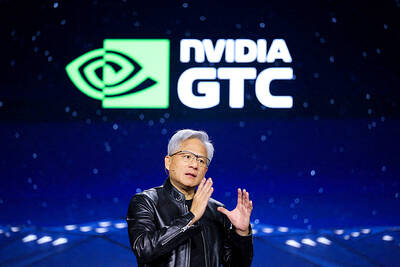
The list of Asian stocks that benefit from business partnership with Nvidia Corp is getting longer, as the region further integrates into the artificial intelligence (AI) chip giant’s business ecosystem. Just in the past week, South Korea’s LG Electronics Inc, Taiwan’s Nanya Technology Corp (南亞科技), as well as China’s Huizhou Desay SV Automotive Co (德賽西威) and Pateo Connect Technology Shanghai Corp (博泰車聯) have become the latest to rally on news of tie-ups, supply-chain participation or product collaboration with the US chip designer. Asian suppliers account for about 90 percent of Nvidia’s production costs, up from about 65 percent last year, data compiled


 RSS
RSS