


US-based ride-hailing service Uber Technologies Inc yesterday announced partnerships with three small-scale Taipei taxi operators to set up its UberTaxi service, in its latest efforts to secure a licensed operation.
Uber Taiwan, a local arm of Uber Technologies, is transforming itself into a taxi-hailing platform from a vehicle-sharing service by collaborating with licensed cab drivers, as it faces mounting pressure from local regulators to exit Taiwan.
Since making a comeback in mid-April, Uber Taiwan has teamed up with more than 100 local car rental companies, which provide licensed drivers and cars.

Photo: Chien Jung-fong, Taipei Times
“We do this in complete cooperation and working with local governments,” said Brooks Entwistle, the firm’s new chief business officer for the Asia-Pacific region, at a news conference in Taipei. “This is what we want to do and what we are doing going forward.”
Uber has launched its UberTaxi service in Myanmar, Malaysia and Sydney, Entwistle said.
Entwistle said the company could help boost earnings for local taxi drivers through its app.
There are 30,000 registered taxi drivers in Taipei, who operate at a 30 percent utilization rate, meaning they spend most of the time driving around the city looking for passengers, Entwistle said, citing an unspecified survey.
“The 30 percent of utilization is a number we can do a lot on [the] Uber platform to increase dramatically,” Entwistle said.
Starting today, the company’s ride-hailing app allows users to arrange and schedule transportation and logistics services with third parties.
The San Fransisco-based company said it is providing its app to Crown Taxi (皇冠大車隊), Asia Pacific Satellite Taxi Co (亞太衛星車隊) and QTaxi, a new entrant to the market.
While the business model remains the same, a major change is that passengers using the new service are to pay according to the taxi meter, rather than by credit card or other digital payment systems at a price calculated by Uber.
During the initial stage of about three months, Uber is to offer the taxi operators free use of its platform, the company said, adding that it did not rule out offering similar services in other cities.
“We do not see Uber as a competitor — we are cooperating with each other,” Asia Pacific Satellite Taxi president Chen Shin-chun (陳新鈞) told reporters. “The cooperation means a lot for a small-scale fleet like us, as we could save the NT$3 million to NT$4 million [US$99,321 to US$132,428] it would cost build our own app.”
“Taiwan’s taxi-hailing industry is too traditional. We need to make a change to survive,” Chen said.
Taxi drivers are only making half the income they used to earn 30 years ago, as the high-speed railway and the Mass Rapid Transit system have taken a toll on the business, Chen said, adding that about one-third of Asia Pacific Satellite’s drivers have joined the program.

CHIP RACE: Three years of overbroad export controls drove foreign competitors to pursue their own AI chips, and ‘cost US taxpayers billions of dollars,’ Nvidia said China has figured out the US strategy for allowing it to buy Nvidia Corp’s H200s and is rejecting the artificial intelligence (AI) chip in favor of domestically developed semiconductors, White House AI adviser David Sacks said, citing news reports. US President Donald Trump on Monday said that he would allow shipments of Nvidia’s H200 chips to China, part of an administration effort backed by Sacks to challenge Chinese tech champions such as Huawei Technologies Co (華為) by bringing US competition to their home market. On Friday, Sacks signaled that he was uncertain about whether that approach would work. “They’re rejecting our chips,” Sacks

It is challenging to build infrastructure in much of Europe. Constrained budgets and polarized politics tend to undermine long-term projects, forcing officials to react to emergencies rather than plan for the future. Not in Austria. Today, the country is to officially open its Koralmbahn tunnel, the 5.9 billion euro (US$6.9 billion) centerpiece of a groundbreaking new railway that will eventually run from Poland’s Baltic coast to the Adriatic Sea, transforming travel within Austria and positioning the Alpine nation at the forefront of logistics in Europe. “It is Austria’s biggest socio-economic experiment in over a century,” said Eric Kirschner, an economist at Graz-based Joanneum

BUBBLE? Only a handful of companies are seeing rapid revenue growth and higher valuations, and it is not enough to call the AI trend a transformation, an analyst said Artificial intelligence (AI) is entering a more challenging phase next year as companies move beyond experimentation and begin demanding clear financial returns from a technology that has delivered big gains to only a small group of early adopters, PricewaterhouseCoopers (PwC) Taiwan said yesterday. Most organizations have been able to justify AI investments through cost recovery or modest efficiency gains, but few have achieved meaningful revenue growth or long-term competitive advantage, the consultancy said in its 2026 AI Business Predictions report. This growing performance gap is forcing executives to reconsider how AI is deployed across their organizations, it said. “Many companies
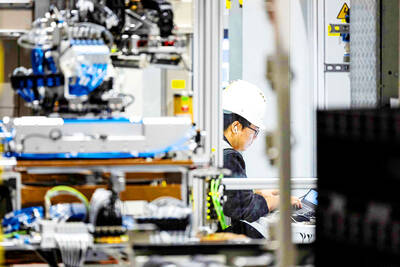
France is developing domestic production of electric vehicle (EV) batteries with an eye on industrial independence, but Asian experts are proving key in launching operations. In the Verkor factory outside the northern city of Dunkirk, which was inaugurated on Thursday, foreign specialists, notably from South Korea and Malaysia, are training the local staff. Verkor is the third battery gigafactory to open in northern France in a region that has become known as “Battery Valley.” At the Automotive Energy Supply Corp (AESC) factory near the city of Douai, where production has been under way for several months, Chinese engineers and technicians supervise French recruits. “They


 RSS
RSS