


The environmental impact assessment (EIA) report on a massive investment project to build a new fab in the south announced by Taiwan Semiconductor Manufacturing Co (TSMC, 台積電) is expected to be completed in one-and-a-half years to ensure that TSMC can go ahead with its plans, the Southern Taiwan Science Park Bureau said on Saturday.
TSMC aims to build an advanced 3-nanometer foundry in the Tainan Science Park (台南科學園區), which is a part of the Southern Taiwan Science Park (南部科學工業園).
Taiwan Science Park Administration director-general Lin Wei-cheng (林威呈) said that his office would need about one year to collect information about the project’s possible effect on the environment.
The bureau, which is supervised by the Ministry of Science and Technology, will need an additional six months to finish the assessment report before a 30-hectare plot of land can be assigned for construction of the new facility by the end of 2020, Lin said.
TSMC, the world’s largest contract chipmaker, on Friday announced that it had chosen Tainan as the site to house its first 3-nanometer process fab, which is expected to help the company maintain the lead over its peers in the global market.
While TSMC did not disclose financial details about the plan, local media reported that the investment could total NT$500 billion (US$16.5 billion) and commercial production is expected to begin in 2022.
The fab is expected to be the largest investment ever made in Taiwan.
Lin said that the timeframe for the bureau to complete an EIA report for TSMC’s newest investment plan is expected to meet the company’s aim to start mass production by 2022.
The Ministry of Economic Affairs will be in charge of water and power supply for the plant, he said, adding that about half of the water supplied to the plant is to come from recycled sources, while tap water would make up the other half.
Construction of a water recycling plant in Tainan’s Yongkang District (永康) is under way and other water recycling facilities near the new plant are being planned to meet TSMC’s needs.
As for power consumption, Lin said that Premier William Lai (賴清德) has promised to ensure sufficient supply of electricity to TSMC.
TSMC would probably not have announced such an important investment if the company had failed to secure a firm promise from the government, Lin added.
Before Friday’s announcement, the market speculated that TSMC would build the sophisticated plant outside Taiwan, possibly in the US, amid worries over adequate water and power supply.
“Now it turns out that TSMC is willing to stay in Taiwan. The move will be economically positive for the country,” Hua Nan Securities Co (華南永昌證券) analyst Kevin Su (蘇俊宏) said.
Taiwan needs massive investments to boost its economy to offset the effect from possible weakness in global demand in the future, said Dachrahn Wu (吳大任), director of National Central University’s Research Center for Taiwan Economic Development.
TSMC’s purchases of production equipment and its hiring for the new plant, as well as future exports of its products, will no doubt benefit Taiwan’s economy, said Gordon Sun (孫明德), director of the Taiwan Institute of Economic Research’s Economic Forecasting Center.
Some market analysts said TSMC’s investments would prompt its suppliers at home and abroad to pour funds into Taiwan and raise production to meet the demand from such an important customer.

Taichung reported the steepest fall in completed home prices among the six special municipalities in the first quarter of this year, data compiled by Taiwan Realty Co (台灣房屋) showed yesterday. From January through last month, the average transaction price for completed homes in Taichung fell 8 percent from a year earlier to NT$299,000 (US$9,483) per ping (3.3m²), said Taiwan Realty, which compiled the data based on the government’s price registration platform. The decline could be attributed to many home buyers choosing relatively affordable used homes to live in themselves, instead of newly built homes in the city’s prime property market, Taiwan Realty
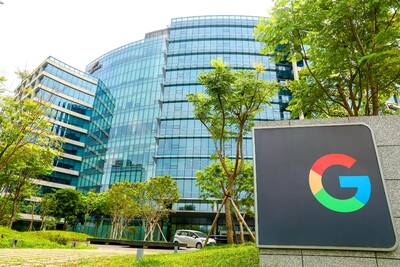
The government yesterday approved applications by Alphabet Inc’s Google to invest NT$27.08 billion (US$859.98 million) in Taiwan, the Ministry of Economic Affairs said in a statement. The Department of Investment Review approved two investments proposed by Google, with much of the funds to be used for data processing and electronic information supply services, as well as inventory procurement businesses in the semiconductor field, the ministry said. It marks the second consecutive year that Google has applied to increase its investment in Taiwan. Google plans to infuse NT$25.34 billion into Charter Investments Ltd (特許投資顧問) through its Singapore-based subsidiary Fructan Holdings Singapore Pte Ltd, and

JET JUICE: The war on Iran’s secondary effects have seen fuel prices skyrocket, knocking flight schedules down to earth in return as airlines struggle with costs Airline passengers should brace for more irritation in the next few months as carriers worldwide cancel flights and ground planes to cope with stratospheric increases in jet-fuel prices. Dutch flag carrier KLM is the latest company to cut its schedule, saying on Thursday that it would scrap 80 return flights at Amsterdam’s Schiphol Airport in the coming month. That puts it in the same league as United Airlines Holdings Inc, Deutsche Lufthansa AG and Cathay Pacific Airways Ltd, which have all pruned itineraries to mitigate costs. Global capacity for next month has been reduced by about 3 percentage points, with all
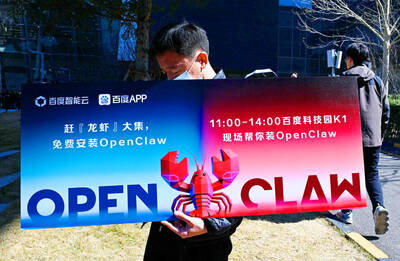
FORESEEABLE CONSEQUENCES: New technology always comes with new innovations by the iniquitous in exploiting users for financial gain or more nefarious ends Artificial intelligence (AI) “agents” say they can save users time and energy by automating tasks, but the growing power of systems such as OpenClaw is putting cybersecurity experts on edge. Powered by a wave of hype, OpenClaw today says it has more than three million users worldwide. The system allows users to create so-called agents, tools based on a large language model (LLM) such as OpenAI’s ChatGPT or Anthropic PBC’s Claude, that can carry out online tasks. “We’ve moved from an AI you could talk with via a chatbot to an agentic AI, which can take action... the threat and the risks are


 RSS
RSS