


Traditional heavyweights Fiat Chrysler Automobiles NV, PSA Peugeot Citroen and Volvo Car Corp might have shunned this year’s International Motor Show (IAA) in Frankfurt, Germany, but for Taiwanese and Chinese automakers looking to make inroads in Europe the chance to step into the limelight was not to be missed.
Two years after becoming a surprise hit at the previous IAA with an electric sedan concept car to rival Tesla Motors Inc’s Model S, Taiwanese upstart Thunder Power Co Ltd (淳紳) was back at Europe’s top industry showcase, which ends today.
However, this time there was no mistaking its ambitions.
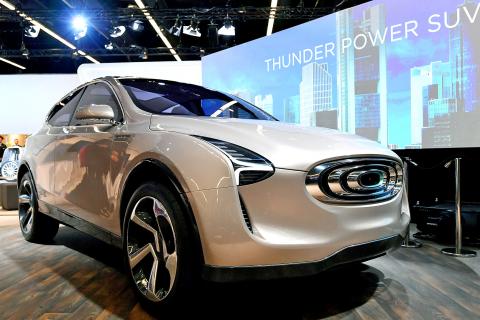
Photo: EPA
Positioning itself a stone’s throw away from luxury brands Maserati and Ferrari, Thunder Power unveiled a second prototype, a high-end electric sports utility vehicle (SUV), with which it hopes to capture a slice of the booming 4x4 market.
“I’m not interested in gasoline cars. I want to build an electric car that is the best in the world,” chairman Wellen Shen (沈瑋) said.
The sedan is set for mass production in 2019, followed by the SUV a year later, he told reporters, adding that the company already has a factory in China and plans to set up one in Spain.
Starting with Germany and Britain, Thunder Power eventually aims to sell 40,000 units a year in Europe, he said.
On the other side of the mammoth Frankfurt convention center, fairgoers marveled at the renaissance of storied German brand Borgward, which went under 50 years ago, but was brought back to life in 2015 with the help of Chinese truck maker Beiqi Foton Motor Co Ltd (北汽福田).
“We are coming to Europe this year,” chief executive officer Ulrich Walker said, adding that its limited-edition BX7 SUV, priced at about 45,000 euros (US$53,780), would go on sale in Germany first before other models are launched across the continent.
Tapping into nostalgia for the brand’s heyday, Borgward also unveiled a sporty Isabella concept car inspired by a legendary 1950s coupe of the same name.
The reborn German-Chinese manufacturer, which is already producing cars in China, plans to increase its European footprint by building an assembly plant in Borgward’s original hometown of Bremen in northern Germany next year.
The plant is to manufacture electric vehicles for European consumers, with production slated for 2019.
“Like the Japanese and South Koreans in the past, Chinese manufacturers want to show they can be successful in Europe, it’s a mark of quality, a test before expanding to other markets outside Europe,” Walker said.
Two other Chinese manufacturers, high-end Wey and the mass-market Chery Automobile Co (奇瑞汽車), made their IAA debuts this year.
Wey, the newly created luxury label of Chinese automaker Great Wall Motor Co Ltd (長城汽車), showcased a range of compact 4x4s offering both gasoline and hybrid drivetrains.
It also wowed with its XEV concept, a sleek crossover with futuristic-looking gull-wing doors, but did not make any announcements about when it might land in Europe.
Chery showed off the Exeed Tx, an urban crossover designed for European tastes that it says will be made available with hybrid, plug-in hybrid and fully electric drivetrains.
“We have the firm intention to come to Europe, but it’s too early to disclose the details,” Chery chief executive officer Anning Chen (陳安寧) said, hinting only that “this product isn’t going to be the cheapest car on the market.”
Chinese automakers’ more visible presence at this year’s IAA is not just for European consumption, said industry expert Laurent Petizon at consultancy AlixPartners LLP.
Showing that they appeal to an international audience is also a way for the brands to increase their cachet back home in the world’s largest car market, he told reporters, adding that those jostling for attention at the IAA were not China’s biggest players.
“The goal is not to invade the European market, at least not for now,” he said.
However, analyst Ferdinand Dudenhoeffer of Germany’s CAR research center said that Chinese manufacturers had worked hard in recent years to improve their chances of gaining a foothold in Europe’s competitive and mature car market.
“The design and quality are now at the level of those seen in general European manufacturers like Renault, Opel, Volkswagen,” he said, calling the Chinese focus on offering electrified SUVs “a good strategy.”
Chen for his part said he was “confident” of a European breakthrough.

GROWING OWINGS: While Luxembourg and China swapped the top three spots, the US continued to be the largest exposure for Taiwan for the 41st consecutive quarter The US remained the largest debtor nation to Taiwan’s banking sector for the 41st consecutive quarter at the end of September, after local banks’ exposure to the US market rose more than 2 percent from three months earlier, the central bank said. Exposure to the US increased to US$198.896 billion, up US$4.026 billion, or 2.07 percent, from US$194.87 billion in the previous quarter, data released by the central bank showed on Friday. Of the increase, about US$1.4 billion came from banks’ investments in securitized products and interbank loans in the US, while another US$2.6 billion stemmed from trust assets, including mutual funds,
AI TALENT: No financial details were released about the deal, in which top Groq executives, including its CEO, would join Nvidia to help advance the technology Nvidia Corp has agreed to a licensing deal with artificial intelligence (AI) start-up Groq, furthering its investments in companies connected to the AI boom and gaining the right to add a new type of technology to its products. The world’s largest publicly traded company has paid for the right to use Groq’s technology and is to integrate its chip design into future products. Some of the start-up’s executives are leaving to join Nvidia to help with that effort, the companies said. Groq would continue as an independent company with a new chief executive, it said on Wednesday in a post on its Web
RESPONSE: The Japanese Ministry of Finance might have to intervene in the currency markets should the yen keep weakening toward the 160 level against the US dollar Japan’s chief currency official yesterday sent a warning on recent foreign exchange moves, after the yen weakened against the US dollar following Friday last week’s Bank of Japan (BOJ) decision. “We’re seeing one-directional, sudden moves especially after last week’s monetary policy meeting, so I’m deeply concerned,” Japanese Vice Finance Minister for International Affairs Atsushi Mimura told reporters. “We’d like to take appropriate responses against excessive moves.” The central bank on Friday raised its benchmark interest rate to the highest in 30 years, but Bank of Japan Governor Kazuo Ueda chose to keep his options open rather than bolster the yen,

Even as the US is embarked on a bitter rivalry with China over the deployment of artificial intelligence (AI), Chinese technology is quietly making inroads into the US market. Despite considerable geopolitical tensions, Chinese open-source AI models are winning over a growing number of programmers and companies in the US. These are different from the closed generative AI models that have become household names — ChatGPT-maker OpenAI or Google’s Gemini — whose inner workings are fiercely protected. In contrast, “open” models offered by many Chinese rivals, from Alibaba (阿里巴巴) to DeepSeek (深度求索), allow programmers to customize parts of the software to suit their


 RSS
RSS