


Chunghwa Picture Tubes Ltd (CPT, 中華映管) saw its quarterly profits improve this quarter from the last due to higher prices, as seasonal demand for handset and car displays added to supply constraints.
The world’s No. 3 car display supplier said it has raised panel prices by a double-digit percentage this quarter from a quarter earlier and expects another 5 percent hike next quarter, as demand is expected to continue exceeding supply.
“All of our factories are fully utilized, but we still cannot fully meet demand from customers, as this quarter is a peak season for consumer electronics and the auto industry,” Ryan Chung (鍾兆其), vice president of CPT’s sales and marketing center, told reporters on the sidelines of the Touch Taiwan Display show at the Taipei World Trade Center Nangang Exhibition Hall.
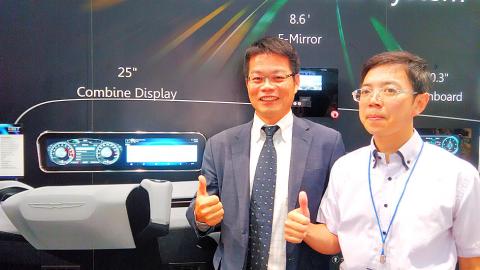
Photo: CNA
As new smartphone displays with 18:9 aspect ratio rapidly gain traction, the company can only deliver 80 percent of customers’ orders, Chung said.
“We are expecting the growth momentum to last through the end of this year,” Chung said.
As the LCD industry is becoming healthier and less volatile, CPT is confident that profits this quarter will be better than last quarter, he said.
Next quarter will be even stronger than this quarter, Chung added.
The Taoyuan-based company posted its fourth profitable quarter in a row last quarter, with net income reaching NT$1.16 billion (US$38.4 million), more than tripling from NT$283 million a year earlier.
Chung attributed the increase to the company’s efforts to diversify its product portfolio to the higher-margin displays used in cars and industrial devices.
Combined revenue contribution from cars and industrial devices would climb to 35 percent of CPT’s total revenue this year, compared with 25 percent last year, Chung said.
“We have greater exposure to Japanese and Chinese car brands. One in three Chinese brand cars is equipped with CPT displays,” he said. “We are trying to break into European and US car brands.”
CPT, which holds 16 percent of the global car display market, said it aims to expand car display revenue to more than 50 percent of its total revenue in three years, given that more and bigger LCD panels are to be installed in the dashboards and central information displays of cars.
The revenue share is expected to grow to between 60 and 70 percent in the next five years, Chung said.
Separately, E Ink Holdings Inc (元太科技), which supplies e-paper displays for Amazon.com’s Kindle series, is also planning to diversify its product portfolio to boost profitability.
E-paper displays used in e-readers is the biggest revenue source for the company, making up 70 percent of its total revenue last quarter, after exiting the LCD market earlier this year.
“We are seeking to apply e-paper displays to more applications,” E Ink chairman Frank Ko (柯富仁) told a media briefing in Taipei. “We are trying to bring our e-paper displays to more Internet-of-Things devices.”
E Ink has seen an increasing number of retailers, hypermarkets and e-commerce operators willing to adopt electronic shelf labels to replace paper labels, given the former’s relatively lower costs and higher efficiency, Ko said.
As a result, shipments of electronic shelf labels are expected to grow by 20 to 30 percent annually this year from last, he said.
E Ink said it has also made progress in promoting its e-paper displays for use in “smart” credit cards, point-collection cards and public transportation cards.
The new applications would become the company’s new growth drivers, Ko said.

SECOND-RATE: Models distilled from US products do not perform the same as the original and undo measures that ensure the systems are neutral, the US’ cable said The US Department of State has ordered a global push to bring attention to what it said are widespread efforts by Chinese companies, including artificial intelligence (AI) start-up DeepSeek (深度求索), to steal intellectual property from US AI labs, according to a diplomatic cable. The cable, dated Friday and sent to diplomatic and consular posts around the world, instructs diplomatic staff to speak to their foreign counterparts about “concerns over adversaries’ extraction and distillation of US AI models.” Distillation is the process of training smaller AI models using output from larger, more expensive ones to lower the costs of training a powerful new
Micron Technology Inc is a driving force pushing the US Congress to pass legislation that would put new export restrictions on equipment its Chinese competitors use to make their chips, according to people familiar with the matter. A US House of Representatives panel yesterday was to vote on the “MATCH Act,” a bill designed to close gaps in restrictions on chipmaking equipment. It would also pressure foreign companies that sell equipment to Chinese chipmaking facilities to align with export curbs on US companies like Lam Research Corp and Applied Materials Inc. The bill targets facilities operated by China’s ChangXin Memory Technologies Inc

Singapore-based ride-hailing and delivery giant Grab Holdings’ planned acquisition of Foodpanda’s Taiwan operations has yet to enter the formal review stage, as regulators await supplementary documents, the Fair Trade Commission (FTC) said yesterday. Acting FTC Chairman Chen Chih-min (陳志民) told the legislature’s Economics Committee that although Grab submitted its application on March 27, the case has not been officially accepted because required materials remain incomplete. Once the filing is finalized, the FTC would launch a formal probe into the deal, focusing on issues such as cross-shareholding and potential restrictions on market competition, Chen told lawmakers. Grab last month announced that it would acquire
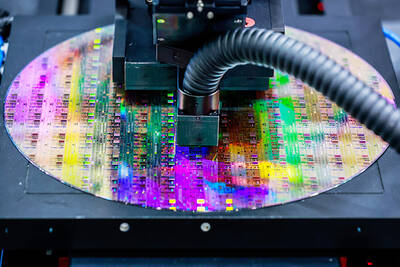
The artificial intelligence (AI) boom has triggered a seismic reshuffling of global equity markets, with Taiwan and South Korea muscling past European nations one by one. With its stock market now valued at nearly US$4.3 trillion, Taiwan surpassed the UK, Europe’s biggest market, earlier this month, data compiled by Bloomberg showed. South Korea is about US$140 billion away from doing the same. The tech-heavy Asian markets have shot past Germany and France in the past seven months. The shift is largely down to massive gains in shares of three companies that provide essential hardware for AI: Taiwan Semiconductor Manufacturing Co (TSMC, 台積電),


 RSS
RSS