


China’s latest crackdown on pyramid schemes was prompted by three shocking deaths: one young man who was beaten, another who was found dead in a pond and a third left to die on a road.
Like elsewhere in the world, the scams have proliferated in China as fraudsters trick people into thinking they can become rich quickly.
Members are charged a joining fee and required to recruit new investors with promises of high returns.
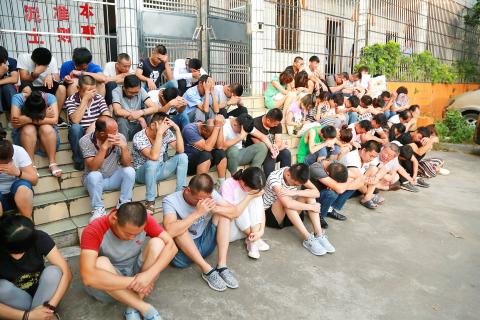
Photo: AFP
However, the three deaths in July put a spotlight on more extreme tactics used by some organizations in China, where the schemes can raise large amounts of money.
Warning that pyramid schemes have become “more rampant,” four Chinese government agencies responded last month by launching a three-month crackdown that targets misleading online job adverts designed to lure young people.
Many of those who sign up online to promises of easy riches discover a harsh reality in which they are faced with intense demands, harassment or even physical abuse.
Pyramid schemes in China were criminalized in 2005, but are still booming, with authorities investigating more than 2,800 cases last year, a 20 percent increase from 2015.
An official from the government’s anti-pyramid scheme department said that there are “too many” scams and investigating them requires a lot of resources.
“Especially nowadays, many pyramid scheme organizations move their base to the countryside and develop members through the Internet, making it harder to monitor them and obtain evidence,” the official said.
In a surprising additional challenge, hundreds of members of a pyramid scheme in July held a demonstration in Beijing to protest against an investigation into their group, known as Shanxinhui (善心匯) or “philanthropic exchange.”
Scores have been detained.
Many pyramid schemes operate in cramped spaces where people eat together and sleep on the floor, said Li Xu (李旭), the founder of an organization that rescues people who become trapped.
The organizations that resort to violence do so to intimidate members into not reporting them to the police, he said, adding that the crackdowns have made it more difficult to recruit people.
“They are also afraid that newcomers will call the police. So they take away their mobile phone, control the newcomers by illegal detention and other violent means in order keep more people,” he said.
Li formed the China Anti-Pyramid Promotional Association after he was fooled into joining one himself more than a decade ago.
“Pyramid schemes in China target people who desire to change their life at a low cost,” he said.

CHIP RACE: Three years of overbroad export controls drove foreign competitors to pursue their own AI chips, and ‘cost US taxpayers billions of dollars,’ Nvidia said China has figured out the US strategy for allowing it to buy Nvidia Corp’s H200s and is rejecting the artificial intelligence (AI) chip in favor of domestically developed semiconductors, White House AI adviser David Sacks said, citing news reports. US President Donald Trump on Monday said that he would allow shipments of Nvidia’s H200 chips to China, part of an administration effort backed by Sacks to challenge Chinese tech champions such as Huawei Technologies Co (華為) by bringing US competition to their home market. On Friday, Sacks signaled that he was uncertain about whether that approach would work. “They’re rejecting our chips,” Sacks

NATIONAL SECURITY: Intel’s testing of ACM tools despite US government control ‘highlights egregious gaps in US technology protection policies,’ a former official said Chipmaker Intel Corp has tested chipmaking tools this year from a toolmaker with deep roots in China and two overseas units that were targeted by US sanctions, according to two sources with direct knowledge of the matter. Intel, which fended off calls for its CEO’s resignation from US President Donald Trump in August over his alleged ties to China, got the tools from ACM Research Inc, a Fremont, California-based producer of chipmaking equipment. Two of ACM’s units, based in Shanghai and South Korea, were among a number of firms barred last year from receiving US technology over claims they have

It is challenging to build infrastructure in much of Europe. Constrained budgets and polarized politics tend to undermine long-term projects, forcing officials to react to emergencies rather than plan for the future. Not in Austria. Today, the country is to officially open its Koralmbahn tunnel, the 5.9 billion euro (US$6.9 billion) centerpiece of a groundbreaking new railway that will eventually run from Poland’s Baltic coast to the Adriatic Sea, transforming travel within Austria and positioning the Alpine nation at the forefront of logistics in Europe. “It is Austria’s biggest socio-economic experiment in over a century,” said Eric Kirschner, an economist at Graz-based Joanneum

OPTION: Uber said it could provide higher pay for batch trips, if incentives for batching is not removed entirely, as the latter would force it to pass on the costs to consumers Uber Technologies Inc yesterday warned that proposed restrictions on batching orders and minimum wages could prompt a NT$20 delivery fee increase in Taiwan, as lower efficiency would drive up costs. Uber CEO Dara Khosrowshahi made the remarks yesterday during his visit to Taiwan. He is on a multileg trip to the region, which includes stops in South Korea and Japan. His visit coincided the release last month of the Ministry of Labor’s draft bill on the delivery sector, which aims to safeguard delivery workers’ rights and improve their welfare. The ministry set the minimum pay for local food delivery drivers at


 RSS
RSS