


The tax reform plan proposed by the Ministry of Finance is to encourage more local retail investors to enter the equity market and facilitate the development of the bourse, analysts and academics said.
The plan aims to ease equity investors’ financial burden by cutting their taxes on dividends they receive from investments in locally listed companies, Capital Securities Corp (群益證券) president Chao Yung-fei (趙永飛) said.
Once the dividend income tax is lowered, the local equity market is to become more attractive to retail investors, who will be more willing to raise their equity holdings, Chao said.
That could boost daily turnover in the local bourse, Chao said, adding that as long as turnover increases, securities brokerages will also benefit.
As part of the government’s efforts to make the nation’s tax system more equitable, the ministry on Friday proposed the elimination of the imputation tax system.
Ratified in 1998, the system awards local investors who receive dividends from credits for taxes paid by the company.
However, the system was revised in 2015, halving the tax credits and angering local investors who then had to pay higher taxes than the 20 percent foreign institutional investors have to pay on their dividend income.
With such an uneven dividend income tax system, many major local players who trade more than NT$500 million (US$16.58 million) in equities in a single quarter have left the trading floor.
As a result, the local equity market has been dominated by foreign institutional investors.
In addition to eliminating the imputation system, the ministry has proposed two alternative tax plans.
Plan A would allow investors to enjoy tax-free status on 37 percent of dividends they receive, while the remaining dividends would be counted as personal income tax.
Plan B would include two options: Option one would allow equity investors to be taxed at a flat rate of 26 percent, while the second choice would tax all dividend income as personal income taxes, but would give taxpayers a deduction of up to NT$80,000.
As for foreign investors, the ministry has proposed a 21 percent tax on their dividend income, up from 20 percent.
If the government adopts the first plan, retail investors would see their tax rate cut to about 25.2 percent, which would come closer to foreign institutional investors’ 21 percent, National Taipei University of Business professor Sun Keh-nan (孫克難) said.
The second plan would be good for high-income earners if they choose to pay a flat rate of 26 percent, Sun added.
To pursue a fairer tax system, the government should consider raising the tax rate for foreign investors to 25 percent, while under Plan A for local investors, the tax deduction ceiling should be raised to 40 percent from the proposed 37 percent, he said.
Chien Hung-ming (簡宏明), chief secretary of the Securities and Futures Bureau of the Financial Supervisory Commission, said that he has faith that the dividend income tax reform would pave the way for more retail investors to buy equity and improve the local equity market.
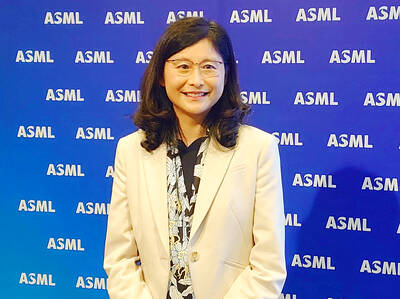
Netherlands-based semiconductor equipment supplier ASML Holding NV yesterday said that it is planning to hire an additional 1,000 people in Taiwan this year in response to growing demand from clients. ASML had previously planned to recruit 600 people this year, but that the plan has been adjusted upward, ASML vice president and ASML Taiwan general manager Grace Wang (汪佳慧) told reporters. ASML has a workforce of more than 4,500 in Taiwan, accounting for about 10 percent of its global total, Wang said. This year’s recruitment campaign would focus on adding people in the customer support, manufacturing and supply chain domains to assist ASML
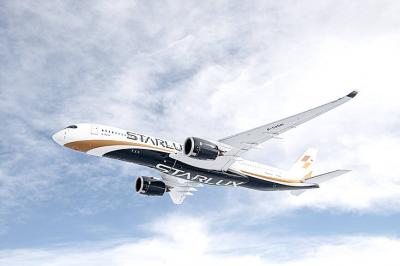
Starlux Airlines Co (星宇航空) today unveiled a long-haul network expansion plan at a shareholders’ meeting in Taipei, including direct flights to Barcelona, Spain, and Zurich, Switzerland, as well as a service connecting Taipei, Sydney and New Zealand. Starlux is to become the first Taiwanese carrier to offer non-stop services to the two European cities, while the inaugural oceanic route is expected to expand transit opportunities within the Australia-New Zealand market, Starlux said. Flight services to Chicago, Dallas, Washington and New York are under evaluation, the airline added. Prior to the shareholders’ meeting, the airline earlier this year announced that it would be
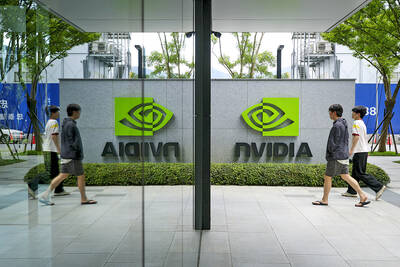
UNDER MICROSCOPE: Taiwan detained three people who allegedly conspired to buy servers in Taiwan and export them using fraudulent documentation, prosecutors said Nvidia Corp chief executive officer Jensen Huang (黃仁勳) on Saturday urged Super Micro Computer Inc to tighten up on compliance after Taiwan detained three people this week for allegedly making fraudulent declarations about artificial intelligence (AI) servers made by its US partner. The development marked the nation’s first crackdown on semiconductor smuggling, which grew after the US slapped restrictions on exports of high-end chips such as Nvidia AI accelerators to China. Nvidia is “rigorous” in explaining regulations to all of its partners, Huang told reporters after arriving in Taipei. “Ultimately Super Micro has to run their own company,” he said in response to

Nvidia Corp yesterday announced that CEO Jensen Huang (黃仁勳) would attend an employee meeting in Taipei tomorrow to celebrate the launch of the company’s Taiwan headquarters project. Huang would attend a gathering at the site of Nvidia’s planned headquarters in Beitou Shilin Technology Park (北投士林科技園區), the company said in a statement. After arriving in Taiwan on Saturday last week, Huang told reporters that he plans to meet with Quanta Computer Inc (廣達) chairman Barry Lam (林百里) and Taiwan Semiconductor Manufacturing Co (TSMC, 台積電) chairman C.C. Wei (魏哲家), and would attend the groundbreaking ceremony for Nvidia’s Taiwan headquarters tomorrow. Nvidia has not yet applied


 RSS
RSS