


US corporate acquisitions in China collapsed to their lowest level for 14 years in the first half of this year, as trade tensions between the two countries and uncertainty about Chinese government regulations took a toll on dealmaking.
The value of mergers and acquisitions involving US companies in China dropped 32 percent to US$523 million in the six months to June 30 from US$771 million in the same period last year, and were down 87 percent from US$4 billion in the first six months of 2015, according to Thomson Reuters data.
Bankers and lawyers involved in dealmaking say that increasing signs of trade friction between Washington and Beijing are acting as a deterrent.
The tensions were reflected at a meeting earlier this month when officials from the two countries failed to agree on steps to reduce the US trade deficit with China.
US companies do not want to make acquisitions in an environment where they could get caught in crossfire between the two governments, the sources said.
That could happen if, for example, US President Donald Trump’s administration imposed punitive tariffs on Chinese steel and other products and Beijing retaliated with its own action against US goods or entities.
That in turn leads to the danger that US companies will not be able to take full advantage of China’s still buoyant economic growth of just under 7 percent per year, adding further to the stresses in the trade and investment relationship between the two countries.
“The new norm for China and the US is to be at odds on trade issues. As of now, they are having huge differences with regards to the steel industry, huge differences with regards to trade imbalance,” said Roy Zou (鄒國榮), a Beijing partner at law firm Hogan Lovells LLP. “I don’t see a big increase in US investments in China.”
The decline is happening at a time when Chinese deals in the US are still rising, though opposition in Washington to certain kinds of Chinese purchases on national security grounds is also increasing and could add to tensions.
European companies’ dealmaking has also been declining, but at a slower pace. Their acquisitions in China in the first half of this year were worth US$223 million, against US$268 million in the same period last year.
Foreign firms have complained for some time about not being offered a level playing field in China. Among their concerns are restrictions on foreign ownership in key sectors — including finance and technology — and various regulations that favor domestic firms over foreign rivals.
The American Chamber of Commerce (AmCham) in Shanghai said in its annual China Business Report published on July 12 that the Chinese government needed to halt policies and regulations that favor domestic firms over foreign businesses.
The lobby group complained of long-established “systemic inequities” in the report, which was based on responses from 426 AmCham member companies in China.
While buyers of assets in China have faced many such challenges before, they have not usually had to do so against such a backdrop of trade tensions and wider political uncertainty.
The picture is further complicated by the approaching 19th National Congress of the Chinese Communist Party, this autumn. The gathering is expected to lead to a consolidation of Chinese President Xi Jinping’s (習近平) power.
Many of the organs of the party and government are focused on making sure the congress, which is held every five years, goes off without a hitch and that there is not any kind of economic or political schism in the months leading up to it.
“Chinese economic bureaucracy is now dominated by a desire to manage systemic risk in preparation for the upcoming 19th party congress,” said Brock Silvers, managing director of Kaiyuan Capital Ltd (開源), a Shanghai-based investment advisory firm.
“Any policies or reforms to be adopted after the congress are still unknown,” he said, adding that his firm last week advised a US private equity fund to postpone plans for China investments until regulatory issues are clarified.
The Chinese authorities’ increasing scrutiny of some of the most acquisitive Chinese companies of recent years, such as the HNA Group Co Ltd (海航集團), which has led to a slowdown in their dealmaking, has added to the uncertainty.
This is focusing attention on the opaque nature of their ownership and finances and might make them less appealing as dealmakers, whether as buyers and sellers of assets, or as partners in any transactions.
Some trade experts worry that a more hawkish Washington approach to the national security risks of proposed Chinese investments in the US could easily trigger retaliation from Beijing.
“The sense we get from talking to our clients is there is concern as to whether anti-trust policies [in China] could now be used to discriminate against foreign enterprises,” said Mustafa Hadi, head of disputes and international arbitration for Greater China and North Asia, at advisory and consultancy firm Berkeley Research Group LLC.
In the financial sector in particular, there are concerns that some deals and expectations of reform could get derailed if China-US relations deteriorate, according to people familiar with the situation.
JPMorgan Chase & Co is in talks to set up a new joint venture with a local partner in China, while Morgan Stanley is looking to further increase its stake in its China investment-banking operations after already raising it to 49 percent this year, people with direct knowledge of the discussions have said.
AI TALENT: No financial details were released about the deal, in which top Groq executives, including its CEO, would join Nvidia to help advance the technology Nvidia Corp has agreed to a licensing deal with artificial intelligence (AI) start-up Groq, furthering its investments in companies connected to the AI boom and gaining the right to add a new type of technology to its products. The world’s largest publicly traded company has paid for the right to use Groq’s technology and is to integrate its chip design into future products. Some of the start-up’s executives are leaving to join Nvidia to help with that effort, the companies said. Groq would continue as an independent company with a new chief executive, it said on Wednesday in a post on its Web
GROWING OWINGS: While Luxembourg and China swapped the top three spots, the US continued to be the largest exposure for Taiwan for the 41st consecutive quarter The US remained the largest debtor nation to Taiwan’s banking sector for the 41st consecutive quarter at the end of September, after local banks’ exposure to the US market rose more than 2 percent from three months earlier, the central bank said. Exposure to the US increased to US$198.896 billion, up US$4.026 billion, or 2.07 percent, from US$194.87 billion in the previous quarter, data released by the central bank showed on Friday. Of the increase, about US$1.4 billion came from banks’ investments in securitized products and interbank loans in the US, while another US$2.6 billion stemmed from trust assets, including mutual funds,
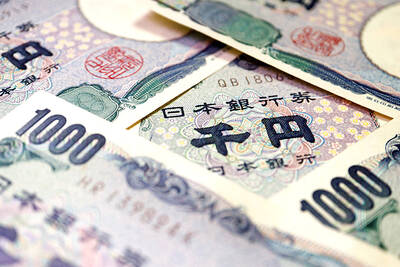
RESPONSE: The Japanese Ministry of Finance might have to intervene in the currency markets should the yen keep weakening toward the 160 level against the US dollar Japan’s chief currency official yesterday sent a warning on recent foreign exchange moves, after the yen weakened against the US dollar following Friday last week’s Bank of Japan (BOJ) decision. “We’re seeing one-directional, sudden moves especially after last week’s monetary policy meeting, so I’m deeply concerned,” Japanese Vice Finance Minister for International Affairs Atsushi Mimura told reporters. “We’d like to take appropriate responses against excessive moves.” The central bank on Friday raised its benchmark interest rate to the highest in 30 years, but Bank of Japan Governor Kazuo Ueda chose to keep his options open rather than bolster the yen,

Even as the US is embarked on a bitter rivalry with China over the deployment of artificial intelligence (AI), Chinese technology is quietly making inroads into the US market. Despite considerable geopolitical tensions, Chinese open-source AI models are winning over a growing number of programmers and companies in the US. These are different from the closed generative AI models that have become household names — ChatGPT-maker OpenAI or Google’s Gemini — whose inner workings are fiercely protected. In contrast, “open” models offered by many Chinese rivals, from Alibaba (阿里巴巴) to DeepSeek (深度求索), allow programmers to customize parts of the software to suit their


 RSS
RSS