


The Legislature’s Economics Committee yesterday failed to approve the first reading of an amendment to the Mining Act (礦業法) and might resume the review in September at the earliest, as lawmakers disagreed with the Ministry of Economic Affairs over mining rights.
UNCERTAINTY
“We will likely have to select another date to resume the review after the new legislative session begins in September,” Democratic Progressive Party (DPP) Legislator Gao Jyh-peng (高志鵬), who serves as the committee convener, said before adjourning the meeting.
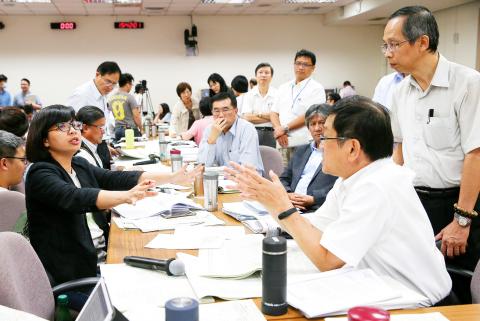
Photo: CNA
However, there are uncertainties on when to continue the review, as it would be up to the next legislative session’s committee convener to decide what draft bill reviews to prioritize.
THREE DAYS
The committee this week arranged a three-day meeting to review the amendment, but lawmakers and ministry officials only discussed 17 out of the more than 80 articles of the amendment, with the remaining articles still awaiting negotiation.
DPP Legislator Hsiao Bi-khim (蕭美琴) and Chinese Nationalist Party (KMT) Legislator Yosi Takun (孔文吉) proposed cutting the validity of quarries’ mining licenses to 10 years from 20 years, with extensions lasting no more than 10 years.
DPP lawmakers Lin Shu-feng (林淑芬) and Kolas Yotaka said that enterprises that have applied to extend their mining rights, but the mining rights of which have expired pending approval of their application, should be required to halt all mining activities unconditionally.
SUSPENSION
Companies should also be required to suspend mining operations while they are undergoing environmental impact assessments (EIA), Lin added.
However, Vice Minister of Economic Affairs Wang Mei-hua (王美花) said it was not practical to limit mining licenses to 10 years, as mining operations require a lot of capital and it takes years for enterprises to pass their EIAs for projects before the actual start of mining.
It is unfair to blame license expirations on the companies and they should be allowed to continue operations while undergoing EIAs, Wang said.
If a quarrying operation was to be abruptly suspended, it would severely affect the domestic cement industry and its supply chain, Wang added.
The ministry’s position is to keep the current law unchanged, which grants companies 20-year mining licenses and 20-year extensions, Wang said.
CONSENSUS
Lawmakers and officials agreed that the government should carry out strategic environmental assessments every five years to measure each quarry’s reserves, and supply and demand for specific materials, such as cement, in domestic and international markets.
They also reached consensus about allowing Aboriginal communities to mine for non-commercial purposes without requiring a mining license.

AI TALENT: No financial details were released about the deal, in which top Groq executives, including its CEO, would join Nvidia to help advance the technology Nvidia Corp has agreed to a licensing deal with artificial intelligence (AI) start-up Groq, furthering its investments in companies connected to the AI boom and gaining the right to add a new type of technology to its products. The world’s largest publicly traded company has paid for the right to use Groq’s technology and is to integrate its chip design into future products. Some of the start-up’s executives are leaving to join Nvidia to help with that effort, the companies said. Groq would continue as an independent company with a new chief executive, it said on Wednesday in a post on its Web

RESPONSE: The Japanese Ministry of Finance might have to intervene in the currency markets should the yen keep weakening toward the 160 level against the US dollar Japan’s chief currency official yesterday sent a warning on recent foreign exchange moves, after the yen weakened against the US dollar following Friday last week’s Bank of Japan (BOJ) decision. “We’re seeing one-directional, sudden moves especially after last week’s monetary policy meeting, so I’m deeply concerned,” Japanese Vice Finance Minister for International Affairs Atsushi Mimura told reporters. “We’d like to take appropriate responses against excessive moves.” The central bank on Friday raised its benchmark interest rate to the highest in 30 years, but Bank of Japan Governor Kazuo Ueda chose to keep his options open rather than bolster the yen,

Even as the US is embarked on a bitter rivalry with China over the deployment of artificial intelligence (AI), Chinese technology is quietly making inroads into the US market. Despite considerable geopolitical tensions, Chinese open-source AI models are winning over a growing number of programmers and companies in the US. These are different from the closed generative AI models that have become household names — ChatGPT-maker OpenAI or Google’s Gemini — whose inner workings are fiercely protected. In contrast, “open” models offered by many Chinese rivals, from Alibaba (阿里巴巴) to DeepSeek (深度求索), allow programmers to customize parts of the software to suit their

Global server shipments are expected to surge to 15 million units next year, from 4 million units this year, with artificial intelligence (AI) servers accounting for about 30 percent, driven by massive capital spending by major cloud service providers, the Market Intelligence and Consulting Institute (MIC) said on Thursday last week. Major cloud service providers — including Google’s parent company Alphabet Inc, Microsoft Corp, Amazon.com Inc and Meta Platforms Inc — are projected to budget US$450 million for capital expenditure next year, up from US$400 million this year, MIC ICT [information and communications technology] Industry Research Center director Edward Lin


 RSS
RSS