


Taiwan Semiconductor Manufacturing Co (TSMC, 台積電) yesterday posted the lowest quarterly net profit in five quarters, but it expects a strong rebound starting this quarter, thanks to a speedy ramp-up in production of 10-nanometer mobile phone chips and the depletion of excessive inventory in the supply chain.
TSMC, which supplies 10-nanometer chips to Apple Inc for the latest iPhone series, expects revenue this quarter to expand by up to16.6 percent to between US$8.12 billion and US$8.22 billion, compared with NT$213.86 billion (US$7.04 billion) in the prior quarter.
“This growth is driven by fast ramp-up of 10-nanometer mobile customer products, but moderated by [fabless customers’] continuous inventory adjustment,” TSMC co-chief executive officer Mark Liu (劉德音) told investors.
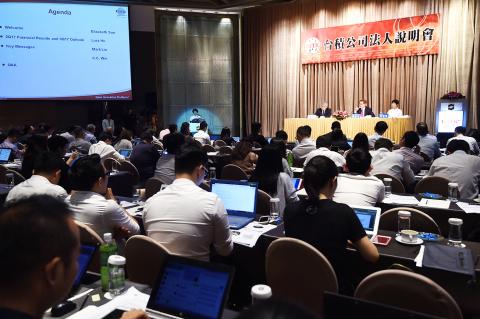
Photo: Chien Jung-fong, Taipei Times
TSMC expects 10-nanometer chips’ revenue contribution to surge to 10 percent of total revenue this quarter, up from 1 percent last quarter.
Meanwhile, fabless customers are expected to reduce their inventories to the normal seasonal level by the end of this quarter, Liu said.
The chipmaker said it expects revenue growth in all segments.
“Other than smartphones, we continue to see good momentum coming from the industrial and automotive sections,” Liu said.
In China, the smartphone market is expected to pick up in the second half of this year with new models set to hit the market, after a slowdown in the first half, Liu said.
However, gross margin is forecast to shrink to between 48.5 percent and 50.5 percent, compared with last quarter’s 50.8 percent, due to the strong New Taiwan dollar.
“The fourth quarter will also be a strong quarter,” Liu said.
Revenue next quarter is likely to reach another record high, as TSMC expects revenue to grow 5 percent annually in the second half of this year, following a flattish third quarter on an annual basis.
For the year, TSMC still expects revenue to grow between 5 percent and 10 percent annually in US dollar terms, he said.
Liu raised his revenue growth projection for the worldwide semiconductor industry excluding memory chips to 6 percent this year from his previous estimate of 4 percent, due to rising silicon contents.
TSMC also said that the enhanced version of its 7-nanometer technology will be the most advanced technology in the foundry market next year, outstripping rivals like Samsung Electronics Co.
Net profit tumbled 24.4 percent to NT$66.27 billion during the quarter ending June 30, compared with NT$87.63 billion in the first quarter, marking the lowest profit since the first quarter of last year.
TSMC attributed the contraction to severe inventory correction in the supply chain.
On an annual basis, net profit contracted 8.6 percent from NT$72.51 billion.
Gross margin fell to 50.8 percent last quarter from 51.9 percent in the first quarter and 51.5 percent in the second quarter last year.
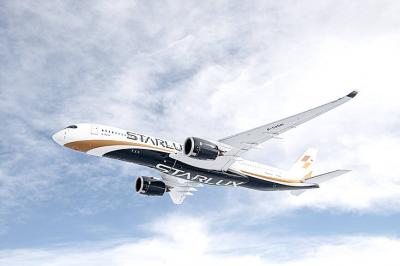
Starlux Airlines Co (星宇航空) today unveiled a long-haul network expansion plan at a shareholders’ meeting in Taipei, including direct flights to Barcelona, Spain, and Zurich, Switzerland, as well as a service connecting Taipei, Sydney and New Zealand. Starlux is to become the first Taiwanese carrier to offer non-stop services to the two European cities, while the inaugural oceanic route is expected to expand transit opportunities within the Australia-New Zealand market, Starlux said. Flight services to Chicago, Dallas, Washington and New York are under evaluation, the airline added. Prior to the shareholders’ meeting, the airline earlier this year announced that it would be
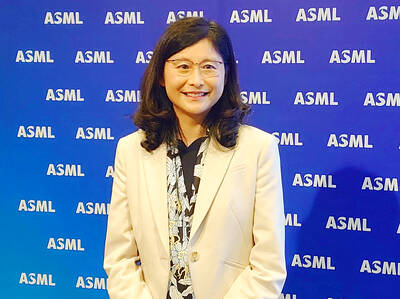
Netherlands-based semiconductor equipment supplier ASML Holding NV yesterday said that it is planning to hire an additional 1,000 people in Taiwan this year in response to growing demand from clients. ASML had previously planned to recruit 600 people this year, but that the plan has been adjusted upward, ASML vice president and ASML Taiwan general manager Grace Wang (汪佳慧) told reporters. ASML has a workforce of more than 4,500 in Taiwan, accounting for about 10 percent of its global total, Wang said. This year’s recruitment campaign would focus on adding people in the customer support, manufacturing and supply chain domains to assist ASML
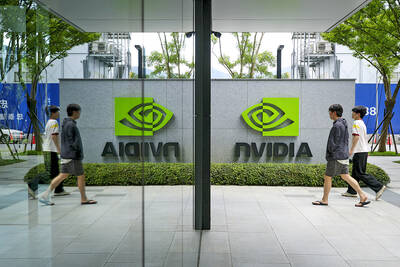
UNDER MICROSCOPE: Taiwan detained three people who allegedly conspired to buy servers in Taiwan and export them using fraudulent documentation, prosecutors said Nvidia Corp chief executive officer Jensen Huang (黃仁勳) on Saturday urged Super Micro Computer Inc to tighten up on compliance after Taiwan detained three people this week for allegedly making fraudulent declarations about artificial intelligence (AI) servers made by its US partner. The development marked the nation’s first crackdown on semiconductor smuggling, which grew after the US slapped restrictions on exports of high-end chips such as Nvidia AI accelerators to China. Nvidia is “rigorous” in explaining regulations to all of its partners, Huang told reporters after arriving in Taipei. “Ultimately Super Micro has to run their own company,” he said in response to

Nvidia Corp yesterday announced that CEO Jensen Huang (黃仁勳) would attend an employee meeting in Taipei tomorrow to celebrate the launch of the company’s Taiwan headquarters project. Huang would attend a gathering at the site of Nvidia’s planned headquarters in Beitou Shilin Technology Park (北投士林科技園區), the company said in a statement. After arriving in Taiwan on Saturday last week, Huang told reporters that he plans to meet with Quanta Computer Inc (廣達) chairman Barry Lam (林百里) and Taiwan Semiconductor Manufacturing Co (TSMC, 台積電) chairman C.C. Wei (魏哲家), and would attend the groundbreaking ceremony for Nvidia’s Taiwan headquarters tomorrow. Nvidia has not yet applied


 RSS
RSS