


Hon Hai Precision Industry Co (鴻海精密) is reportedly considering forming a strategic alliance with Macronix International Co (旺宏電子), the world’s No. 2 NOR flash memorychip maker, to help Hon Hai’s bid to acquire Toshiba Corp’s memorychip unit.
Hon Hai chairman Terry Gou (郭台銘) and General Interface Solution Holding Ltd (GIS, 業成) chairman Chou Hsien-ying (周賢穎) last month met several times with Macronix chairman Miin Wu (吳敏求) to discuss a potential alliance, as Macronix owns a large number of patents for memory products that could be used as a bargaining chip in the Toshiba bid, the Chinese-language newspaper Economic Daily News reported yesterday.
Toshiba on June 21 selected a consortium consisting of Innovation Network Corp of Japan, state-backed Development Bank of Japan, Bain Capital LP and South Korea’s SK Hynix as a “preferred bidder” for Toshiba Memory.
Gou on June 22 told an international news conference that the Japanese government and Toshiba had intentionally pushed Hon Hai out, despite the Hon Hai-led consortium, including Apple Inc and Amazon.com Inc, offering a higher price.
Macronix in April filed a patent infringement lawsuit against Toshiba over Macronix’s memory products, including NAND and NOR flash memories used in mobile devices and car navigation systems. The US International Trade Commission (ITC) has launched an investigation into the complaint.
If the investigation concludes that Toshiba has infringed upon patent rights, the ITC may ban the infringing products, or products containing infringing components, from being imported to the US, Macronix said in a statement in April.
In terms of the number of patents for 3D stacked memory technology, Macronix ranks No. 4 worldwide with 95, while Toshiba has 44 patents, Macronix said, citing an analysis by LexInnova in 2015.
Hon Hai reached out to Macronix mainly due to the memorychip maker’s patents and its ongoing lawsuit against Toshiba, the newspaper said, citing unnamed sources that are familiar with Gou’s meetings with Wu.
Hon Hai and Macronix yesterday declined to comment.
Gou on Saturday told during an interview with the Nikkei Asian Review that Hon Hai will drop its bid for Toshiba Memory after six months if Toshiba continues to exclude Hon Hai.
“I would no longer want to acquire [Toshiba’s memory unit] after six months, because by then its technology will be falling behind the others,” Gou said.
Macronix shares yesterday surged by 4.79 percent to NT$17.5 at the beginning of the trading session. The stock closed at NT$16.8, up 0.6 percent from the previous trading session.
Hon Hai’s stock price fell 0.43 percent to close at NT$116.5, Taiwan Stock Exchange data showed.
AI TALENT: No financial details were released about the deal, in which top Groq executives, including its CEO, would join Nvidia to help advance the technology Nvidia Corp has agreed to a licensing deal with artificial intelligence (AI) start-up Groq, furthering its investments in companies connected to the AI boom and gaining the right to add a new type of technology to its products. The world’s largest publicly traded company has paid for the right to use Groq’s technology and is to integrate its chip design into future products. Some of the start-up’s executives are leaving to join Nvidia to help with that effort, the companies said. Groq would continue as an independent company with a new chief executive, it said on Wednesday in a post on its Web
RESPONSE: The Japanese Ministry of Finance might have to intervene in the currency markets should the yen keep weakening toward the 160 level against the US dollar Japan’s chief currency official yesterday sent a warning on recent foreign exchange moves, after the yen weakened against the US dollar following Friday last week’s Bank of Japan (BOJ) decision. “We’re seeing one-directional, sudden moves especially after last week’s monetary policy meeting, so I’m deeply concerned,” Japanese Vice Finance Minister for International Affairs Atsushi Mimura told reporters. “We’d like to take appropriate responses against excessive moves.” The central bank on Friday raised its benchmark interest rate to the highest in 30 years, but Bank of Japan Governor Kazuo Ueda chose to keep his options open rather than bolster the yen,

Even as the US is embarked on a bitter rivalry with China over the deployment of artificial intelligence (AI), Chinese technology is quietly making inroads into the US market. Despite considerable geopolitical tensions, Chinese open-source AI models are winning over a growing number of programmers and companies in the US. These are different from the closed generative AI models that have become household names — ChatGPT-maker OpenAI or Google’s Gemini — whose inner workings are fiercely protected. In contrast, “open” models offered by many Chinese rivals, from Alibaba (阿里巴巴) to DeepSeek (深度求索), allow programmers to customize parts of the software to suit their
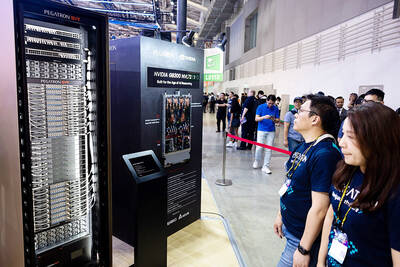
Global server shipments are expected to surge to 15 million units next year, from 4 million units this year, with artificial intelligence (AI) servers accounting for about 30 percent, driven by massive capital spending by major cloud service providers, the Market Intelligence and Consulting Institute (MIC) said on Thursday last week. Major cloud service providers — including Google’s parent company Alphabet Inc, Microsoft Corp, Amazon.com Inc and Meta Platforms Inc — are projected to budget US$450 million for capital expenditure next year, up from US$400 million this year, MIC ICT [information and communications technology] Industry Research Center director Edward Lin


 RSS
RSS