


The official manufacturing purchasing managers’ index (PMI) posted 58.7 last month, falling from 61 in April, as local manufacturers reported a softer, but solid improvement in operating conditions, the Chung-Hua Institution for Economic Research (CIER, 中華經濟研究院) said yesterday.
The latest PMI data lent support to a continued recovery in the global technology cycle, but uncertainty has mounted over the launch of Apple Inc’s next iPhone model due to reported technology snags, CIER president Wu Chung-shu (吳中書) told a news conference.
Local and international media have said Apple might have to delay mass production of its new iPhone from September to October or November, as it has failed to overcome hurdles related to touch-identification features.
“Uncertainty gains strength and diversity as the high sales season approaches,” Wu said.
Local technology firms supply chips, camera lenses, casings, batteries, touch screens and other critical components used in iPhones and might take a hit if Apple delays the production of the new model.
Regardless of the new iPhone’s launch, sales of technology products generally fare better in the second half compared with the first, Wu said, adding that the seasonal trend has remained on track so far this year.
The PMI aims to gauge the health of the manufacturing industry, with scores above 50 indicating expansion and scores below the threshold suggesting contraction.
Despite last month’s decline, the leading barometer rose for the 15th consecutive month as firms in all sectors reported business expansions, thanks to robust demand from clients at home and abroad, the CIER survey found.
The critical sub-index on new orders registered 57.3 last month even though firms involved in the supply of basic materials had slipped into contraction mode, according to the survey.
“Seasonality varies for different sectors,” Wu said.
Makers of electronic and optical devices, the main growth driver for the nation’s economy, showed the best performance with a PMI of 63.2, the survey found.
The output sub-index shed 5.2 points to 60 last month, while employment gained 0.4 percentage points to 60.4, both comfortably above the neutral mark, it said.
Most firms have positive views about their business outlook, tipping the six-month outlook sub-index to 61.1, from 63.2 in April.
The non-manufacturing industry also benefited from the recovering economy with the non-manufacturing index falling from April’s 56.3 to 55.4 last month, a separate report found.
While domestic demand accounts for a lion’s share of GDP, exports tend to affect its showing and the uptrend reflects benign external demand, Wu said.
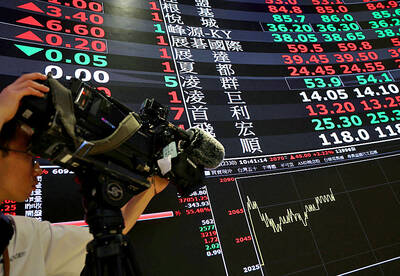
After several years flying high as Asia’s best Nvidia Corp proxy, Taiwan Semiconductor Manufacturing Co (TSMC, 台積電) is increasingly vying with other artificial intelligence (AI) stocks for investor attention. Stock traders are chasing a wider array of beneficiaries as mainstream usage of AI creates demand for hardware beyond the most-advanced chips TSMC makes for Nvidia. Subthemes from the deepening memory crunch to advances in robotics are also luring bids. At the same time, investment caps on single stocks are pushing funds to diversify, while retail investors long familiar with TSMC through its US depositary receipts are being offered a broader set of

UNDER MICROSCOPE: Taiwan detained three people who allegedly conspired to buy servers in Taiwan and export them using fraudulent documentation, prosecutors said Nvidia Corp chief executive officer Jensen Huang (黃仁勳) on Saturday urged Super Micro Computer Inc to tighten up on compliance after Taiwan detained three people this week for allegedly making fraudulent declarations about artificial intelligence (AI) servers made by its US partner. The development marked the nation’s first crackdown on semiconductor smuggling, which grew after the US slapped restrictions on exports of high-end chips such as Nvidia AI accelerators to China. Nvidia is “rigorous” in explaining regulations to all of its partners, Huang told reporters after arriving in Taipei. “Ultimately Super Micro has to run their own company,” he said in response to
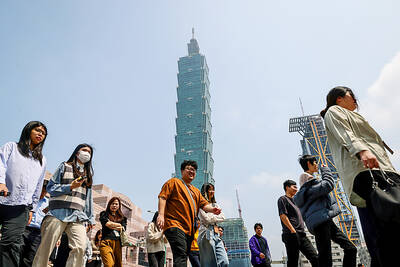
TECH RELIANCE: Growth is increasingly reflecting an unequal K-shaped distribution, where technology sectors outperform and other industries struggle, an expert said Standard Chartered Bank has significantly raised its forecast for Taiwan’s economic growth to 9.5 percent this year, up from 7.6 percent previously, citing surging artificial intelligence (AI) demand driving exports, semiconductor production and investment. The upgrade reflects a sustained AI supercycle that continues to fuel demand for advanced chips and technology infrastructure, which form the backbone of Taiwan’s exports, the bank said in a report this week. “We raise our 2026 growth forecast to reflect a much stronger-than-expected first-quarter GDP figure,” Standard Chartered senior economist for greater China and Asia Tommy Wu (胡東安) said in the report. Driven largely by a 35.3 percent
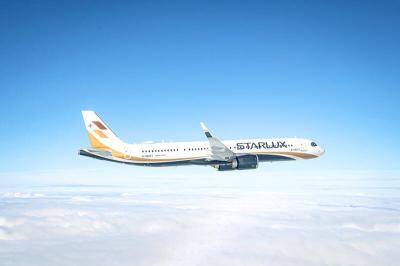
Two of Taiwan’s international carriers, Starlux Airlines Co (星宇航空) and EVA Airways Corp (長榮航空), have retained the five-star airline rating awarded by international airline review organization Skytrax. Starlux was awarded the distinction for a second consecutive year, while EVA Air received it for the 11th straight year, Skytrax said in statements released yesterday and on Thursday last week, respectively. The five-star rating is considered one of the airline industry's highest honors and is awarded following professional audits of airline product and frontline service standards, Skytrax said. The ratings are based on in-depth assessments using unified global quality standards rather than customer review scores


 RSS
RSS