


Taipei Times (TT): Has Softbank set a different goal for ARM in running its Internet of Things (IoT) business following the acquisition?
Dipesh Patel: We have been pursuing IoT strategy for the past four years. With the Softbank acquisition, we are in the position to accelerate investments. The strategy we are pursuing is very similar to what we were pursuing before.
We have built a new device managing service unit. It is called “mbed cloud.” The service just started. We have been working closely with our lead partners to have their devices connected and to start managing their devices. This is our goal.
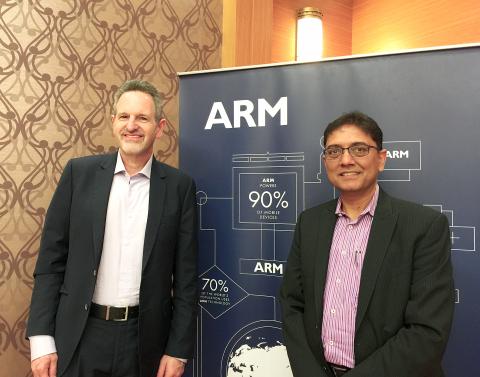
Photo courtesy of Lisa Wang, Taipei Times.
TT: Which IoT sectors does ARM focus on?
Dipesh: We have chosen three sectors to focus on. The first one is about utilities, such as “smart” meters and energy management. The second one is about asset-tracking. This is where you can track assets as they go from the source to destination. The third one is about connecting spaces. It is more about “smart” building and environments where you can have IoT devices.
TT: ARM has announced a joint venture in China. What role will the joint venture play?
Rene Haas: We signed a memorandum of understanding on May 15 with the intent to establish a joint venture in China. The primary reason, or the benefit for us, is entering the Chinese market with products that we might have been unable to introduce if we tried to market them independently.
The joint venture will be a joint effort between outside investors and ARM. It intends to develop projects specifically for the Chinese market.
The Chinese government plans to implement a policy about security and control and wants products that are able to address the requirements. We thought the best strategy was to establish a joint venture.
The products developed by the joint venture would also be made available for ARM to license them worldwide.
TT: What will be the first product from the joint venture?
Haas: Areas like IoT, artificial intelligence (AI), machine learning, these are big sectors. Also, security. China has very specific requirements for security and what needs to stay inside China.
TT: What is ARM’s take on Apple Inc’s and Samsung Electronic Co’s plans to develop their own graphic processing units (GPUs)?
Haas: We are investing very heavily on our GPU road map... We think it is a very big market. It is not only for mobile devices, but also for computer vision, machine learning, AI processors, etc. The products we are announcing [during Computex Taipei] are well-suited for those applications.
TT: What can ARM offer in terms of AI?
Dipesh: AI is a field that is just beginning. One of the things that [gives us] huge opportunities is AI being at every edge of computing.
Today, a lot of what we hear about AI is mostly in the cloud or in data centers. We believe AI is going to exist in the cloud, in networks, as well as in client devices. ARM’s technologies address all those markets. [Edge computing is a method of optimizing cloud computing systems by performing data processing at the edge of the network, near the source of the data.]
TT: Has ARM set any targets for its server business?
Haas: We have set a target of taking 25 percent of the global share by 2021. This market takes time [to grow]... We already see some good indicators. Microsoft Corp made a big announcement a few months ago, regarding what they are going to do with ARM-based servers.
TT: How many partners is ARM working with in the server business?
Haas: We have been working with seven or eight chipmakers, including Hisilicon Technologies Co (海思半導體) [a handset chip designing subsidiary of Huawei Technologies Inc (華為)].
TT: Do you have a target for the new mbed cloud unit?
Dipesh: We have not announced any targets yet. On Wednesday [today], I am going to talk about our partnership with Advantech Co (研華). That is an example of where we are working very closely with our partners to bring their products into production. We are also working with other partners, including those from Taiwan.
In the lighting space, we are working with General Electric Co. General Electric is doing the “smart” lighting in San Diego.
TT: Which process technology has ARM adopted for server CPUs, 7-nanometer or 10-nanometer? Which foundry are your partners working with? Samsung Electronics Co or Taiwan Semiconductor Manufacturing Co (TSMC, 台積電)?
Haas: All of those. It is still early. We have partners working on both 10-nanometer and 7-nanometer with Samsung and TSMC.
TT: The timing for ARM to enter the PC market is intriguing as the market is declining. Why now?
Haas: Microsoft is really pushing this. Windows 10 is going to support both [Intel Corp’s] x86 and ARM architecture. Old applications that used to run x86 do not run on ARM. Now Microsoft has solved that problem. Legacy applications will run on ARM [chips] just as fast as they did on x86.
Microsoft is really pushing the strategy more than ARM and our partners. Microsoft still wants laptops that have greater battery life and are very small, very light, very thin and that also can have application capabilities like smartphones. That has not changed. Now that the software application issues have been addressed, the timing is quite good.
TT: What are ARM’s thoughts about Intel’s expansion into the foundry business?
Haas: It is a good strategy for them. It is a tough market. They have leading technology products, so I think it is a good strategy. When you look at the capital investment they make, which is just very like large companies do, that can compete with Samsung and TSMC. I thinks it is a good allocation of capital, but it is a tough market, because it is very competitive.
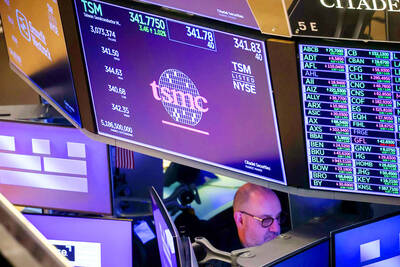
STRONG INTEREST: Analysts have pointed to optimism in TSMC’s growth prospects in the artificial intelligence era as the cause of the rising number of shareholders The number of people holding shares of chipmaker Taiwan Semiconductor Manufacturing Co (TSMC, 台積電) hit a new high last week despite a decline in its stock price, the Taiwan Depository and Clearing Corp (TDCC, 台灣集保) said. The number of TSMC shareholders rose to 2.46 million as of Friday, up 75,536 from a week earlier, TDCC data showed. The stock price fell 1.34 percent during the same week to close at NT$1,840 (US$57.55). The decline in TSMC’s share price resulted from volatility in global tech stocks, driven by rising international crude oil prices as the war against Iran continues. Dealers said
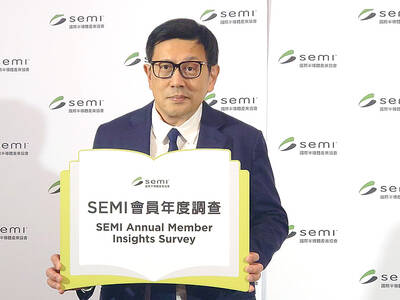
PRICE HIKES: The war in the Middle East would not significantly disrupt supply in the short term, but semiconductor companies are facing price surges for materials Taiwan’s semiconductor companies are not facing imminent supply disruptions of essential chemicals or raw materials due to the war in the Middle East, but surges in material costs loom large, industry association SEMI Taiwan said yesterday. The association’s comments came amid growing concerns that supplies of helium and other key raw materials used in semiconductor production could become a choke point after Qatar shut down its liquefied natural gas (LNG) production and helium output earlier this month due to the conflict. Qatar is the second-largest LNG supplier in the world and accounts for about 33 percent of global helium output. Helium is
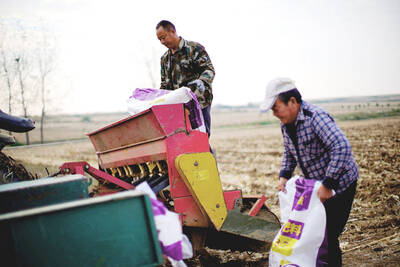
China is clamping down on fertilizer exports to protect its domestic market, industry sources said, putting an additional strain on global markets that were already grappling with shortages caused by the US-Israeli war on Iran. China is among the largest fertilizer exporters — shipping more than US$13 billion of it last year — and it has a history of controlling exports to keep prices low for farmers. Shipments through the war-blocked Strait of Hormuz account for about one-third of the sea-borne supply. This month, Beijing banned exports of nitrogen-potassium fertilizer blends and certain phosphate varieties, sources said. The ban, which has not

AMAZING ABUNDANCE: Elon Musk has announced plans for a new facility in Texas which would manufacture chips for Tesla and SpaceX to use in robotics and AI Elon Musk said his Terafab project — a grand plan to eventually manufacture his own chips for robotics, artificial intelligence (AI) and space data centers — would be built in Austin and jointly run by Tesla Inc and Space Exploration Technologies Corp (SpaceX). Musk, the chief executive officer of the two companies, said he would start off with an “advanced technology fab” in Austin that would have all of the equipment necessary to make chips of any kind. The project would call for one day supporting 1 terawatt (TW) of computing power per year, the amount Musk expects the companies to


 RSS
RSS