


Softbank Group Corp, the Japanese company that raised a US$93 billion fund for technology investments, is considering boosting its stake in chipmaker Nvidia Corp, people familiar with the matter said.
The firm would raise its holding over time and begin to work more closely with Nvidia, the people said, asking not to be identified because the deliberations are private.
“While we don’t comment on rumors about our investments, we consider ourselves long-term partners to companies, whether private or public,” Softbank said in an e-mailed statement.
Nvidia declined to comment.
Softbank had bought a 4.9 percent stake, just under the amount that would require a regulatory disclosure in the US, making it the fourth-largest shareholder in the graphics chipmaker, people familiar with the situation said previously.
The holding has a market value of about US$4.1 billion.
Softbank chief executive officer Masayoshi Son is working to become the world’s most prolific technology investor and closed the first round of capital commitments for his Vision Fund this month.
He has used money from his domestic telecom operations to pay for investments in start-ups in China, India and the US and for acquisitions of companies such as UK chipmaker ARM Holdings PLC and US wireless operator Sprint Corp.
Microsoft Corp, which uses Nvidia’s graphic chips for its Xbox gaming console, has the right of first refusal to buy the shares if another company tries to take a more than 30 percent stake, Nvidia has said in regulatory filings.
Under its founder, Huang Jen-hsun (黃仁勳), Nvidia has become one of the chipmakers leading the charge to provide the underpinnings of machine intelligence in everything from data centers to automobiles.
As the biggest maker of graphics chips, Nvidia has proved that type of processor’s ability to perform multiple tasks in parallel has value in new markets, where artificial intelligence is increasingly important.
Nvidia shares rose 2.2 percent to US$141.25 at 3:27pm in New York City on Friday, giving it a market value of US$84.1 billion.
The Santa Clara, California-based company has been a good bet for those that backed it. Nvidia’s stock more than tripled last year and is up 32 percent this year. Since the stock started rallying in 2013 it has climbed by at least 25 percent each year.
CHIP RACE: Three years of overbroad export controls drove foreign competitors to pursue their own AI chips, and ‘cost US taxpayers billions of dollars,’ Nvidia said China has figured out the US strategy for allowing it to buy Nvidia Corp’s H200s and is rejecting the artificial intelligence (AI) chip in favor of domestically developed semiconductors, White House AI adviser David Sacks said, citing news reports. US President Donald Trump on Monday said that he would allow shipments of Nvidia’s H200 chips to China, part of an administration effort backed by Sacks to challenge Chinese tech champions such as Huawei Technologies Co (華為) by bringing US competition to their home market. On Friday, Sacks signaled that he was uncertain about whether that approach would work. “They’re rejecting our chips,” Sacks
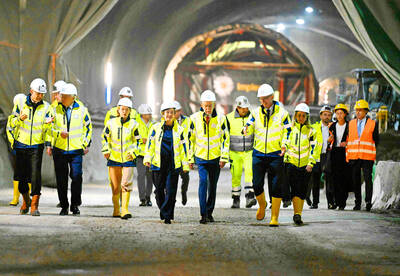
It is challenging to build infrastructure in much of Europe. Constrained budgets and polarized politics tend to undermine long-term projects, forcing officials to react to emergencies rather than plan for the future. Not in Austria. Today, the country is to officially open its Koralmbahn tunnel, the 5.9 billion euro (US$6.9 billion) centerpiece of a groundbreaking new railway that will eventually run from Poland’s Baltic coast to the Adriatic Sea, transforming travel within Austria and positioning the Alpine nation at the forefront of logistics in Europe. “It is Austria’s biggest socio-economic experiment in over a century,” said Eric Kirschner, an economist at Graz-based Joanneum

BUBBLE? Only a handful of companies are seeing rapid revenue growth and higher valuations, and it is not enough to call the AI trend a transformation, an analyst said Artificial intelligence (AI) is entering a more challenging phase next year as companies move beyond experimentation and begin demanding clear financial returns from a technology that has delivered big gains to only a small group of early adopters, PricewaterhouseCoopers (PwC) Taiwan said yesterday. Most organizations have been able to justify AI investments through cost recovery or modest efficiency gains, but few have achieved meaningful revenue growth or long-term competitive advantage, the consultancy said in its 2026 AI Business Predictions report. This growing performance gap is forcing executives to reconsider how AI is deployed across their organizations, it said. “Many companies
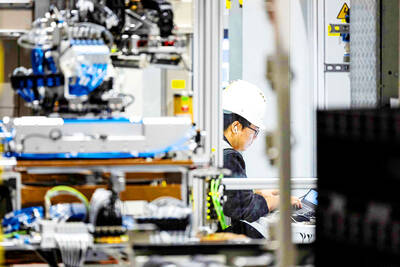
France is developing domestic production of electric vehicle (EV) batteries with an eye on industrial independence, but Asian experts are proving key in launching operations. In the Verkor factory outside the northern city of Dunkirk, which was inaugurated on Thursday, foreign specialists, notably from South Korea and Malaysia, are training the local staff. Verkor is the third battery gigafactory to open in northern France in a region that has become known as “Battery Valley.” At the Automotive Energy Supply Corp (AESC) factory near the city of Douai, where production has been under way for several months, Chinese engineers and technicians supervise French recruits. “They


 RSS
RSS