


One year into President Tsai Ing-wen’s (蔡英文) rule, investors are tallying up their winnings.
The nation’s benchmark stock index has surged 33 percent in US dollar terms since Tsai’s inauguration, the best performance among Asian peers.
Foreign funds in particular have been fans: They have pumped a net US$16.5 billion into Taiwanese equities in the past 12 months, the most in the region — helping send the New Taiwan dollar to highs last seen in 2014.
The gains overcame concern that relations with China, which had warmed under Tsai’s predecessor, would deteriorate under a Democratic Progressive Party government perceived as less friendly to Beijing.
Instead, optimism about iPhone sales and a surge in global technology shares supercharged Taiwan’s US$1.1 trillion stock market, which is dominated by Apple Inc suppliers.
While challenges to the rally are mounting — with the inflated NT dollar starting to crimp exporter profit growth — a strengthening economy and inexpensive valuations are seen supporting further gains.
“One year ago, there were worries about the impact on cross-strait relations and consequently on the economy if the DPP came to power,” KGI Securities Investment Advisory Co (凱基投顧) chairman Tu Jin-lung (杜金龍) said by telephone. “But President Tsai gets at least a ‘B+’ in her first year in office if you take the stock market gains and currency strength as a showcase for the economy.”
While Tsai has avoided making any concrete commitments to Beijing’s ‘one China’ principle that governed relations between the two rivals during the administration of former president Ma Ying-jeou (馬英九), that does not appear to have hurt trade that is vital to Taiwan’s economy.
Government figures show little change to the roughly 40 percent of the nation’s exports that have gone to China since 2007.
Investors are also focused on whether Apple’s next iPhone can meet such high expectations, with the benchmark TAIEX having reclaimed the 10,000 mark for the first time since the dotcom bubble in 2000.
Taiwan Semiconductor Manufacturing Co (台積電), Apple’s main chipmaker, has surged 37 percent in the past 12 months to take its market value to more than US$170 billion.
Hon Hai Precision Industry Co (鴻海精密), which assembles the iPhone, has jumped 51 percent.
The two stocks together account for almost one-quarter of the TAIEX’s total weighting, meaning any disappointment in terms of sales could quickly take the market lower.
A surging NT dollar also risks eroding Taiwan’s competitiveness, with exports accounting for more than half of the nation’s GDP.
The NT dollar has gained 8.4 percent against the US dollar since Tsai’s inauguration, making it one of the world’s top-performing currencies.
Yet, market watchers remain upbeat. Fuh Hwa Securities Investment Trust Co (復華投信), Taishin Securities Investment Trust Co (台新投信) and President Capital Management Corp (統一投顧) all project that the stock index might climb to 10,800 or higher this year, supported by valuations and dividend yields.
Even after the rally, the TAIEX trades at 15 times reported earnings, a 10 percent discount to its five-year average, while its dividend yield of 3.7 percent is among the highest in Asia.
“In the past, the market started to fall after reaching 10,000, but it’s different this time,” Fuh Hwa Securities vice president Stevie Chou (周奇賢) said. “The electronics sector’s peak season is in the third quarter. Seasonally, cyclically, earnings-wise, valuation-wise, the market is still at fair levels.”
The TAIEX yesterday closed down 21.83 points, or 0.22 percent, at 9,947.62 on turnover of NT$69.65 billion (US$2.3 billion).
AI TALENT: No financial details were released about the deal, in which top Groq executives, including its CEO, would join Nvidia to help advance the technology Nvidia Corp has agreed to a licensing deal with artificial intelligence (AI) start-up Groq, furthering its investments in companies connected to the AI boom and gaining the right to add a new type of technology to its products. The world’s largest publicly traded company has paid for the right to use Groq’s technology and is to integrate its chip design into future products. Some of the start-up’s executives are leaving to join Nvidia to help with that effort, the companies said. Groq would continue as an independent company with a new chief executive, it said on Wednesday in a post on its Web
RESPONSE: The Japanese Ministry of Finance might have to intervene in the currency markets should the yen keep weakening toward the 160 level against the US dollar Japan’s chief currency official yesterday sent a warning on recent foreign exchange moves, after the yen weakened against the US dollar following Friday last week’s Bank of Japan (BOJ) decision. “We’re seeing one-directional, sudden moves especially after last week’s monetary policy meeting, so I’m deeply concerned,” Japanese Vice Finance Minister for International Affairs Atsushi Mimura told reporters. “We’d like to take appropriate responses against excessive moves.” The central bank on Friday raised its benchmark interest rate to the highest in 30 years, but Bank of Japan Governor Kazuo Ueda chose to keep his options open rather than bolster the yen,
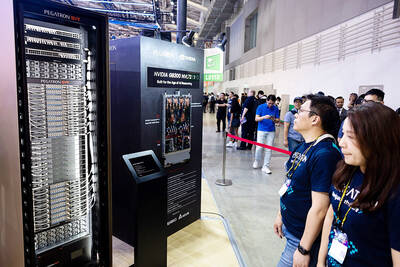
Global server shipments are expected to surge to 15 million units next year, from 4 million units this year, with artificial intelligence (AI) servers accounting for about 30 percent, driven by massive capital spending by major cloud service providers, the Market Intelligence and Consulting Institute (MIC) said on Thursday last week. Major cloud service providers — including Google’s parent company Alphabet Inc, Microsoft Corp, Amazon.com Inc and Meta Platforms Inc — are projected to budget US$450 million for capital expenditure next year, up from US$400 million this year, MIC ICT [information and communications technology] Industry Research Center director Edward Lin
Even as the US is embarked on a bitter rivalry with China over the deployment of artificial intelligence (AI), Chinese technology is quietly making inroads into the US market. Despite considerable geopolitical tensions, Chinese open-source AI models are winning over a growing number of programmers and companies in the US. These are different from the closed generative AI models that have become household names — ChatGPT-maker OpenAI or Google’s Gemini — whose inner workings are fiercely protected. In contrast, “open” models offered by many Chinese rivals, from Alibaba (阿里巴巴) to DeepSeek (深度求索), allow programmers to customize parts of the software to suit their


 RSS
RSS