


Northern Power Development Inc yesterday said it plans to invest at least NT$150 billion (US$4.96 billion) to develop offshore wind farms off the Changhua County coast in partnership with Yushan Energy Pte Ltd, taking advantage of the government’s push to promote “green” energy.
Canada-based Northern Power and Singapore-based Yushan Energy in 2015 formed a venture, Hai Long Offshore Wind Farm Project Office (海龍離岸風電計畫辦公室), to facilitate the deployment of more than 100 wind turbines at two sites 40km to 50km offshore.
Hai Long is seeking syndicated loans from global and local lenders, and to offer equities to finance the construction, which is set to begin in 2019.
The turbines, which are to have a total capacity of 1.2 gigawatts, are to start commercial operation by 2023 or 2024, Hai Long chief executive officer Chen Tsung-hua (陳聰華) told a news conference in Taipei.
“We hope to become the first in Taiwan to offer grid-scale offshore wind energy,” Chen said.
Upon completion of the wind farm, Hai Long’s wind power capacity would make up about 40 percent of the 3 gigawatts of wind power capacity the government aims to encourage private firms to install by 2025, Chen said.
That is part of the government’s eight-year plan to boost sources of renewable energy to account for 20 percent of overall generation by 2025, while reducing the nation’s reliance on coal-fired and nuclear power from 45 percent and 12 percent to 30 percent and zero percent respectively.
About 22 companies at home and overseas have submitted plans to build offshore wind farms, according to statistics from the Ministry of Economic Affairs.
Hai Long said it has submitted an environmental impact assessment to the Environmental Protection Administration for review.
It expects to receive approval from the agency by the end of the year and other permits from other government agencies by June next year.
Hai Long is also looking at other sites to build more offshore wind farms, if the government makes areas available, Chen said.
Hai Long has a direct workforce of about 20 people, which is expected to grow to 120, the company said.
Northern Power is considering the establishment of a wind power storage company to help improve management of electricity delivery, Yushan chairman Ian Hatton said.
“We are in talks with a wind farm storage equipment company to form a power storage [entity]. We are still in the initial stages,” Hatton said.

CHIP RACE: Three years of overbroad export controls drove foreign competitors to pursue their own AI chips, and ‘cost US taxpayers billions of dollars,’ Nvidia said China has figured out the US strategy for allowing it to buy Nvidia Corp’s H200s and is rejecting the artificial intelligence (AI) chip in favor of domestically developed semiconductors, White House AI adviser David Sacks said, citing news reports. US President Donald Trump on Monday said that he would allow shipments of Nvidia’s H200 chips to China, part of an administration effort backed by Sacks to challenge Chinese tech champions such as Huawei Technologies Co (華為) by bringing US competition to their home market. On Friday, Sacks signaled that he was uncertain about whether that approach would work. “They’re rejecting our chips,” Sacks

It is challenging to build infrastructure in much of Europe. Constrained budgets and polarized politics tend to undermine long-term projects, forcing officials to react to emergencies rather than plan for the future. Not in Austria. Today, the country is to officially open its Koralmbahn tunnel, the 5.9 billion euro (US$6.9 billion) centerpiece of a groundbreaking new railway that will eventually run from Poland’s Baltic coast to the Adriatic Sea, transforming travel within Austria and positioning the Alpine nation at the forefront of logistics in Europe. “It is Austria’s biggest socio-economic experiment in over a century,” said Eric Kirschner, an economist at Graz-based Joanneum

BUBBLE? Only a handful of companies are seeing rapid revenue growth and higher valuations, and it is not enough to call the AI trend a transformation, an analyst said Artificial intelligence (AI) is entering a more challenging phase next year as companies move beyond experimentation and begin demanding clear financial returns from a technology that has delivered big gains to only a small group of early adopters, PricewaterhouseCoopers (PwC) Taiwan said yesterday. Most organizations have been able to justify AI investments through cost recovery or modest efficiency gains, but few have achieved meaningful revenue growth or long-term competitive advantage, the consultancy said in its 2026 AI Business Predictions report. This growing performance gap is forcing executives to reconsider how AI is deployed across their organizations, it said. “Many companies
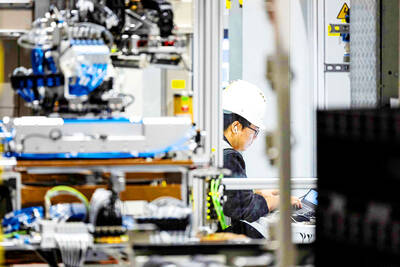
France is developing domestic production of electric vehicle (EV) batteries with an eye on industrial independence, but Asian experts are proving key in launching operations. In the Verkor factory outside the northern city of Dunkirk, which was inaugurated on Thursday, foreign specialists, notably from South Korea and Malaysia, are training the local staff. Verkor is the third battery gigafactory to open in northern France in a region that has become known as “Battery Valley.” At the Automotive Energy Supply Corp (AESC) factory near the city of Douai, where production has been under way for several months, Chinese engineers and technicians supervise French recruits. “They


 RSS
RSS