

The nation’s export orders jumped 22 percent year-on-year to US$33.75 billion last month, driven by strong demand for notebooks, smartphones, TVs and servers, the Ministry of Economic Affairs said yesterday.
The numbers exceeded the ministry’s own forecast of 15.7 percent growth by a wide margin and represented the seventh consecutive annual expansion, the ministry said.
“Last month’s export orders reflected persistent demand for information and communication technology [ICT] products during the traditionally slow season for consumer electronics,” Department of Statistics Director-General Lin Lee-jen (林麗貞) told a news conference.
Lin said that rising global average sales prices for raw materials contributed to the performances of the nation’s traditional industries, such as steel and petrochemical products.
Monthly orders for ICT and electronic products, Taiwan’s most important exports, expanded by 23.9 percent year-on-year and 15.4 percent year-on-year, to US$9.71 billion and 8.73 billion respectively, Lin said.
Orders for precision instruments surged by 55.1 percent annually to US$2.09 billion last month, supported by strong demand in China and Hong Kong for the larger flat panels used in TVs, she said.
Basic metals, petrochemicals, and rubber and plastics saw double-digit percentage annual growth, because of recovering demand as well as rising sales prices, Lin said.
Lin said more demand for industrial automation drove growth for machinery exports, which posted US$1.65 billion, representing a 20.1 percent year-on-year increase.
Orders from the US rose an annual 21.1 percent to US$9.15 billion last month, mainly driven by demand for notebooks, smartphones, and electronic components, Lin said.
Orders from China and Hong Kong expanded by 40.5 percent annually to US$8.72 billion on the back of robust demand for DRAM, chips and large flat panels, she said.
Combined export orders in the first two months of this year totaled NT$69.72 billion, 12.7 percent higher than the same period last year a historical high, she said.
Looking ahead, Lin said the ministry now forecasts export orders to grow from 2 to 5 percent year-on-year to between US$37.5 billion and US$38.5 billion this month, based on manufacturers’ outlooks.
That would represent monthly growth of between 11 percent and 14 percent, she said.
Lin said the ministry estimates export orders for this quarter as a whole would increase by between 8.9 percent and 9.9 percent from the same period last year.
READJUSTMENT? Despite the rumors, a senior Google official said that the company plans to expand its AI research center in Taipei’s Shilin District Google Taiwan is reducing its workforce as the company continues to adjust operations to improve efficiency and focus resources on core goals, the Chinese-language Liberty Times (sister paper of the Taipei Times) reported yesterday. The Alphabet Inc unit said the organizational adjustments have begun and would continue, even though it did not put a figure on the number of potential job cuts or specify the affected departments in its Taiwan operations. The company’s response came after rumors circulated on social media about major job cuts at Google Taiwan. Some posts said the downsizing would target the company’s consumer electronics-related departments
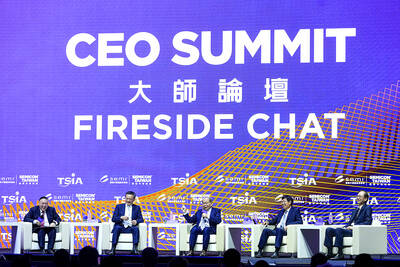
Taiwan Semiconductor Manufacturing Co (TSMC, 台積電) is accelerating capacity expansion fivefold this year, but it is still unable to keep up with the booming demand for artificial intelligence (AI), TSMC deputy cochief operating officer Cliff Hou (侯永清) said yesterday. This year alone, the company is building 25 chip manufacturing fabs and advanced packaging facilities worldwide, including 13 plants in Taiwan, which is unprecedented, Hou said at a CEO Summit fireside chat at Semicon Taiwan in Taipei. In the past, the company was able to build five or six factories a year, said Hou, who is also chairman of the Taiwan Semiconductor Industry
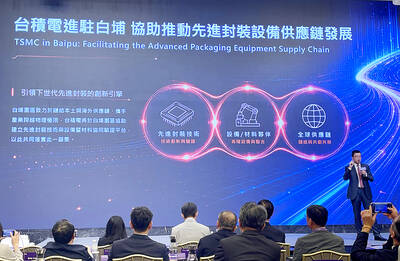
EXPANSION: The 3-hectare site would include small clean rooms and laboratories as well as a world-class training base for advanced packaging talent, the company said Taiwan Semiconductor Manufacturing Co (TSMC, 台積電) is to establish a presence in the Baipu Industrial Park (白埔產業園區) in Kaohsiung to accelerate the testing and validation of semiconductor materials and equipment, a company executive said on Tuesday. The company is working with the Ministry of Economic Affairs and the Kaohsiung City Government on the plan, which is expected to improve validation efficiency by 25 to 50 percent, TSMC vice president of advanced packaging technology and service Jun He (何軍) said at a 3D IC global summit held ahead of the Semicon Taiwan trade show, which opened in Taipei yesterday. TSMC would also conduct
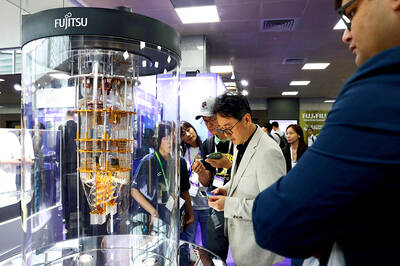
Visitors look at a 64-qubit superconducting quantum computer on display at the Fujitsu booth at the Semicon Taiwan trade show in Taipei yesterday.


 RSS
RSS