


Housing transactions in the nation’s six special municipalities soared 37.5 percent last month from a year earlier as buying interests recovered somewhat due to a stabilizing economy and a reduction in political rhetoric from policymakers, analysts said yesterday.
Deals totaled 15,656 units in the six municipalities despite fewer working days in the month, according to data released by the respective municipal governments on their Web sites on Thursday.
“Some buyers, especially those with real demand, decided to end their sitting on the sidelines after the government took action to lower holding costs and encourage urban renewal,” Sinyi Realty Inc (信義房屋) researcher Tseng Ching-der (曾進德) said by telephone.
The Taipei City Government has trimmed extra taxes on luxury homes — or units built with expensive materials and located in prime locations — which had virtually frozen luxury home transactions in recent years.
The actual pace of rebound could be faster if one takes the shorter Lunar New Year holiday out of the calculations, Tseng said.
New Taipei City reported the steepest rebound, 70.1 percent to 4,984 units, as buyers achieved price concessions and builders delivered presale housing projects in Tamsui (淡水), Banciao (板橋) and Sinjhuang (新莊) districts, Evertrust Rehouse Co (永慶房屋) manager Jay Hsieh (謝志傑) said.
Transactions in Tainan increased 39.1 percent to 1,445 units and the figures gained 32.3 percent to 2,516 units in Taoyuan, the data showed.
Taichung saw a pickup of 27 percent to 2,897 units, while Kaohsiung posted a 20.4 percent rise to 2,518 units.
Transactions in Taipei rose 24.5 percent to 1,763 units, data showed.
The figures represented declines of between 9.4 percent and 23.4 percent if compared with December last year, the traditional high sales season, Hsieh said.
However, it would be premature to take the rebound for a solid recovery, as most buyers are demanding more price concessions before making a deal, he said.
More than 100,000 new houses will join the market this year, adding correction pressures on the part of sellers, Evertrust said.
As expected, overall housing transactions nationwide slumped 16.1 percent to a record low of 245,000 units for the whole of last year, Ministry of the Interior data showed.
Last year, Taipei fared the poorest measured by the pace of retreat at 28.1 percent, followed by Taichung at 25.98 percent and Tainan at 21.52 percent, government statistics showed.
“Unaffordability remains a major concern in the capital city and elsewhere,” H&B Realty Co (住商不動產) researcher Jessica Hsu (徐佳馨) said.
Keelung proved the only exception, with transactions growing 57.7 percent to 8,926 units last year.
A longstanding low base contributed to the noticeable advancement in the port city, Hsu said.

CHIP RACE: Three years of overbroad export controls drove foreign competitors to pursue their own AI chips, and ‘cost US taxpayers billions of dollars,’ Nvidia said China has figured out the US strategy for allowing it to buy Nvidia Corp’s H200s and is rejecting the artificial intelligence (AI) chip in favor of domestically developed semiconductors, White House AI adviser David Sacks said, citing news reports. US President Donald Trump on Monday said that he would allow shipments of Nvidia’s H200 chips to China, part of an administration effort backed by Sacks to challenge Chinese tech champions such as Huawei Technologies Co (華為) by bringing US competition to their home market. On Friday, Sacks signaled that he was uncertain about whether that approach would work. “They’re rejecting our chips,” Sacks
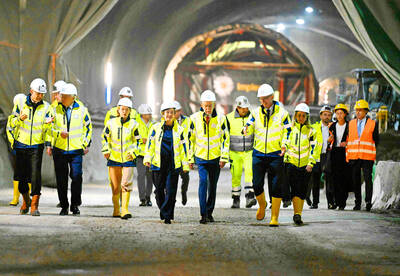
It is challenging to build infrastructure in much of Europe. Constrained budgets and polarized politics tend to undermine long-term projects, forcing officials to react to emergencies rather than plan for the future. Not in Austria. Today, the country is to officially open its Koralmbahn tunnel, the 5.9 billion euro (US$6.9 billion) centerpiece of a groundbreaking new railway that will eventually run from Poland’s Baltic coast to the Adriatic Sea, transforming travel within Austria and positioning the Alpine nation at the forefront of logistics in Europe. “It is Austria’s biggest socio-economic experiment in over a century,” said Eric Kirschner, an economist at Graz-based Joanneum

BUBBLE? Only a handful of companies are seeing rapid revenue growth and higher valuations, and it is not enough to call the AI trend a transformation, an analyst said Artificial intelligence (AI) is entering a more challenging phase next year as companies move beyond experimentation and begin demanding clear financial returns from a technology that has delivered big gains to only a small group of early adopters, PricewaterhouseCoopers (PwC) Taiwan said yesterday. Most organizations have been able to justify AI investments through cost recovery or modest efficiency gains, but few have achieved meaningful revenue growth or long-term competitive advantage, the consultancy said in its 2026 AI Business Predictions report. This growing performance gap is forcing executives to reconsider how AI is deployed across their organizations, it said. “Many companies
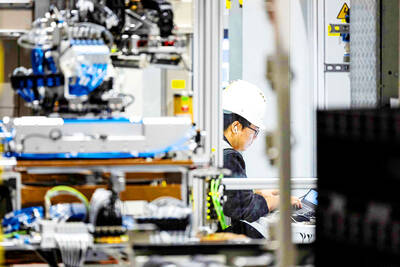
France is developing domestic production of electric vehicle (EV) batteries with an eye on industrial independence, but Asian experts are proving key in launching operations. In the Verkor factory outside the northern city of Dunkirk, which was inaugurated on Thursday, foreign specialists, notably from South Korea and Malaysia, are training the local staff. Verkor is the third battery gigafactory to open in northern France in a region that has become known as “Battery Valley.” At the Automotive Energy Supply Corp (AESC) factory near the city of Douai, where production has been under way for several months, Chinese engineers and technicians supervise French recruits. “They


 RSS
RSS