


Major property brokers saw transactions increase mildly last month, driven by real demand from people wanting to move house ahead of the Lunar New Year holiday.
Sinyi Realty Inc (信義房屋), the nation’s only listed broker, reported a 3.5 percent monthly increase in transactions, mostly in Taoyuan and Taichung, thanks to their relatively affordable housing prices, Sinyi researcher Tseng Ching-der (增進德) said.
“The pickup is modest despite the high sales season, as buyers generally remained conservative and sellers grew less eager to grant concessions after the government indicated plans to lower holding costs,” Tseng said in a statement.
Transactions picked up 17.3 percent in Taoyuan and 10.5 percent in Taichung last month from a month earlier, but shrank 10 percent in Taipei, 5.8 percent in New Taipei City and 9.6 percent in Kaohsiung, Tseng said, citing internal data.
Sellers in Taipei recovered some confidence after the city government floated plans to cut the housing tax to ease the burden on homeowners, Tseng said.
The improving sentiment might slow trading going forward, as different surveys show buyers are likely to stay on the sidelines unless sellers are willing to lower prices by 5 to 15 percent.
Evertrust Rehouse Co (永慶房屋), the nation’s largest by number of offices, reported flat transactions last month.
Trading in Greater Taipei stabilized after some construction companies lowered prices to attract buyers, but softened in central and southern Taiwan due to increasing caution, Evertrust spokesman Lin Tai-lung (林泰隆) said.
“Many buyers prefer to wait and see, because they fail to see eye-to-eye with sellers over housing value,” Lin said.
The interest rate hikes by the US Federal Reserve might inspire the central bank to do the same by 12.5 to 25 basis points, Lin said, citing an internal survey.
Even if the central bank raises interest rates, borrowing costs would remain low, rendering little pressure on sellers to cash out, Lin said.
Taiwan Realty Co (台灣房屋), another major broker, said it saw an increase of 0.2 percent in transactions last month from November, led mainly by a rebound in Hsinchu.
Apartments with three bedrooms and priced between NT$11 million and NT$13 million (US$340,779 and US$402,739) in Hsinchu appealed to investors, as it is relatively easy to find tenants, the broker said.
Trading in Taoyuan increased 1.8 percent and by 2.6 percent in Koahsiung, but was slack elsewhere, Taiwan Realty said, adding that continued expectations of price corrections accounted for the lackluster showing.
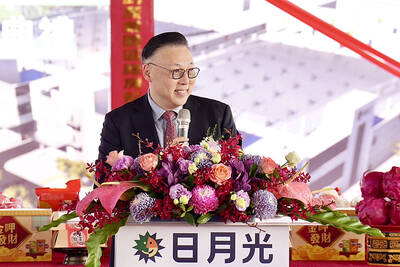
ENERGY ISSUES: The TSIA urged the government to increase natural gas and helium reserves to reduce the impact of the Middle East war on semiconductor supply stability Chip testing and packaging service provider ASE Technology Holding Co (日月光投控) yesterday said it planned to invest more than NT$100 billion (US$3.15 billion) in building a new advanced chip testing facility in Kaohsiung to keep up with customer demand driven by the artificial intelligence (AI) boom. That would be included in the company’s capital expenditure budget next year, ASE said. There is also room to raise this year’s capital spending budget from a record-high US$7 billion estimated three months ago, it added. ASE would have six factories under construction this year, another record-breaking number, ASE chief operating officer Tien Wu

The EU and US are nearing an agreement to coordinate on producing and securing critical minerals, part of a push to break reliance on Chinese supplies. The potential deal would create incentives, such as minimum prices, that could advantage non-Chinese suppliers, according to a draft of an “action plan” seen by Bloomberg. The EU and US would also cooperate on standards, investments and joint projects, as well as coordinate on any supply disruptions by countries like China. The two sides are additionally seeking other “like-minded partners” to join a multicountry accord to help create these new critical mineral supply chains, which feed into

For weeks now, the global tech industry has been waiting for a major artificial intelligence (AI) launch from DeepSeek (深度求索), seen as a benchmark for China’s progress in the fast-moving field. More than a year has passed since the start-up put Chinese AI on the map in early last year with a low-cost chatbot that performed at a similar level to US rivals. However, despite reports and rumors about its imminent release, DeepSeek’s next-generation “V4” model is nowhere in sight. Speculation is also swirling over the geopolitical implications of which computer chips were chosen to train and power the new
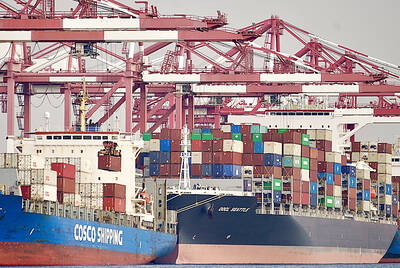
TECH WINNERS: Taiwan and South Korea reported robust trade, which suggests that they have critical advantages in the rapidly expanding AI supply chain, an official said Exports last month surged to a new high, as booming demand tied to artificial intelligence (AI) infrastructure fueled shipments of advanced technology components, underscoring the nation’s pivotal role in the global semiconductor supply chain. Outbound shipments climbed to US$80.18 billion, the highest ever for a single month, rising 61.8 percent from a year earlier and marking the 29th consecutive month of growth, the Ministry of Finance said yesterday. “The surge was driven primarily by global investment in AI infrastructure,” Department of Statistics Director-General Beatrice Tsai (蔡美娜) said. The mass production of next-generation AI computing systems has accelerated procurement across the semiconductor supply


 RSS
RSS