


South Korea’s antitrust regulator slapped a record 1.03 trillion won (US$853 million) fine on Qualcomm Inc for violating antitrust laws, the latest in a string of government actions that threaten the US chipmaker’s most profitable business.
The South Korean Fair Trade Commission (KFTC) said yesterday that the company licensed its key patents only to smartphone makers and did not properly negotiate the terms of its licenses. The agency also said Qualcomm coerced its customers into signing patent license contracts when selling its chips used in phones in the nation and it did not fairly pay for the use of patents held by other smartphone makers.
The decision from the home country of Samsung Electronics Co adds to investor concern that the San Diego-based chipmaker, which is also the subject of investigations in the US and Europe, might struggle to defend its lucrative licensing business.
Qualcomm gets the majority of its profit — US$6.5 billion the past financial year — from selling the right to use technology that is fundamental to all modern phone systems.
Qualcomm, calling the decision “unprecedented and insupportable,” said it would appeal the decision in the South Korean High Court.
The ruling does not go into effect immediately and Qualcomm would seek a stay from the courts while it appeals, Qualcomm general counsel Don Rosenberg said.
“The KFTC ruling will not just benefit local handset makers, but other global chipset makers too, so today’s ruling from the commission seems a bit broader and stronger than that of China last year,” SU Intellectual Property patent lawyer Jung Dong-joon said. “Qualcomm sales accounts for about 20 percent in the [South] Korean market and that’s a significant market for Qualcomm.”
For Samsung, the world’s biggest phone maker, and LG Electronics Inc, the ruling opens up the possibility they might be able to pay lower rates to Qualcomm.
When Qualcomm settled a probe by Chinese regulators last year, it accepted a lower rate charged on phones sold in that nation.
Samsung Electronics is Qualcomm’s second-largest customer, accounting for about 11 percent of its sales, according Bloomberg supply chain analysis.
The US company also designs and sells chips that are the main components in smartphones.
“Qualcomm Inc, a holder of standard-essential patents as well as a monopolistic service provider of modem chips from manufacturing to sales, has violated its agreement to license patents on fair reasonable and non-discriminatory terms, known as FRAND,” the commission said in a statement.
Qualcomm offers the rights to use all of its standard-essential patents, some of which cover the core technology behind modern wireless systems, in a combined package. Some of those inventions are used in industry standards.
Aside from the fine, the commission wants Qualcomm to let chipmakers access its key patents and refrain from imposing unfair conditions on customers when signing contracts.
The agency also said Qualcomm should make standard-essential patents available for separate licensing rather than bundling them with chip sales and the US company should accord greater value to other companies’ patents when accounting for them in cross-licensing agreements.
As in other cases that Qualcomm has won, the company expects the courts to side with it because its licensing business follows industry practices that have been in place for decades, Rosenberg said.
Profits from licensing fees are crucial to funding the firm’s industry-leading research and development efforts and maintaining Qualcomm’s competitive edge, he said.
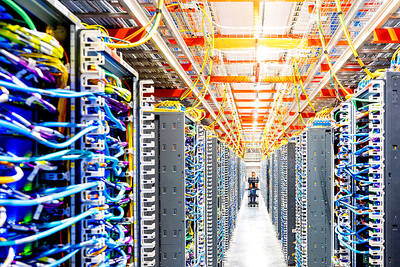
AI SPLURGE: The four major US tech companies have lost more than US$950 billion in value since releasing earnings and outlooks, while equipment makers were gaining Four of the biggest US technology companies together have forecast capital expenditures that would reach about US$650 billion this year — a flood of cash earmarked for new data centers and all the gear within them. The spending planned by Alphabet Inc, Amazon.com Inc, Meta Platforms Inc and Microsoft Corp, all in pursuit of dominance in the still-nascent market for artificial intelligence (AI) tools, is a boom without a parallel this century. Each of the companies’ estimates for this year is expected either near or surpass their budgets for the past three years combined. They would set a high-watermark for capital spending
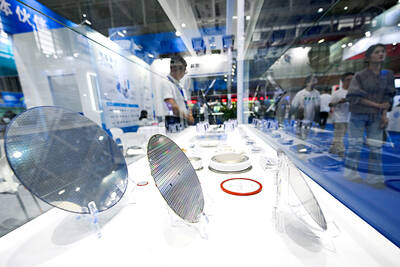
China’s top chipmaker has warned that breakaway spending on artificial intelligence (AI) chips is bringing forward years of future demand, raising the risk that some data centers could sit idle. “Companies would love to build 10 years’ worth of data center capacity within one or two years,” Semiconductor Manufacturing International Corp (SMIC, 中芯) cochief executive officer Zhao Haijun (趙海軍) said yesterday on a call with analysts. “As for what exactly these data centers will do, that hasn’t been fully thought through.” Moody’s Ratings projects that AI-related infrastructure investment would exceed US$3 trillion over the next five years, as developers pour eye-watering sums
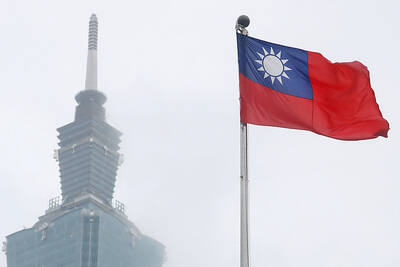
Bank of America Corp nearly doubled its forecast for the nation’s economic growth this year, adding to a slew of upgrades even after a rip-roaring last year propelled by demand for artificial intelligence (AI). The firm lifted its projection to 8 percent from 4.5 percent on “relentless global demand” for the hardware that Taiwanese companies make, according to a note dated yesterday by analysts including Xiaoqing Pi (皮曉青). Taiwan’s GDP expanded 8.63 percent last year, the fastest pace since 2010. The increase “reflects our sustained optimism over Taiwan’s technology driven expansion and is reinforced by several recent developments,” including a more stable currency,

COLLABORATION: Taiwan and the US could jointly find solutions to weaknesses in supply chain resilience for critical materials, focusing on mining and initial refinement Taiwan is likely to purchase rare earths from the US in the future, and is also in talks with Australia and Canada to strengthen global rare earth supply chain security, Minister of Economic Affairs Kung Ming-hsin (龔明鑫) said yesterday. Taiwan and the US last month concluded the sixth Economic Prosperity Partnership Dialogue, during which both sides signed a joint statement endorsing the principles of the Pax Silica Declaration, pledging to deepen cooperation in areas including critical minerals. At the time, Kung said the two sides would establish working groups to advance cooperation in areas including artificial intelligence, digital infrastructure, critical materials and


 RSS
RSS