


Austria is one Europe’s richest countries, yet the hills are alive not with optimism but with worries about the economy, boosting the far-right candidate ahead of Sunday’s presidential election.
For example, at a job center in Vienna’s fifth district, manager Astrid Mayer is busy.
“Things are getting worse every year,” Mayer told reporters. “The figures speak for themselves. I’ve been here for 15 years and I’ve never seen it like this.”
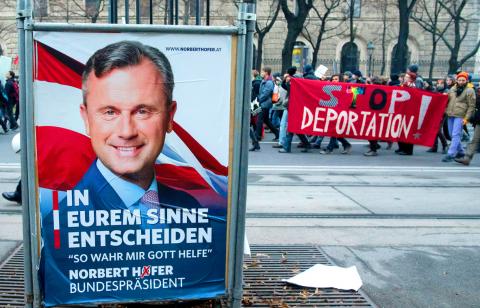
Photo: AFP
When Mayer started, the jobless rate was “three point something,” she said.
Now it is 8.6 percent. Adjusted to compare with the rest of the EU, it is 6.3 percent, no longer the lowest in the bloc.
Doris Blei is one of the lucky ones. The 48-year-old has found a new job after being laid off by her bank.
“Lots of banks are reducing headcount. It’s hard, particularly when you get older,” she told reporters as she lined up.
Even those in work do not necessarily have it easy. About 400,000 people are classified as the “working poor” — in employment but unable to get by.
Austria is on the crossroads between Italy, Germany and the EU’s newer eastern members. Bordering eight countries, it lives off tourism, agriculture and, most importantly, selling goods abroad.
Like Germany, the Alpine nation of 8.7 million people boasts a raft of world-beating exporters. Glock guns, Novomatic gaming machines and energy drink Red Bull are all Austrian, as is motorbike maker KTM.
“Austria is one of the biggest winners of the EU, the euro and EU enlargement,” KTM chief executive officer Stefan Pierer said.
Close to 98 percent of KTM’s products — the firm has an alliance with India’s Bajaj Auto — are exported, half to outside the EU.
However, cracks in the Austrian model are beginning to show. Working hours are too rigid, non-wage labor costs are too high and the bureaucracy is dizzying, Pierer said.
“It’s awful, demoralizing,” he said.
Austria’s competitiveness rankings are far from glowing and investment is mostly just to keep things ticking over, not for the future.
“Out of every 10 euros invested, eight go into renovating existing plants and only two into new projects,” said Franz Schellhorn, of think-tank Agenda Austria.
Austrian Chancellor Christian Kern — who spent 20 years working in industry — said he is aware that life has gottem harder.
However, his promises to jumpstart the unhappy “grand coalition” with the center-right and launch a “New Deal” package of reforms have so far disappointed, critics said.
Nonetheless, Schellhorn said that by international standards, Austrians live well.
Growth has picked up and unemployment fallen this year. The government has cut some taxes.
“People have in fact never had it so good,” Schellhorn told reporters. “But there is a feeling that things are getting worse.”
Just 23 percent of Austrians are optimistic about the future, a recent Imas survey showed.
Like populists elsewhere, the Freedom Party (FPOe) has tapped into this pessimism.
The party portrays itself as being on the side of ordinary Austrian workers against jobs-killing immigration and globalization.
“Austrian jobs should first be for Austrians, not for EU foreigners and definitely not for the many economic migrants,” FPOe Austrian presidential candidate Norbert Hofer said.
The opposition party’s economic policies — slash taxes, splurge on infrastructure — strongly resemble those of US president-elect Donald Trump.
While this might boost growth, like Trump the FPOe is suspicious of trade deals and it is ambivalent about the EU, particularly the free movement of labor.
The message is bearing fruit in the race for the largely ceremonial presidency, with Hofer neck-and-neck in polls with independent candidate Alexander Van der Bellen.
Van der Bellen, a staunchly pro-EU economics professor, also bemoans the lack of reforms.
However, Hofer depicts him as being from the same out-of-touch elite as the government.

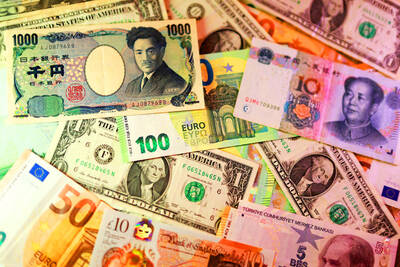
Taiwan’s foreign exchange reserves fell below the US$600 billion mark at the end of last month, with the central bank reporting a total of US$596.89 billion — a decline of US$8.6 billion from February — ending a three-month streak of increases. The central bank attributed the drop to a combination of factors such as outflows by foreign institutional investors, currency fluctuations and its own market interventions. “The large-scale outflows disrupted the balance of supply and demand in the foreign exchange market, prompting the central bank to intervene repeatedly by selling US dollars to stabilize the local currency,” Department of Foreign

Intel Corp is joining Elon Musk’s long-shot effort to develop semiconductors for Tesla Inc, Space Exploration Technologies Corp and xAI, marking a surprising twist in the chipmaker’s comeback bid. Intel would help the Terafab project “refactor” the technology in a chip factory, the company said on Tuesday in a post on X, Musk’s social media platform. That is a stage in the development process that typically helps make chips more powerful or reliable. The chipmaker’s shares jumped 4.2 percent to US$52.91 in New York trading on Tuesday. The Terafab project is a grand plan by Musk to eventually manufacture his own chips for
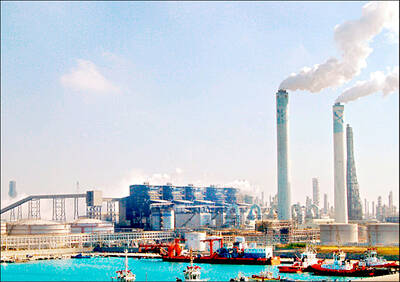
Taiwan Power Co (Taipower, 台電) yesterday said it plans to resume operations at two coal-fired power generators for three months to boost security of electricity supply as liquefied natural gas (LNG) supply risks are running high due to the Middle East conflict. The two coal-fired power generators are at Mailiao Power Plant in Yunlin County’s Mailiao Township (麥寮). The plant, operated by Formosa Plastics Group (台塑集團), supplied electricity to Taipower’s power grid until the end of last year. Taipower’s decision came about one month after Minister of Economic Affairs Kung Ming-hsin (龔明鑫) on March 10 said that the nation had no imminent
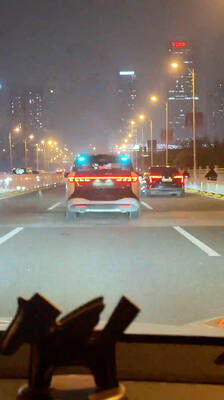
Some robotaxi passengers were left stranded in the middle of fast-moving traffic in a major Chinese city after their driverless vehicles stopped running, according to police and media reports on Wednesday. A preliminary investigation indicates more than 100 robotaxis came to a halt because of a “system malfunction,” police in the city of Wuhan said in a statement, without elaborating. No injuries were reported. One passenger told Chinese media that their robotaxi stopped after turning a corner. An instruction on a screen read: “Driving system malfunction. Staff are expected to arrive in 5 minutes.” After no one showed up, the passenger pushed


 RSS
RSS