


After eight years, the socially responsible luxury brand Suno is shutting its doors.
Suno will not produce its spring 2017 collection, the designer Max Osterweis told Business of Fashion this week. Neither Osterweis nor his design partner, Erin Beatty, was available for further comment.
The news raised questions about the viability of small businesses trying to combine a socially responsible mission with style.
Founded in 2008 by Osterweis, the label from the beginning was committed to practices like training tailors in Kenya, making its first collection from East African kangas and working with small-batch factories in Italy, Romania and South Korea. It expanded after hiring Beatty, who had previously worked as a creative director at Tory Burch and as a product manager at Gap Inc.
Over time, Suno, which is carried by more than 70 retailers including net-a-porter and Neiman Marcus, attracted support from celebrities (Michelle Obama, Beyonce, Taylor Swift and Michelle Williams are fans) and industry players. In 2013, Suno won the CFDA Swarovski Award for womenswear, and in 2014 it was a finalist for the LVMH Young Fashion Designers Prize.
DOWNFALL
However, what made Suno appealing to some may also have been its downfall.
“The product is beautiful, but it was very specific,” said Gary Wassner, the chief executive of Hilldun Corp, which offers loans and credit to designers, and which has offered financial assistance to Beatty and Osterweis for years. “It’s made in Africa, it’s sustainable, they’re very true to their beliefs, and that limited their ability to be competitive price-wise and in scale.”
The label toppled because one of the partners wanted to leave, and the other had been struggling to find a replacement, said Wassner, whose clients have included Alexander Wang and Marc Jacobs. A spokesman for Suno would neither confirm nor deny that that was the case.
Elisa Niemtzow, the director of consumer sectors at BSR, a nonprofit that works with companies like Nike, Levi’s, Kering and H&M on sustainability practices, said that Suno’s closing should not be seen as a failure for socially responsible brands.
There is not one industrywide standard for sustainability and social responsibility, Niemtzow said. Many companies set their own goals. S ome choose to work with factories where employees are offered fair wages and safe conditions. Others focus on developing fabrics that require less water or energy to produce.
The Better Cotton Initiative, for example, brings together more than 50 retailers and 700 suppliers working to set higher environmental and social standards in cotton production. H&M and Levi’s work with an organization called I:CO to collect, reuse and recycle clothing.
Patagonia offers customers the opportunity to have their clothes repaired to prevent excessive waste.
Reformation, a boutique clothing brand, collects information on the environmental impact of each of its garments and shares those findings with potential customers through its Web site.
NOT CHEAP
However, Niemtzow conceded that sustainability and so-called ethical practices do not come cheap.
“We do hear from brands that making more sustainable choices can be more expensive,” she said. “Sometimes the brand has to choose to have lower margins on the products.”
She offered the designer Stella McCartney’s use of faux leather as an example.
“That’s actually a more expensive choice,” she said.
However, she said it can pay off in the long run, adding that McCartney’s brand has been showing double-digit growth in the past few years.
“You’ll have good will and attract a following,” she said.
Steve Swartz, a partner at McKinsey & Co, made a similar point in an e-mail.
“Sustainable and/or ethical fashion is a balancing act between the ability to charge a price premium and the technical expertise to create product with better environmental or social performance without adversely impacting the product’s margin,” he wrote.


Taiwan’s foreign exchange reserves fell below the US$600 billion mark at the end of last month, with the central bank reporting a total of US$596.89 billion — a decline of US$8.6 billion from February — ending a three-month streak of increases. The central bank attributed the drop to a combination of factors such as outflows by foreign institutional investors, currency fluctuations and its own market interventions. “The large-scale outflows disrupted the balance of supply and demand in the foreign exchange market, prompting the central bank to intervene repeatedly by selling US dollars to stabilize the local currency,” Department of Foreign

Intel Corp is joining Elon Musk’s long-shot effort to develop semiconductors for Tesla Inc, Space Exploration Technologies Corp and xAI, marking a surprising twist in the chipmaker’s comeback bid. Intel would help the Terafab project “refactor” the technology in a chip factory, the company said on Tuesday in a post on X, Musk’s social media platform. That is a stage in the development process that typically helps make chips more powerful or reliable. The chipmaker’s shares jumped 4.2 percent to US$52.91 in New York trading on Tuesday. The Terafab project is a grand plan by Musk to eventually manufacture his own chips for
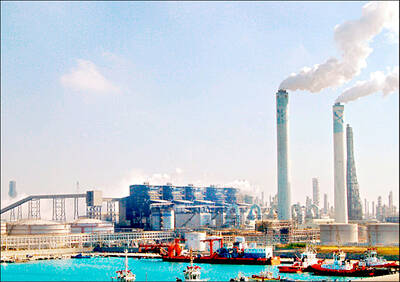
Taiwan Power Co (Taipower, 台電) yesterday said it plans to resume operations at two coal-fired power generators for three months to boost security of electricity supply as liquefied natural gas (LNG) supply risks are running high due to the Middle East conflict. The two coal-fired power generators are at Mailiao Power Plant in Yunlin County’s Mailiao Township (麥寮). The plant, operated by Formosa Plastics Group (台塑集團), supplied electricity to Taipower’s power grid until the end of last year. Taipower’s decision came about one month after Minister of Economic Affairs Kung Ming-hsin (龔明鑫) on March 10 said that the nation had no imminent

Some robotaxi passengers were left stranded in the middle of fast-moving traffic in a major Chinese city after their driverless vehicles stopped running, according to police and media reports on Wednesday. A preliminary investigation indicates more than 100 robotaxis came to a halt because of a “system malfunction,” police in the city of Wuhan said in a statement, without elaborating. No injuries were reported. One passenger told Chinese media that their robotaxi stopped after turning a corner. An instruction on a screen read: “Driving system malfunction. Staff are expected to arrive in 5 minutes.” After no one showed up, the passenger pushed


 RSS
RSS