


Indian Prime Minister Narendra Modi’s move to withdraw higher-value banknotes from circulation is hurting ordinary people rather than making a serious attempt at combating corruption, former US Treasury secretary Lawrence Summers said.
Modi this month announced that 500 and 1000 rupee notes will no longer be legal tender in a bid to crack down on counterfeiting and graft, effectively scrapping more than 85 percent of notes in circulation. It caught people by surprise in an economy where businesses and consumers often transact in hard cash.
Frustrations have boiled over across the nation as ATMs ran out of money and customers waited in long lines to exchange their old notes for new ones, while shopkeepers complained of slower sales.

Photo: AFP
“We strongly suspect that those with the largest amount of ill-gotten gain do not hold their wealth in cash, but instead have long since converted it into foreign exchange, gold, bitcoin or some other store of value,” Summers and coauthor Natasha Sarin wrote in a blog post on his Web site on Monday. “So it is petty fortunes, not the hugest and most problematic ones, that are being targeted.”
Summers said that same argument he has advocated for abolishing large denominations in the US and Europe cannot be made for poorer India.
The 500-rupee note — the equivalent to about US$7.3 — is widely used in the South Asian nation, while the biggest denomination in the US — US$100 bills — are rarely handled by even the richest Americans, according to the blog post.
“The ongoing chaos in India and the resulting loss of trust in government fortify us in this judgement,” Summers wrote.
The authors also questioned the efficacy of the measures.
While the government assesses that the move could expose as much as US$74 billion in unaccounted cash, opinions are mixed about its impact on tax evasion.
“Without new measures to combat corruption, we doubt that this currency reform will have lasting benefits,” Summers and Sarin said. “Corruption will continue albeit with slightly different arrangements.”


Taiwan’s foreign exchange reserves fell below the US$600 billion mark at the end of last month, with the central bank reporting a total of US$596.89 billion — a decline of US$8.6 billion from February — ending a three-month streak of increases. The central bank attributed the drop to a combination of factors such as outflows by foreign institutional investors, currency fluctuations and its own market interventions. “The large-scale outflows disrupted the balance of supply and demand in the foreign exchange market, prompting the central bank to intervene repeatedly by selling US dollars to stabilize the local currency,” Department of Foreign

Intel Corp is joining Elon Musk’s long-shot effort to develop semiconductors for Tesla Inc, Space Exploration Technologies Corp and xAI, marking a surprising twist in the chipmaker’s comeback bid. Intel would help the Terafab project “refactor” the technology in a chip factory, the company said on Tuesday in a post on X, Musk’s social media platform. That is a stage in the development process that typically helps make chips more powerful or reliable. The chipmaker’s shares jumped 4.2 percent to US$52.91 in New York trading on Tuesday. The Terafab project is a grand plan by Musk to eventually manufacture his own chips for
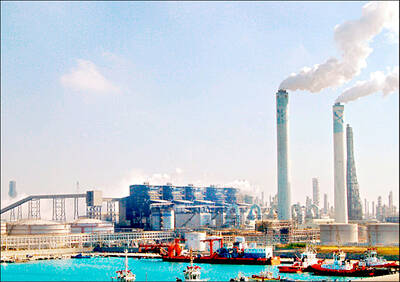
Taiwan Power Co (Taipower, 台電) yesterday said it plans to resume operations at two coal-fired power generators for three months to boost security of electricity supply as liquefied natural gas (LNG) supply risks are running high due to the Middle East conflict. The two coal-fired power generators are at Mailiao Power Plant in Yunlin County’s Mailiao Township (麥寮). The plant, operated by Formosa Plastics Group (台塑集團), supplied electricity to Taipower’s power grid until the end of last year. Taipower’s decision came about one month after Minister of Economic Affairs Kung Ming-hsin (龔明鑫) on March 10 said that the nation had no imminent

Some robotaxi passengers were left stranded in the middle of fast-moving traffic in a major Chinese city after their driverless vehicles stopped running, according to police and media reports on Wednesday. A preliminary investigation indicates more than 100 robotaxis came to a halt because of a “system malfunction,” police in the city of Wuhan said in a statement, without elaborating. No injuries were reported. One passenger told Chinese media that their robotaxi stopped after turning a corner. An instruction on a screen read: “Driving system malfunction. Staff are expected to arrive in 5 minutes.” After no one showed up, the passenger pushed


 RSS
RSS