


Taipei Times: What are Tesla’s plans at the Neihu (內湖) Technology Park?
Robin Ren (任宇翔): Our plan is to turn it into a multipurpose headquarters for Tesla in Taiwan. The Neihu subsidiary will have an education center for people to test drive cars and understand technologies related to electric vehicles. We will also build a service center to serve the owners of Tesla cars in Taiwan.
In addition, Tesla is planning to build an office as a gathering place so that Tesla can invite guests from the government, media and universities to work together.
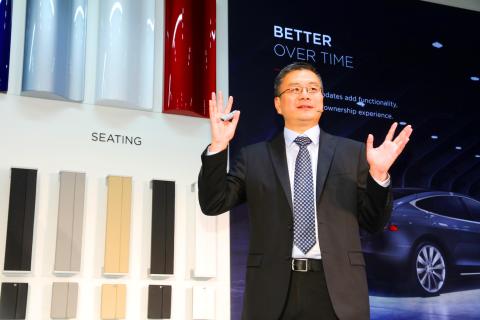
Photo: Courtesy of Tesla Motors Inc
We are currently working with all parties involved and hope to launch the headquarters as soon as possible next year.
We are also considering hiring more local employees at the Neihu headquarters when the construction is completed.
TT: What kinds of charging solutions will Tesla provide to meet Taiwanese customers’ needs?
Ren: Charging is the enabling factor for electric vehicles.
People might not realize that the majority of our customers worldwide charge their cars at home. We think the best place for owners to charge their car is where they charge their phone, which means their home or office.
However, we understand that people move around. We hope to combine home charging solutions with two other solutions for our customers, destination charging stations and superchargers.
Destination charging stations are intended to allow people to charge theirs cars where they spend their leisure time.
We are discussing with different Taiwanese partners about putting destination charging stations in the car parks of shopping malls, office buildings and high-end hotels.
The other option is the supercharger, which enables long-distance travel. For example, people could charge their cars at a supercharger near highways and continue their journeys a short time later.
Given the special geography of Taiwan, I think Tesla does not need to build too many superchargers to cover the entire nation.
We need to be very strategic about the future sites of superchargers, as those stations obviously require more power. It takes the company a longer time and more money to install superchargers.
We are looking at many potential sites for superchargers and hope the first one will be in the metropolitan area of Taipei.
TT: Does Tesla have any plans to collaborate with local governments and companies?
Ren: If you look at different governments across the world, electric vehicle policy plays a very important role in deciding how successful an electric vehicle rollout is.
The key is how the government accelerates the adoption of electric vehicles in the market.
We are watching and lobbying the Taiwanese government not just to put policies in place for Tesla, but to put the right polices in place for the entire electric vehicle industry.
As for collaborations with Taiwanese companies, it is all about building an ecosystem. We are now doing many things with local private industries.
Tesla already has quite a few Taiwanese suppliers. These companies supply auto parts for our global factory in California, where all of Tesla’s cars are made.
We would like to expand our relationship with local suppliers, as there are still lots of opportunities for us to work with more companies from the electronics and software industries.
We will be working with other types of companies when local customers receive their Tesla vehicles, including those in the retail, utility, logistics and financial industries, which will help us provide complete solutions for our customers.
TT: Can you talk more about the company’s long-term goals for Taiwan?
Ren: Tesla started its Taiwanese business in the third quarter of this year, with the first shipments to local customers planned for the first quarter of next year. You can see that Taiwan is still a very new market for the company, but we have high ambitions for the market.
Our global sales target is to ship between 80,000 and 90,000 vehicles this year. We expect to see significant sales growth in the coming year, as Tesla will start to ship the Model 3 in the second half of next year.
TT: What are the key differences between Taiwan and other Asian markets?
Ren: I think Taiwan is special in Asia because it has all the ingredients for success. One thing is that Taiwan has wonderful high-tech companies and many people are excited about new technologies. The new government is also very pro-eco-friendly issues. That makes Taiwan a great potential market for electric vehicles.
In addition, the neighboring markets are doing well for Tesla, such as China and Hong Kong. We might able to apply a lot of lessons we learned from those neighboring markets to Taiwan, which enables Tesla to ramp up in the local market even faster.
TT: Have you had any feedback from Taiwanese customers so far?
Ren: We started to take reservations for vehicles in July this year and received a tremendous response from the potential customer base.
I found that not just elite or businesspeople have shown an interest in Tesla. A lot of families and young couples have visited our showroom in Taipei. Local people are thinking about how electric vehicles could be part of their future.
Also, I have noticed that some customers have imported Tesla vehicles to Taiwan on their own. That is usually a good indicator that there is real demand in the local market.
Once we start delivering vehicles in Taiwan, I think things will pick up very quickly.

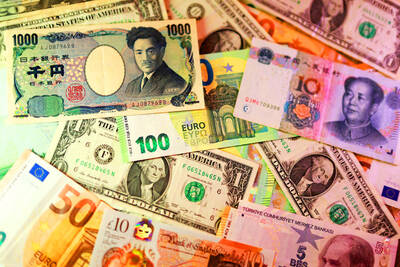
Taiwan’s foreign exchange reserves fell below the US$600 billion mark at the end of last month, with the central bank reporting a total of US$596.89 billion — a decline of US$8.6 billion from February — ending a three-month streak of increases. The central bank attributed the drop to a combination of factors such as outflows by foreign institutional investors, currency fluctuations and its own market interventions. “The large-scale outflows disrupted the balance of supply and demand in the foreign exchange market, prompting the central bank to intervene repeatedly by selling US dollars to stabilize the local currency,” Department of Foreign
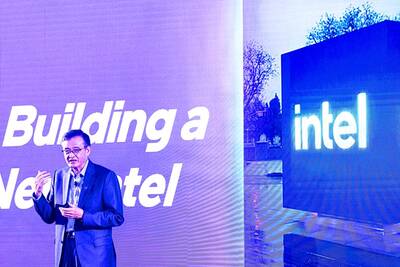
Intel Corp is joining Elon Musk’s long-shot effort to develop semiconductors for Tesla Inc, Space Exploration Technologies Corp and xAI, marking a surprising twist in the chipmaker’s comeback bid. Intel would help the Terafab project “refactor” the technology in a chip factory, the company said on Tuesday in a post on X, Musk’s social media platform. That is a stage in the development process that typically helps make chips more powerful or reliable. The chipmaker’s shares jumped 4.2 percent to US$52.91 in New York trading on Tuesday. The Terafab project is a grand plan by Musk to eventually manufacture his own chips for
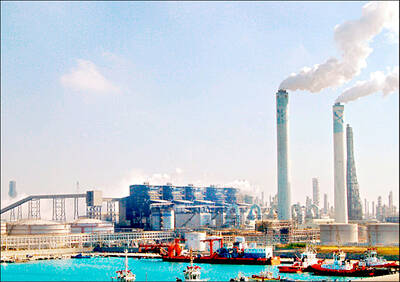
Taiwan Power Co (Taipower, 台電) yesterday said it plans to resume operations at two coal-fired power generators for three months to boost security of electricity supply as liquefied natural gas (LNG) supply risks are running high due to the Middle East conflict. The two coal-fired power generators are at Mailiao Power Plant in Yunlin County’s Mailiao Township (麥寮). The plant, operated by Formosa Plastics Group (台塑集團), supplied electricity to Taipower’s power grid until the end of last year. Taipower’s decision came about one month after Minister of Economic Affairs Kung Ming-hsin (龔明鑫) on March 10 said that the nation had no imminent
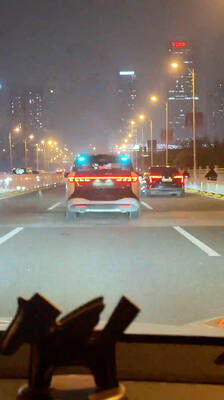
Some robotaxi passengers were left stranded in the middle of fast-moving traffic in a major Chinese city after their driverless vehicles stopped running, according to police and media reports on Wednesday. A preliminary investigation indicates more than 100 robotaxis came to a halt because of a “system malfunction,” police in the city of Wuhan said in a statement, without elaborating. No injuries were reported. One passenger told Chinese media that their robotaxi stopped after turning a corner. An instruction on a screen read: “Driving system malfunction. Staff are expected to arrive in 5 minutes.” After no one showed up, the passenger pushed


 RSS
RSS