


The nation’s investor confidence fell to a record low this quarter, lower than the level during the 2008 global financial crisis, as unease intensified over the economy, cross-strait relations and capital markets, a survey by JPMorgan Asset Management Taiwan Ltd (摩根資產管理) showed.
The investor confidence gauge compiled by the local unit of the US fund house fell to 80.1 this quarter, down 5.7 points from the previous poll conducted in January and lower than the 81.8 points recorded in 2008, as local investors grew pessimistic about the political and economic scene at home, the survey said.
“The findings reflect a bleak sentiment about the economic outlook and cross-strait relations,” JPMorgan Taiwan vice president Alex Chio (邱亮士) said.
The quarterly survey aims to capture how local investors view economic, political and market developments, with scores above 100 points suggesting positive sentiment and below signifying a lack of confidence.
The sub-index on the domestic economy fell by 8.3 points to 71.3 and the gauge on cross-strait relations dropped by 19 points to 72.7, while the confidence reading on the stock market dropped by 10.1 points to 75.4, according to the survey of 1,069 investors between mid-April and early last month.
Concerns over political and market uncertainty should have subsided following the smooth power transition on May 20 and ongoing global fund inflows, with the chance of interest rate hikes by US Federal Reserve dwindling, Chio said.
The TAIEX recovered to 8,715.48 on Wednesday, representing a 4.03 percent increase since the end of April, although market turnover remains light, Taiwan Stock Exchange data showed.
The local stock market was closed on Thursday and yesterday for the Dragon Boat Festival holiday.
While President Tsing Ing-wen (蔡英文) made no mention of the “one China” principle in her inaugural address, she pledged to guard peace across the Taiwan Strait and refrain from provocative moves against China.
Even so, Taiwan’s economy is likely to remain weak, as exports contracted 9.6 percent last month from a year earlier and might decline further in the coming months, the Ministry of Finance said on Monday.
Crude oil and raw material prices have stabilized recently, but the June 23 referendum in the UK on whether to leave the EU is causing jitters, Chio said.
The latest lackluster job data in the US cast a shadow on its growth outlook, but helped calm expectations of interest rate hikes by the Fed later this month, driving hot money to return to emerging markets including Taiwan, JPMorgan said.
Low confidence often corresponds with weak risk appetite, but bold investors tend to reap profits as evidenced in the past, Chio said.
The chance of gains stood at 41 percent for investments in offshore funds, an increase of 15 percentage points from the January poll, the survey said.
CHIP RACE: Three years of overbroad export controls drove foreign competitors to pursue their own AI chips, and ‘cost US taxpayers billions of dollars,’ Nvidia said China has figured out the US strategy for allowing it to buy Nvidia Corp’s H200s and is rejecting the artificial intelligence (AI) chip in favor of domestically developed semiconductors, White House AI adviser David Sacks said, citing news reports. US President Donald Trump on Monday said that he would allow shipments of Nvidia’s H200 chips to China, part of an administration effort backed by Sacks to challenge Chinese tech champions such as Huawei Technologies Co (華為) by bringing US competition to their home market. On Friday, Sacks signaled that he was uncertain about whether that approach would work. “They’re rejecting our chips,” Sacks
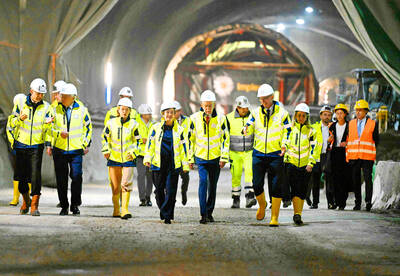
It is challenging to build infrastructure in much of Europe. Constrained budgets and polarized politics tend to undermine long-term projects, forcing officials to react to emergencies rather than plan for the future. Not in Austria. Today, the country is to officially open its Koralmbahn tunnel, the 5.9 billion euro (US$6.9 billion) centerpiece of a groundbreaking new railway that will eventually run from Poland’s Baltic coast to the Adriatic Sea, transforming travel within Austria and positioning the Alpine nation at the forefront of logistics in Europe. “It is Austria’s biggest socio-economic experiment in over a century,” said Eric Kirschner, an economist at Graz-based Joanneum

BUBBLE? Only a handful of companies are seeing rapid revenue growth and higher valuations, and it is not enough to call the AI trend a transformation, an analyst said Artificial intelligence (AI) is entering a more challenging phase next year as companies move beyond experimentation and begin demanding clear financial returns from a technology that has delivered big gains to only a small group of early adopters, PricewaterhouseCoopers (PwC) Taiwan said yesterday. Most organizations have been able to justify AI investments through cost recovery or modest efficiency gains, but few have achieved meaningful revenue growth or long-term competitive advantage, the consultancy said in its 2026 AI Business Predictions report. This growing performance gap is forcing executives to reconsider how AI is deployed across their organizations, it said. “Many companies
Taiwan’s long-term economic competitiveness will hinge not only on national champions like Taiwan Semiconductor Manufacturing Co. (TSMC, 台積電) but also on the widespread adoption of artificial intelligence (AI) and other emerging technologies, a US-based scholar has said. At a lecture in Taipei on Tuesday, Jeffrey Ding, assistant professor of political science at the George Washington University and author of "Technology and the Rise of Great Powers," argued that historical experience shows that general-purpose technologies (GPTs) — such as electricity, computers and now AI — shape long-term economic advantages through their diffusion across the broader economy. "What really matters is not who pioneers


 RSS
RSS