


As China’s richest man, Wang Jianlin (王健林), prepares to delist his main commercial real estate company from Hong Kong, bankers expect more Chinese businesses to head back home, irked by the deep discount for shares listed on the territory’s stock exchange.
Hong Kong has been the most popular location for share listings from Chinese state-owned and private enterprises for three decades, making it the world’s leading destination for initial public offerings (IPOs).
Chinese companies have long been drawn by Hong Kong’s standing as a global financial hub, stable legal regime and large pool of institutional investors, but the downside of those benefits is a much lower share price than they could achieve on mainland bourses.
Over two-thirds of shares listed in both Hong Kong and China trade at a premium of more than 50 percent in the mainland, according to a UBS research report. That gap has substantially widened since 2014, making it less appealing for companies to raise secondary funds in Hong Kong.
The premium arises because of restrictions on capital flows to and from China, which create artificially high demand for local stocks. That demand has risen as alternative investments such as real estate faltered in China’s slowing economy.
At least 10 Chinese companies with Hong Kong listings have unveiled plans to either delist, spin off assets and list them in China or sell a controlling stake to a mainland-listed company since November last year. There were only a handful of such deals in each of 2012, 2013 and 2014.
There were still nearly 30 Chinese companies that listed in Hong Kong over the same period, but those deals were much smaller, and IPO fundraisings fell 18 percent last year.
“Selected Chinese entrepreneurs will be tempted to delist their companies from Hong Kong if the AH premiums continue at these high levels,” said Prashant Bhayani, chief investment officer for Asia at BNP Paribas Wealth Management, which oversees US$64.5 billion in assets.
UBS has identified 38 Hong Kong-listed Chinese companies with similar characteristics to those recently delisted, using criteria such as negative share price performance since listing, a forward price-to-earnings (P/E) multiple below 30 and where founders own more than 40 percent of the companies.
The top 10 companies in the UBS list have a combined market value of about US$40 billion, and eight belong in the property sector, including Country Garden Holdings Co (碧桂園) and Shimao Property Holdings Ltd (世茂房地產控股).
Shimao said it had no plans to delist from Hong Kong and was happy with its current structure, with a Shanghai-listed unit focusing on commercial property, while Country Garden said it studied “everything that can help with the valuation, to create better return for the investors.”
Since Wang’s Dalian Wanda Commercial Properties Co (大連萬達商業地產) announced its plans, China’s No. 2 listed developer, Evergrande Real Estate Group Ltd (恆大地產集團), bought a controlling stake in a smaller, loss-making rival listed in Shenzhen, the main attraction being its lofty valuations and access to China’s capital markets through the mainland listing.
“Property companies, when they go public in Hong Kong, one of the reasons is to be able to do foreign issuance [of bonds], have better credit rating and cheaper financing,” said Ringo Choi (蔡偉榮), Asia-Pacific IPO leader at consulting firm Ernst & Young. “But now, when you look at the bond market in mainland China, it’s getting more and more popular. So if you’re listed in the A share market, it’s very easy to issue bonds also.”
Listing fees remain a big part of Hong Kong Exchanges and Clearing Ltd’s (HKEX) turnover, accounting for a fifth of total revenue, up from a 10th a decade ago.
“How, when and where a company lists are commercial decisions determined by a wide variety of factors, but we are convinced that Hong Kong remains a very competitive listing center with many advantages,” HKEX said in a statement.
HKEX could also have a valuable ally in the China Securities Regulatory Commission, which on Friday said that it was concerned by the huge valuation gap between domestic and overseas stock and speculation on shares in shell companies, which can be used to repatriate overseas-listed companies.
The regulator has only said it is studying the issues, but if it takes action to address the gap or deter such re-listings, that could help avert, or at least delay, any day of reckoning for Hong Kong.
“Hong Kong will face competition from Shanghai and Shenzhen for hosting big Chinese companies, but we are not there yet,” BNP’s Bhayani said.

GROWING OWINGS: While Luxembourg and China swapped the top three spots, the US continued to be the largest exposure for Taiwan for the 41st consecutive quarter The US remained the largest debtor nation to Taiwan’s banking sector for the 41st consecutive quarter at the end of September, after local banks’ exposure to the US market rose more than 2 percent from three months earlier, the central bank said. Exposure to the US increased to US$198.896 billion, up US$4.026 billion, or 2.07 percent, from US$194.87 billion in the previous quarter, data released by the central bank showed on Friday. Of the increase, about US$1.4 billion came from banks’ investments in securitized products and interbank loans in the US, while another US$2.6 billion stemmed from trust assets, including mutual funds,
AI TALENT: No financial details were released about the deal, in which top Groq executives, including its CEO, would join Nvidia to help advance the technology Nvidia Corp has agreed to a licensing deal with artificial intelligence (AI) start-up Groq, furthering its investments in companies connected to the AI boom and gaining the right to add a new type of technology to its products. The world’s largest publicly traded company has paid for the right to use Groq’s technology and is to integrate its chip design into future products. Some of the start-up’s executives are leaving to join Nvidia to help with that effort, the companies said. Groq would continue as an independent company with a new chief executive, it said on Wednesday in a post on its Web
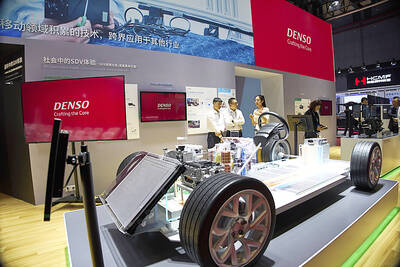
JOINT EFFORTS: MediaTek would partner with Denso to develop custom chips to support the car-part specialist company’s driver-assist systems in an expanding market MediaTek Inc (聯發科), the world’s largest mobile phone chip designer, yesterday said it is working closely with Japan’s Denso Corp to build a custom automotive system-on-chip (SoC) solution tailored for advanced driver-assistance systems and cockpit systems, adding another customer to its new application-specific IC (ASIC) business. This effort merges Denso’s automotive-grade safety expertise and deep vehicle integration with MediaTek’s technologies cultivated through the development of Media- Tek’s Dimensity AX, leveraging efficient, high-performance SoCs and artificial intelligence (AI) capabilities to offer a scalable, production-ready platform for next-generation driver assistance, the company said in a statement yesterday. “Through this collaboration, we are bringing two

Even as the US is embarked on a bitter rivalry with China over the deployment of artificial intelligence (AI), Chinese technology is quietly making inroads into the US market. Despite considerable geopolitical tensions, Chinese open-source AI models are winning over a growing number of programmers and companies in the US. These are different from the closed generative AI models that have become household names — ChatGPT-maker OpenAI or Google’s Gemini — whose inner workings are fiercely protected. In contrast, “open” models offered by many Chinese rivals, from Alibaba (阿里巴巴) to DeepSeek (深度求索), allow programmers to customize parts of the software to suit their


 RSS
RSS