


The US has long been a leader of the free-trade movement around the world, and US President Barack Obama set major trade treaties at the center of his economic initiatives.
Which makes it all the more odd that free trade has become a certified villain among candidates battling to succeed Obama in the White House.
And while it is not uncommon for Democrats to criticize free trade, the candidates of the Republican Party, long a defender of free trade, are falling over each other to demonstrate who is more protectionist.
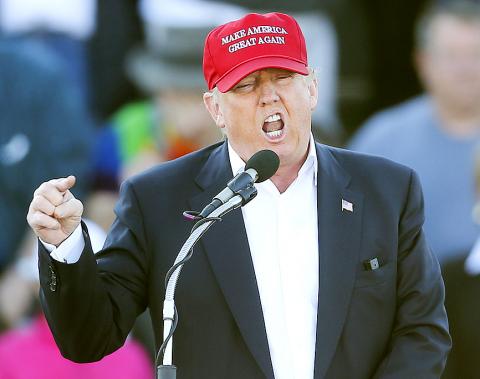
Photo: AP
That has raised questions over whether the next occupant of the White House will pursue ratification of one of Obama’s signal achievements, the Trans-Pacific Partnership trade deal (TPP), and complete negotiations on another, the Transatlantic Trade and Investment Partnership (TTIP).
Democratic frontrunner Hillary Rodham Clinton, who supported the TPP talks as Obama’s secretary of state, now tells voters she does not like the pact.
“I don’t believe it’s going to meet the high bar I have set,” she said.
“We’ve learned a lot about trade agreements in the past years, sometimes they look great on paper,” she said, pointing to the 2012 bilateral trade treaty with South Korea.
“Looking back on it, it doesn’t have the results we thought it would have,” she said.
Socialist rival Bernie Sanders is firmer in his opposition.
He said the TPP would be “disastrous” for US workers and serves only corporate needs in a “race to the bottom.”
Among Republicans, the tone is hardly different.
Donald Trump, the real-estate tycoon leading the pack, said the TPP “is going to lead to nothing but trouble” and has declared he would hit Mexico, China and Japan with high tariffs.
“Let’s slap a 45 percent tariff on Chinese imports,” Trump declared in January.
In a debate on Thursday night, Trump’s main rival, US Senator Ted Cruz, declared: “I opposed TPP, and have always opposed TPP... We’re getting killed in international trade right now.”
Such rhetoric has made US business, which has strongly backed both of Obama’s pacts, nervous.
“We are concerned the prescriptions that have been offered are even worse than the disease,” US Chamber of Commerce senior vice president for international policy John Murphy said. “Trade has been a huge part of the recovery.”
The new tone is deeply at odds with the US history of championing open borders and low tariffs.
In 1994, then-US president Bill Clinton, a Democrat, completed the controversial North American Free Trade Agreement that lowered barriers on trade with Canada and Mexico.
In his wake, Republican US president George W. Bush pushed ahead with a number of bilateral and regional trade pacts.
Obama’s TPP and TTIP pacts are far more ambitious, extending well beyond trade in goods to setting standards for investment and technology.
He called them “agreements for fair and free trade that level the playing field for our workers, open new markets for our businesses.”
“These kinds of agreements reflect the realities of a 21st century economy,” he said last year.
However, US voters do not appear persuaded, and the White House candidates understand that.
“What we are seeing is the consequences of trade policies that for years have never focused on helping Americans adjust to rising global economic competition,” Council on Foreign Relations trade expert Edward Alden said.
Critics point to the downturn in US industry over the past two decades. Since 1994, the number of workers in manufacturing has dropped by 30 percent.
“There were a lot of people left behind by the globalization and they’re showing in this election that they’re upset about it,” he said.
The secretiveness of TPP and TTIP negotiations has also stoked opposition.
“The time when you just negotiated and came to an agreement and people said: ‘Hmmm, that’s fine’ — those times are gone,” European Commissioner for Trade Cecilia Malmstroem said during a visit to Washington. “People want to be involved, they want transparency.”
If the change in tone persists after Obama’s successor moves into the White House in January next year, it could make it much harder for the Europeans to strike a TTIP deal with Washington.
However, Murphy said that the reality of the need to support ever-liberalizing trade rules will quickly come to the next president, as it did Obama.
“We’ve been there before. There’s a long tradition in American politics that the new occupant of the Oval Office often finds that trade is a tool needed for economic prosperity and national interests,” Murphy said.
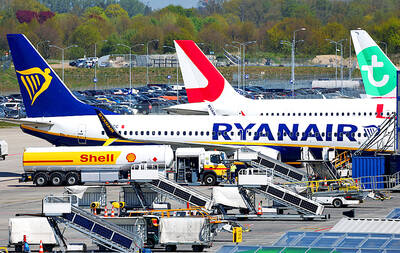
Ryanair, Transavia, Volotea and other low-cost airlines are feeling the financial pain from high jet fuel prices as a result of the Middle East war and are cutting flights. The closure of the Strait of Hormuz has taken a huge chunk of oil supplies off the market, sending the price of jet fuel soaring and triggering fears of shortages that could force airlines to cancel flights. Airlines are not waiting for a lack of supplies to react. “Travel alert: Airlines are cutting thousands of flights right now,” Travel Therapy host Karen Schaler said in an Instagram reel this past weekend.
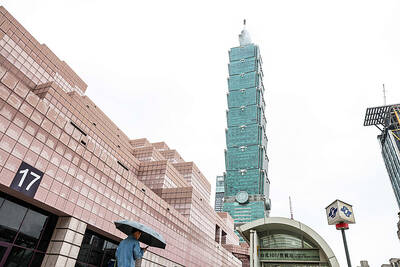
MANAGING RISKS: Taiwan has secured LNG sufficient to cover 95 percent of electricity demand for next month, UBS said, describing the government’s approach as proactive UBS Group AG has raised its forecast for Taiwan’s economic growth this year to 8 percent, up from 6.9 percent previously, and said expansion could reach as high as 8.6 percent if external energy shocks are avoided. The upgrade reflects a stronger-than-expected first-quarter performance and sustained momentum in artificial intelligence (AI)-driven exports, which UBS said are providing a firm foundation for growth despite geopolitical and energy risks. Taiwan’s GDP expanded 13.69 percent year-on-year in the first quarter, the fastest growth since the second quarter of 1987, the Directorate-General of Budget, Accounting and Statistics (DGBAS) reported on Thursday. On a seasonally
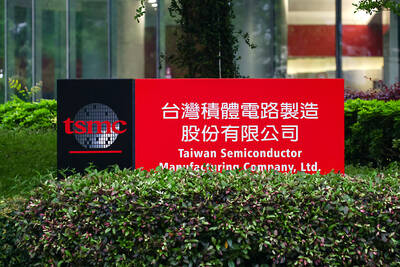
Shares of Taiwan Semiconductor Manufacturing Co (TSMC, 台積電) have repeatedly hit new highs, but an equity analyst said the stock’s valuation remains within a reasonable range and any pullback would likely be technical. The contract chipmaker’s historical price-to-earnings (P/E) ratio has ranged between 20 and 30, Cathay Futures Consultant Co (國泰證期) analyst Tsai Ming-han (蔡明翰) told Central News Agency. With market consensus projecting that TSMC would post earnings per share of about NT$100 (US$3.17) this year, supported by strong global demand for artificial intelligence (AI) applications, and the stock currently trading at a P/E ratio of below 25, Tsai said the valuation
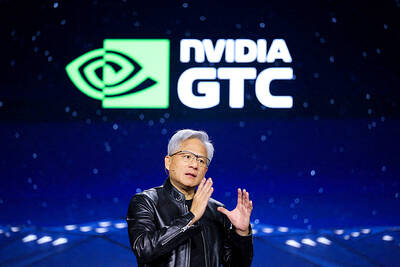
The list of Asian stocks that benefit from business partnership with Nvidia Corp is getting longer, as the region further integrates into the artificial intelligence (AI) chip giant’s business ecosystem. Just in the past week, South Korea’s LG Electronics Inc, Taiwan’s Nanya Technology Corp (南亞科技), as well as China’s Huizhou Desay SV Automotive Co (德賽西威) and Pateo Connect Technology Shanghai Corp (博泰車聯) have become the latest to rally on news of tie-ups, supply-chain participation or product collaboration with the US chip designer. Asian suppliers account for about 90 percent of Nvidia’s production costs, up from about 65 percent last year, data compiled


 RSS
RSS