


After winning the presidency by a landslide yesterday, Democratic Progressive Party (DPP) president-elect Tsai Ing-wen (蔡英文) next has to overcome a tougher challenge — fixing the nation’s anemic economy, worsening income disparities and dimming job opportunities, especially for young people, economists said.
GDP growth averaged 2.5 percent in President Ma Ying-jeou’s (馬英九) second term and looks softer going forward, with the world mired in “the new mediocre” and China entering the “new normal.”
“Tsai must put together a competent team and shift the capital-intensive economy to a one driven by knowledge,” Yuanta-Polaris Research Institute (元大寶華研究院) chairman Liang Kuo-yuan (梁國源) said.

Photo: CNA
The nation’s first-ever female president can take advantage of the four-month transition to boost public confidence by tapping Cabinet officials with innovative visions, Liang said.
The incoming administration must offer measures to boost foreign investment and prevent a brain drain in a bid to restructure the economy to make it less reliant on exports and a few industries, he said.
On the campaign trail, Tsai said that her administration would do whatever it took to improve corporate profits and wages, and she is looking at a new economic model featuring innovation, employment and more equitable distributions of wealth.
The academic-turned-politician has described traditional tax incentives and subsidies as outdated policy tools that benefited a select few, exacerbated the income gap and facilitated talent outflows.
Tsai has underscored the need for corporate reinvention and migration to high-value-added business models, saying the government would help create a friendly environment.
High expectations of change will put tremendous pressure on the president-elect, but disappointing economic data thus far may paradoxically lend a helping hand, Liang said.
The export-oriented economy might start to emerge from the woods in the second half of the year, thanks to the advent of high sales season for local semiconductor companies and a low base of comparison last year, he said.
The nation is in dire need of more companies like Taiwan Semiconductor Manufacturing Co (TSMC, 台積電), which has resisted the allure of cheap labor and low profit margins, but has maintained a global competitive edge through constant innovation, Liang said.
Taiwanese firms also need to actively tap the fledgling market for the Internet of Things and other software applications, as demand for personal computers and related devices has saturated in recent years, explaining why the economy is flagging, given its entrenched focus on electronics.
The government can help diversity by supporting service sectors, as they create more job opportunities at home, Institute of Economic Research (台經院) economist Gordon Sun (孫明德) said, adding that domestic demand accounts for 60 percent of GDP.
Prior to yesterday’s elections, Tsai said a DPP government would seek to build “green” energy research and development centers, national defense industry clusters, a “Silicon Valley” project, biotechnology clusters and “smart” precision industry clusters.
Taiwan has some foundation in those fields and the government would provide cross-sector integration so they can better compete on the international stage, Tsai said, adding that she would also guide funds toward the development of public housing, urban renewal projects, green energy sources and long-term care.
Human capital plays a key role in Tsai’s ambitions and she must act to stop wage stagnation, unaffordable housing and the flight of talent, Sun said.
“The new administration must formulate policies that would allow the public to partake in economic growth and afford a decent quality of living,” Sun said, referring to the ability to save money and buy a house.
A wage hike would gain quick popularity, as a drastic home price correction could incur heavy costs and rattle financial stability, Sun said.
Tsai has scorned minimum-wage protection.
A small and open economy, Taiwan cannot afford to be marginalized on the world stage, but has to court favorable trade terms by seeking membership in the US-led Trans-Pacific Partnership and other trade blocs, National Taipei University professor of public finance Su Jain-rong (蘇建榮) said.
In the meantime, the new government will have to cope with the sustained relocation of manufacturing activity overseas, a trend that has helped elevate GDP growth without real job opportunities, Su said.
Growing competition from China manifests the need for firms to upgrade and differentiate from their Chinese rivals, and migration to Southeast Asia offers no cure except to delay reinvention, Su said.
MANAGING RISKS: Taiwan has secured LNG sufficient to cover 95 percent of electricity demand for next month, UBS said, describing the government’s approach as proactive UBS Group AG has raised its forecast for Taiwan’s economic growth this year to 8 percent, up from 6.9 percent previously, and said expansion could reach as high as 8.6 percent if external energy shocks are avoided. The upgrade reflects a stronger-than-expected first-quarter performance and sustained momentum in artificial intelligence (AI)-driven exports, which UBS said are providing a firm foundation for growth despite geopolitical and energy risks. Taiwan’s GDP expanded 13.69 percent year-on-year in the first quarter, the fastest growth since the second quarter of 1987, the Directorate-General of Budget, Accounting and Statistics (DGBAS) reported on Thursday. On a seasonally

Ryanair, Transavia, Volotea and other low-cost airlines are feeling the financial pain from high jet fuel prices as a result of the Middle East war and are cutting flights. The closure of the Strait of Hormuz has taken a huge chunk of oil supplies off the market, sending the price of jet fuel soaring and triggering fears of shortages that could force airlines to cancel flights. Airlines are not waiting for a lack of supplies to react. “Travel alert: Airlines are cutting thousands of flights right now,” Travel Therapy host Karen Schaler said in an Instagram reel this past weekend.
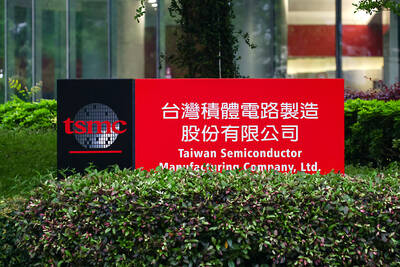
Shares of Taiwan Semiconductor Manufacturing Co (TSMC, 台積電) have repeatedly hit new highs, but an equity analyst said the stock’s valuation remains within a reasonable range and any pullback would likely be technical. The contract chipmaker’s historical price-to-earnings (P/E) ratio has ranged between 20 and 30, Cathay Futures Consultant Co (國泰證期) analyst Tsai Ming-han (蔡明翰) told Central News Agency. With market consensus projecting that TSMC would post earnings per share of about NT$100 (US$3.17) this year, supported by strong global demand for artificial intelligence (AI) applications, and the stock currently trading at a P/E ratio of below 25, Tsai said the valuation

The US Department of Commerce last week ordered multiple chip equipment companies to halt shipments of certain tools to China’s second-largest chipmaker, Hua Hong Semiconductor Ltd (華虹半導體), its latest action to slow the country’s development of advanced chips, two people familiar with the matter said. The department sent letters to at least a handful of companies informing them of restrictions on tools and other materials destined for two Hua Hong facilities US officials believe make China’s most sophisticated chips, the people said. Top US chip equipment companies Lam Research Corp, Applied Materials Inc and KLA Corp, each of which has significant


 RSS
RSS