


CTBC Financial Holding Co (中信金控) expects to add NT$7.04 billion (US$214.6 million) to its annual net income this year after wrapping up the sales of its former headquarters site in Taipei’s Xinyi District (信義).
That will translate into an addition of NT$0.38 earnings per share to CTBC Financial’s net income this year.
The holding company, which owns the nation’s biggest credit card issuer, CTBC Bank (中信銀行), on Friday said that it has sold 95 percent stake in its former headquarters on Songshou Road to a subsidiary of land developer Continental Holdings Corp (欣陸控股) and Green Heaven Investment Ltd BVI (英屬維京群島商子樂開發股份有限公司) for a combined NT$15.12 billion, according to a filing with the Taiwan Stock Exchange.
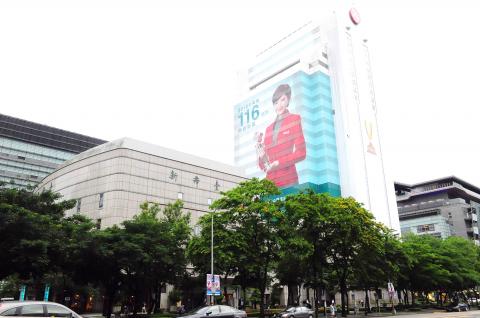
Photo: Chiu Shao-wen, Taipei Times
Green Heaven is a subsidiary set up by foreign private equity firm Riant Capital (子樂投資), while Continental Holding operates real-estate developer Continental Engineering Corp (大陸工程).
The new owners reportedly plan to tear down the two buildings and build a new one.
CTBC Financial said it has reserved a 5 percent stake in the new building so that CTBC Bank Co (中國信託銀行) can continue to operate a branch there. It also said that it retained an option to purchase back the 95 percent stake of the building.
The sale of the site had been delayed since late 2013 after the Taipei City Government declared that part of the site, Novel Hall (新舞台), was a cultural heritage structure.
Concerns about the city’s decision and what it meant for developing the site contributed to the delay, during which time the asking price for the site tumbled from the original estimate of NT$20 billion.
The theater, which is behind CTBC’s headquarters, but connected to it, became the focal point of a preservation drive by prominent artists and cultural experts. The Ministry of Culture also urged its preservation.
At the end of July, CTBC Financial signed an agreement with the Taipei City Government to preserve Novel Hall, paving the way for the sale of the site.
In accordance with that agreement, the site’s new owners have to build a theater with comparable stage space and seating capacity to Novel Hall, which had just under 950 seats, in their new development.
Riant Capital said it plans to develop a NT$10 billion, 45-story complex containing a hotel, retail and office space, and a theater.
The sale still requires the approval of the Ministry of Economic Affairs’ Investment Bureau because the buyers include foreign entities.
In other property news, two high-profile auctions held last month for Shinkong Manhattan World Trade Building and A8 building near the Shin Kong Mitsukoshi Department Store (新光三越百貨) in the Xinyi area failed find a buyer willing to spend more than the respective NT$9 billion and NT$28 billion minimum bid required for the two properties.
Life insurance firms were apparently unwilling to buy the properties because their estimated investment return rates are not likely to exceed the 2.805 percent minimum required by the Financial Supervisory Commission.
Additional reporting by staff writer
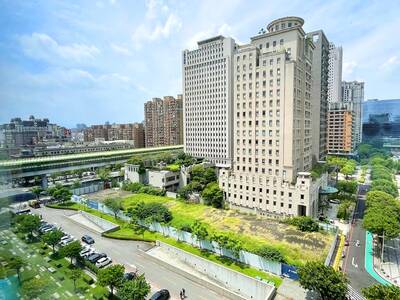
Taichung reported the steepest fall in completed home prices among the six special municipalities in the first quarter of this year, data compiled by Taiwan Realty Co (台灣房屋) showed yesterday. From January through last month, the average transaction price for completed homes in Taichung fell 8 percent from a year earlier to NT$299,000 (US$9,483) per ping (3.3m²), said Taiwan Realty, which compiled the data based on the government’s price registration platform. The decline could be attributed to many home buyers choosing relatively affordable used homes to live in themselves, instead of newly built homes in the city’s prime property market, Taiwan Realty
The government yesterday approved applications by Alphabet Inc’s Google to invest NT$27.08 billion (US$859.98 million) in Taiwan, the Ministry of Economic Affairs said in a statement. The Department of Investment Review approved two investments proposed by Google, with much of the funds to be used for data processing and electronic information supply services, as well as inventory procurement businesses in the semiconductor field, the ministry said. It marks the second consecutive year that Google has applied to increase its investment in Taiwan. Google plans to infuse NT$25.34 billion into Charter Investments Ltd (特許投資顧問) through its Singapore-based subsidiary Fructan Holdings Singapore Pte Ltd, and
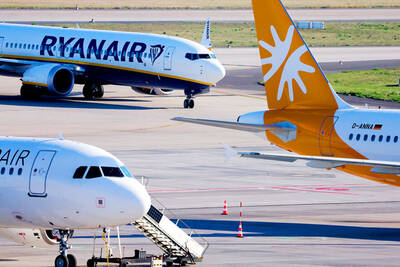
JET JUICE: The war on Iran’s secondary effects have seen fuel prices skyrocket, knocking flight schedules down to earth in return as airlines struggle with costs Airline passengers should brace for more irritation in the next few months as carriers worldwide cancel flights and ground planes to cope with stratospheric increases in jet-fuel prices. Dutch flag carrier KLM is the latest company to cut its schedule, saying on Thursday that it would scrap 80 return flights at Amsterdam’s Schiphol Airport in the coming month. That puts it in the same league as United Airlines Holdings Inc, Deutsche Lufthansa AG and Cathay Pacific Airways Ltd, which have all pruned itineraries to mitigate costs. Global capacity for next month has been reduced by about 3 percentage points, with all
Micron Technology Inc is a driving force pushing the US Congress to pass legislation that would put new export restrictions on equipment its Chinese competitors use to make their chips, according to people familiar with the matter. A US House of Representatives panel yesterday was to vote on the “MATCH Act,” a bill designed to close gaps in restrictions on chipmaking equipment. It would also pressure foreign companies that sell equipment to Chinese chipmaking facilities to align with export curbs on US companies like Lam Research Corp and Applied Materials Inc. The bill targets facilities operated by China’s ChangXin Memory Technologies Inc


 RSS
RSS