


Advanced Semiconductor Engineering Inc (ASE, 日月光半導體), the world’s largest chip packager and tester, yesterday said it expects business to be slow this quarter due to clients’ inventory adjustments and seasonal order cutbacks across the board.
To cope with sagging demand, ASE said it plans to reduce its capital spending by 18.75 percent to about US$650 million this year from the US$800 million it had previously planned.
The company’s utilization rate for chip packaging and testing services is forecast to drop by 4 to 6 percentage points from the previous quarter, ASE chief financial executive officer Joseph Tung (董宏思) told an investors’ conference.
Gross margin for chip packaging and testing services is expected to decline from last quarter’s 26.7 percent to 25.9 percent, Tung said.
“We believe that system-in-a-package [SiP] business will continue to grow in the fourth quarter, but inventory glut is still an issue and needs to be resolved,” Tung told reporters on the sidelines of the conference. “So the fourth quarter will be a slower period than the third quarter.”
The SiP business is expected to contribute as much as 30 percent of ASE’s total revenue this quarter, compared with 22 percent last quarter, Tung said.
For this year as a whole, SiP business is set to account for about 25 percent of ASE’s overall revenue as projected early this year, he said.
Next year, SiP revenues are set to double from this year as a result of broader customer and product portfolios, Tung said.
Apple Inc is one of ASE’s major customers in SiP business.
ASE also reported better-than-expected quarterly net profits for last quarter supported by growth in SiP business, with net income soaring 74 percent to NT$6.37 billion (US$193.9 million) from the second quarter, but declining 12 percent from a year earlier.
Last quarter’s figure surpassed the NT$5.91 billion forecast by Yuanta Securities Investment Consulting Co (元大投顧) due to an increase in non-operating income.
ASE booked NT$1.43 billion in non-operating income last quarter, after posting NT$506 million in non-operating income in the previous quarter.
Looking ahead, Yuanta analyst Andrew Chen (陳治宇) said semiconductor demand is likely to hit the bottom soon, but investors should focus on the big picture: industry consolidation.
"Aside from our expectation that ASE will see double-digit operating profit and net profit year-on-year growth in 2016, we think the likely change in the IC backend industry landscape has been overlooked. For industry leader ASE, we expect horizontal industry consolidation to generate benefits down the road," Chen said in a note.
In September, ASE took a 25-percent stake in Siliconware Precision Industries Co (SPIL, 矽品精密) through a tender offer worth NT$35 billion, becoming the biggest shareholder in its smaller rival.
Daiwa Capital Markets said ASE reported an "upbeat" third-quarter results, however its fourth-quarter outlook appeared "mixed" due to weak electronics manufacturing service business growth.
"But, thanks to its recent purchase of SPIL, which we expect to start contributing to its bottom line from the fourth quarter of 2015," Daiwa analyst Rick Hsu (徐稦成) said in a separate note yesterday.
For this quarter, Daiwa forecast ASE's revenue would still grow better than its rivals with a quarterly increase of 10 percent to NT$80 billion, despite a prolonged inventory correction.
This story has been updated since it was first published.


Taiwan’s foreign exchange reserves fell below the US$600 billion mark at the end of last month, with the central bank reporting a total of US$596.89 billion — a decline of US$8.6 billion from February — ending a three-month streak of increases. The central bank attributed the drop to a combination of factors such as outflows by foreign institutional investors, currency fluctuations and its own market interventions. “The large-scale outflows disrupted the balance of supply and demand in the foreign exchange market, prompting the central bank to intervene repeatedly by selling US dollars to stabilize the local currency,” Department of Foreign

Intel Corp is joining Elon Musk’s long-shot effort to develop semiconductors for Tesla Inc, Space Exploration Technologies Corp and xAI, marking a surprising twist in the chipmaker’s comeback bid. Intel would help the Terafab project “refactor” the technology in a chip factory, the company said on Tuesday in a post on X, Musk’s social media platform. That is a stage in the development process that typically helps make chips more powerful or reliable. The chipmaker’s shares jumped 4.2 percent to US$52.91 in New York trading on Tuesday. The Terafab project is a grand plan by Musk to eventually manufacture his own chips for
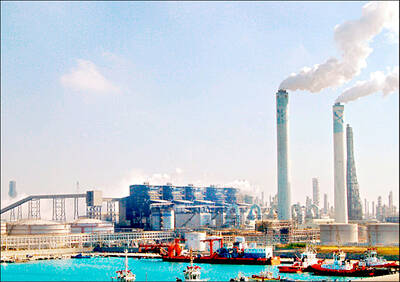
Taiwan Power Co (Taipower, 台電) yesterday said it plans to resume operations at two coal-fired power generators for three months to boost security of electricity supply as liquefied natural gas (LNG) supply risks are running high due to the Middle East conflict. The two coal-fired power generators are at Mailiao Power Plant in Yunlin County’s Mailiao Township (麥寮). The plant, operated by Formosa Plastics Group (台塑集團), supplied electricity to Taipower’s power grid until the end of last year. Taipower’s decision came about one month after Minister of Economic Affairs Kung Ming-hsin (龔明鑫) on March 10 said that the nation had no imminent

Some robotaxi passengers were left stranded in the middle of fast-moving traffic in a major Chinese city after their driverless vehicles stopped running, according to police and media reports on Wednesday. A preliminary investigation indicates more than 100 robotaxis came to a halt because of a “system malfunction,” police in the city of Wuhan said in a statement, without elaborating. No injuries were reported. One passenger told Chinese media that their robotaxi stopped after turning a corner. An instruction on a screen read: “Driving system malfunction. Staff are expected to arrive in 5 minutes.” After no one showed up, the passenger pushed


 RSS
RSS