


Chunghwa Telecom Co (中華電信), the nation’s biggest telecoms operator, aims to increase its revenue by 3 percent annually over the next three years, benefiting from rapidly growing demand for video streaming and enterprise services after launching its high-speed 4G service.
The growth goes against the industry’s trend, as the nation’s telecoms revenues have barely grown over the past five years.
High-speed 4G technology might provide a new growth catalyst for local telecoms operators and be open to more applications.
4G LEADER
Chunghwa Telecom has garnered 2.34 million 4G subscribers since the service debuted in May last year, making the company the nation’s largest 4G service provider.
“We will try every effort to develop new technologies and then make those technologies new sources of our revenue and profit,” chairman Rick Tsai (蔡力行) said during a group interview yesterday.
“I hope Chunghwa Telecom will have sustainable growth. This growth will not be rapid, but I hope to see some results in the next two to three years… Three percent [annual growth] will be our target,” he said.
Tsai also said enterprise business would outpace overall corporate growth, due to growing problems with Internet security, namely hacking.
Years ago, hacking rarely appeared on the agenda of the board’s meetings, he said.
He expects revenue from the company’s corporate customers to contribute a bigger share than the current 30 percent in the foreseeable future.
EYEING PROFITS
Tsai yesterday reiterated his goal of making the company’s 4G business profitable in 2017 after recovering most of the costs from the 4G license fee and network construction next year.
Tsai was tapped as Chunghwa Telecom’s chairman more than a year ago.
Previously, he was chief executive of Taiwan Semiconductor Manufacturing Co (台積電).
To expand the company’s 4G bandwidth, Chunghwa Telecom said it would join the next-round auction of the 2,600-megahertz spectrum in October to cope with fast-growing demand for bandwidth.
Chunghwa Telecom’s 4G users use 8 gigabytes per month on average — double the amount that 3G customers use, it said.
FUTURE PLANS
“If we do not obtain new spectrum, we will be short of bandwidth within two years. That is a worry commonly shared among our rivals,” president Shih Mu-piao (石木標) said.
This year, the company would still focus on expanding its 4G coverage, Shih said.
By the end of this year, Chughwa Telecom plans to add 4,500 new base stations, which would boost the company’s 4G population coverage to 99 percent, he said.
The number of its base stations would expand to 12,000, he said.
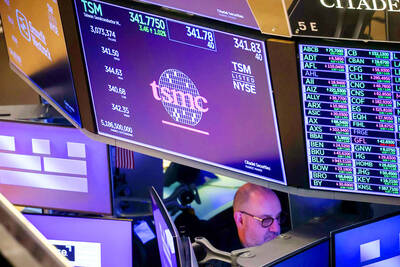
STRONG INTEREST: Analysts have pointed to optimism in TSMC’s growth prospects in the artificial intelligence era as the cause of the rising number of shareholders The number of people holding shares of chipmaker Taiwan Semiconductor Manufacturing Co (TSMC, 台積電) hit a new high last week despite a decline in its stock price, the Taiwan Depository and Clearing Corp (TDCC, 台灣集保) said. The number of TSMC shareholders rose to 2.46 million as of Friday, up 75,536 from a week earlier, TDCC data showed. The stock price fell 1.34 percent during the same week to close at NT$1,840 (US$57.55). The decline in TSMC’s share price resulted from volatility in global tech stocks, driven by rising international crude oil prices as the war against Iran continues. Dealers said
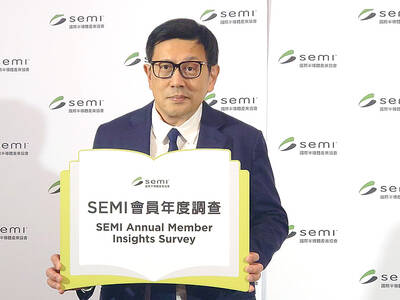
PRICE HIKES: The war in the Middle East would not significantly disrupt supply in the short term, but semiconductor companies are facing price surges for materials Taiwan’s semiconductor companies are not facing imminent supply disruptions of essential chemicals or raw materials due to the war in the Middle East, but surges in material costs loom large, industry association SEMI Taiwan said yesterday. The association’s comments came amid growing concerns that supplies of helium and other key raw materials used in semiconductor production could become a choke point after Qatar shut down its liquefied natural gas (LNG) production and helium output earlier this month due to the conflict. Qatar is the second-largest LNG supplier in the world and accounts for about 33 percent of global helium output. Helium is
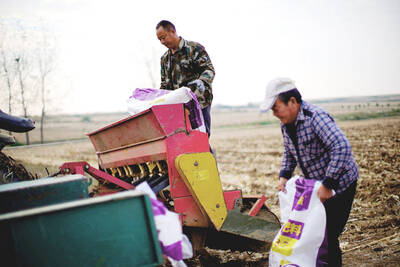
China is clamping down on fertilizer exports to protect its domestic market, industry sources said, putting an additional strain on global markets that were already grappling with shortages caused by the US-Israeli war on Iran. China is among the largest fertilizer exporters — shipping more than US$13 billion of it last year — and it has a history of controlling exports to keep prices low for farmers. Shipments through the war-blocked Strait of Hormuz account for about one-third of the sea-borne supply. This month, Beijing banned exports of nitrogen-potassium fertilizer blends and certain phosphate varieties, sources said. The ban, which has not

AMAZING ABUNDANCE: Elon Musk has announced plans for a new facility in Texas which would manufacture chips for Tesla and SpaceX to use in robotics and AI Elon Musk said his Terafab project — a grand plan to eventually manufacture his own chips for robotics, artificial intelligence (AI) and space data centers — would be built in Austin and jointly run by Tesla Inc and Space Exploration Technologies Corp (SpaceX). Musk, the chief executive officer of the two companies, said he would start off with an “advanced technology fab” in Austin that would have all of the equipment necessary to make chips of any kind. The project would call for one day supporting 1 terawatt (TW) of computing power per year, the amount Musk expects the companies to


 RSS
RSS