


Third-phase water rationing measures are to be postponed for a week in Kaohsiung as the Gaoping River’s (高屏溪) water level is above the low-warning level, the Ministry of Economic Affairs said yesterday.
“If there is sufficient water in the Gaoping River, we should use it instead of letting it flow into the ocean,” Water Resources Agency Chief Secretary Lai Chien-hsin (賴建信) said by telephone.
Lai said that unlike Taoyuan and New Taipei City, which have the Shihmen Reservoir (石門水庫) to store additional water, Kaohsiung relies heavily on the unstable flow of the Gaoping River.
“If we are not using the water when it has sufficient flow, then we are wasting it,” he added.
Lai said that even if the third-phase water rationing measures are implemented in Kaohsiung, the ministry would suspend the measures with immediate effect when the river’s flow rises above 8.1 cubic meters per second.
Given the nature of Kaohsiung’s water supply, the ministry would review and announce water rationing measures on a weekly basis, Lai said.
The third-phase water rationing measures would affect 965,000 people, including 2,959 industrial users, the ministry said.
The Industrial Development Bureau said most of the industrial users accepted the ministry’s decision that it would announce water supply policy on a weekly basis, as the decision suggests that third-phase water rationing measures would not be in force for long stretches of time.
While third-phase water rationing measures have not yet been implemented in Kaohsiung, the government has cut 10 percent from the daily water supply to industrial users.
The ministry said it previously planned to implement third-phase rationing in Kaohsiung on Monday, but it delayed a decision on whether to implement the measures until a meeting on Friday next week.
Separately, state-run oil refiner CPC Corp, Taiwan (CPC, 台灣中油) yesterday said it would cut the wholesale price of liquefied petroleum gas (LPG) and liquefied natural gas (LNG) this month to reflect declining costs due to falling shipping rates and the appreciation of the New Taiwan dollar against the US dollar.
Effective today, prices for household LPG are to drop by NT$0.6 per kilogram and NT$0.4 per liter for LPG used in cars, CPC said in a statement.
After the adjustments, the new price for household LPG is NT$24.96 per kilogram, while the price for a 20kg household gas cylinder is to be cut by NT$12, CPC said.
The wholesale price for LNG is to decline 7.92 percent on average, it said. The new price for household LNG is NT$14.31 per cubic meter.
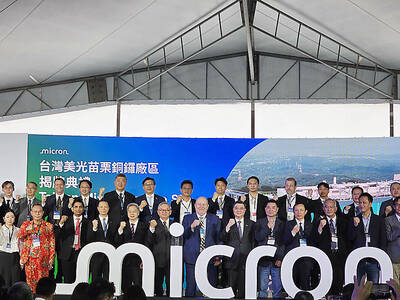
UNPRECEDENTED PACE: Micron Technology has announced plans to expand manufacturing capabilities with the acquisition of a new chip plant in Miaoli Micron Technology Inc unveiled a newly acquired chip plant in Miaoli County yesterday, as the company expands capacity to meet growing demand for advanced DRAM chips, including high-bandwidth memory chips amid the artificial intelligence boom. The plant in Miaoli County’s Tongluo Township (銅鑼), which Micron acquired from Powerchip Semiconductor Manufacturing Corp (力積電) for US$1.8 billion, is expected to make a sizeable capacity contribution to the company from fiscal 2028, the company said in a statement. It would be an extended production site of Micron’s large-scale manufacturing hub in Taichung, the company said. As the global semiconductor industry is racing to reach US$1 trillion
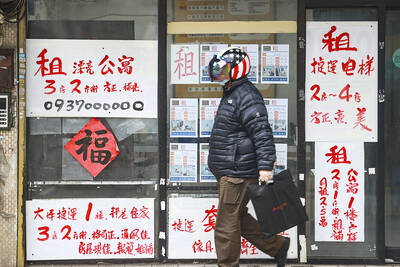
A man walks past real-estate advertisements outside a house in Taipei yesterday. The central bank yesterday said it plans to establish an “Inflation-at-Risk” gauge as a supplementary tool for observing inflation, as policymakers express wish to communicate more effectively with the public when making inflation forecasts.
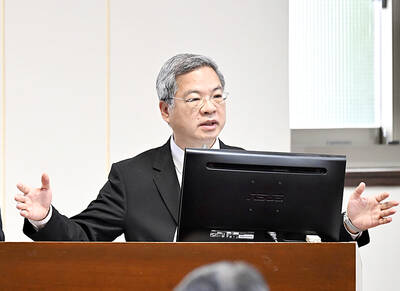
ABOVE LEGAL REQUIREMENT: The Ministry of Economic Affairs is prepared if LNG supply is disrupted, with more than the legal requirement of 11 days of inventory Taiwan has largely secured liquefied natural gas (LNG) supplies through May and arranged about half of June’s supply, Minister of Economic Affairs Kung Ming-hsin (龔明鑫) said yesterday. Since the Middle East conflict began on Feb. 28, Taiwan’s LNG inventories have remained more than 12 days, exceeding the legal requirement of 11 days, indicating no major supply concerns for domestic gas and electricity, Kung said at a meeting of the legislature’s Economics Committee in Taipei. The ministry aims to increase the figure to 14 days by the end of next year, he said. While one or two LNG or crude oil shipments for May

Memory chip stocks extended their losses yesterday after Alphabet Inc’s Google publicized research that could allow more efficient use of the storage needed for artificial intelligence (AI) development. SK Hynix Inc and Samsung Electronics Co, South Korean leaders in the market, fell more than 6 percent and about 5 percent respectively in Seoul. In the US, Micron Technology Inc, Western Digital Corp and Sandisk Corp slid more than 2 percent in pre-market trading, after they all closed lower on Wednesday. Memory companies have been on a tear in recent months as the rapid development of AI infrastructure triggered a spike in chip


 RSS
RSS