


Taiwanese microcontroller and semiconductor companies including Generalplus Technology Inc (凌通) and MediaTek Inc (聯發科) have begun efforts to capture the nascent market for wireless charging, a feature that is becoming increasingly common with wearable devices.
Research institute IHS said that the market for mobile device wireless charging was expected to surge from US$15 million last year to US$480 million by the end of this year, and grow in excess of US$1 billion by 2019.
After the early success of a few pioneers in the niche market, the growing popularity of wearable devices will be marked by the forthcoming release of the Apple Watch on April 24.
Although the high-profile smartwatch from the US technology giant will come equipped with Apple’s proprietary wireless charging solution, industry observers say the feature is expected to see rapid growth as it becomes more mainstream.
Samsung, the world’s second-largest smartphone maker as of the fourth quarter of last year, recently unveiled its Galaxy S6 and S6 Edge flagships, both of which are designed to be compatible with the two major wireless charging platforms, while Huawei Technologies Co (華為), one of the top Chinese mobile device makers, also unveiled a smartwatch product geared for the high-end market.
In addition, IKEA has announced that it would release a series of wireless charging-equipped furniture, with Starbucks Coffee Co pledging to provide wireless charging at more of its branches.
MediaTek announced that its MT3188 chipset recently passed compatibility certification for the BSS 1.2 standard set by the Alliance for Wireless Power (A4WP), the Qi standard established by Wireless Power Consortium (WPC) and the receiver specification 1.0 standard of Power Matters Alliance’s (PMA), and is set to begin mass production.
Aside from MediaTek, power management chipmakers Richtek (立錡) and ENE Technology Inc (迅杰) have also adopted a diversified approach to wireless charging networks by joining both the WPC and A4WP alliances.
Meanwhile, Anpec Electronics Co (茂達) announced that its wireless charging products, based on the WPC standard for tablets and smartphones, is expected to be ready for the market no later than the third quarter of this year.


Taiwan’s foreign exchange reserves fell below the US$600 billion mark at the end of last month, with the central bank reporting a total of US$596.89 billion — a decline of US$8.6 billion from February — ending a three-month streak of increases. The central bank attributed the drop to a combination of factors such as outflows by foreign institutional investors, currency fluctuations and its own market interventions. “The large-scale outflows disrupted the balance of supply and demand in the foreign exchange market, prompting the central bank to intervene repeatedly by selling US dollars to stabilize the local currency,” Department of Foreign

Intel Corp is joining Elon Musk’s long-shot effort to develop semiconductors for Tesla Inc, Space Exploration Technologies Corp and xAI, marking a surprising twist in the chipmaker’s comeback bid. Intel would help the Terafab project “refactor” the technology in a chip factory, the company said on Tuesday in a post on X, Musk’s social media platform. That is a stage in the development process that typically helps make chips more powerful or reliable. The chipmaker’s shares jumped 4.2 percent to US$52.91 in New York trading on Tuesday. The Terafab project is a grand plan by Musk to eventually manufacture his own chips for
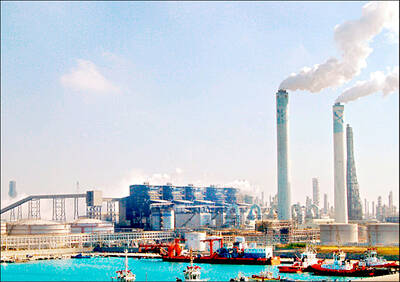
Taiwan Power Co (Taipower, 台電) yesterday said it plans to resume operations at two coal-fired power generators for three months to boost security of electricity supply as liquefied natural gas (LNG) supply risks are running high due to the Middle East conflict. The two coal-fired power generators are at Mailiao Power Plant in Yunlin County’s Mailiao Township (麥寮). The plant, operated by Formosa Plastics Group (台塑集團), supplied electricity to Taipower’s power grid until the end of last year. Taipower’s decision came about one month after Minister of Economic Affairs Kung Ming-hsin (龔明鑫) on March 10 said that the nation had no imminent

Some robotaxi passengers were left stranded in the middle of fast-moving traffic in a major Chinese city after their driverless vehicles stopped running, according to police and media reports on Wednesday. A preliminary investigation indicates more than 100 robotaxis came to a halt because of a “system malfunction,” police in the city of Wuhan said in a statement, without elaborating. No injuries were reported. One passenger told Chinese media that their robotaxi stopped after turning a corner. An instruction on a screen read: “Driving system malfunction. Staff are expected to arrive in 5 minutes.” After no one showed up, the passenger pushed


 RSS
RSS