


Emerging-market stocks fell for an eighth day after Chinese factory and retail sales data indicated that the world’s second-largest economy is slowing further.
China Construction Bank Corp (中國建設銀行) led a gauge of Hong Kong-traded Chinese shares to a five-week low. China Petroleum & Chemical Corp (中國石化) sank 5.5 percent in Hong Kong after the refiner known as Sinopec agreed to sell a 107 billion yuan (US$17.5 billion) stake in its retail unit. India’s rupee dropped to a one-month low as Asian currencies weakened.
The MSCI Emerging Markets Index fell 0.6 percent to 1,055.47 at 12:51pm yesterday, poised for its longest run of losses since the 10 days through Nov. 13 last year.
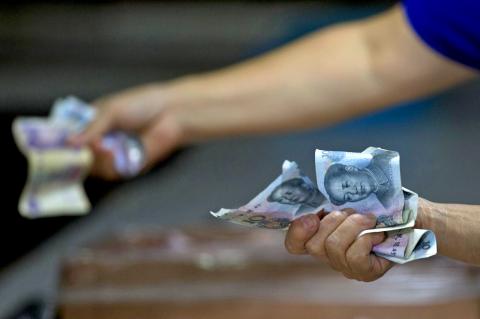
Photo: Bloomberg
Reports on Chinese industrial production, retail sales and asset investment over the weekend all missed estimates, underscoring the risks of a deepening economic slowdown. Some of the factors that have becalmed developed nations are increasing risks for emerging markets, affecting US$1.4 trillion in funds focused on those assets, the Bank for International Settlements said.
“China’s economic slowdown will be a drag on other developing countries because Chinese demand represents a significant portion of exports,” said Porranee Thongyen, head of research at Asia Plus Securities PCL in Bangkok.
The Hang Seng China Enterprises Index of mainland companies listed in Hong Kong slid 1.6 percent. China Construction Bank, the nation’s second-biggest bank by assets, fell 1 percent to a one-week low. China Life Insurance (中國人壽), the country’s biggest insurer, lost 1.5 percent. The Shanghai Composite Index slipped 0.2 percent after closing at an 18-month high on Friday last week.
China’s industrial output last month rose 6.9 percent from a year earlier, the statistics bureau said on Saturday, down from 9 percent in July. That is the slowest pace outside the January-February Lunar New Year holiday period since December 2008, based on previously reported figures compiled by Bloomberg.
Retail sales gained 11.9 percent and fixed-asset investment in the January-August period climbed 16.5 percent, both missing analyst estimates.
The data add to risks that China’s third-quarter economic growth will drop below Chinese Premier Li Keqiang’s (李克強) goal for this year of about 7.5 percent after a measure of new credit released last week trailed estimates and last month’s imports dropped.
Li last week said that the government will not rely on monetary stimulus to spur growth and will stick to targeted policies.
India’s S&P BSE SENSEX dropped 0.8 percent, poised for the sharpest decline in more than a month. The rupee slid 0.6 percent.
The Philippine Stock Exchange Index lost 0.6 percent. Malaysia’s FTSE Bursa Malaysia KLCI retreated 0.5 percent, while South Korea’s KOSPI fell 0.2 percent.
The Indonesian rupiah and Malaysian ringgit weakened 0.7 percent, while the Philippine peso lost 0.4 percent.
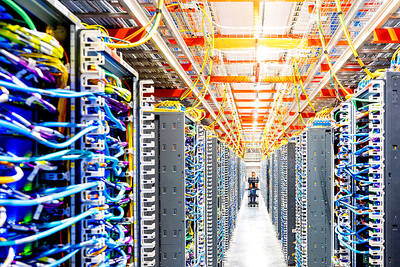
AI SPLURGE: The four major US tech companies have lost more than US$950 billion in value since releasing earnings and outlooks, while equipment makers were gaining Four of the biggest US technology companies together have forecast capital expenditures that would reach about US$650 billion this year — a flood of cash earmarked for new data centers and all the gear within them. The spending planned by Alphabet Inc, Amazon.com Inc, Meta Platforms Inc and Microsoft Corp, all in pursuit of dominance in the still-nascent market for artificial intelligence (AI) tools, is a boom without a parallel this century. Each of the companies’ estimates for this year is expected either near or surpass their budgets for the past three years combined. They would set a high-watermark for capital spending
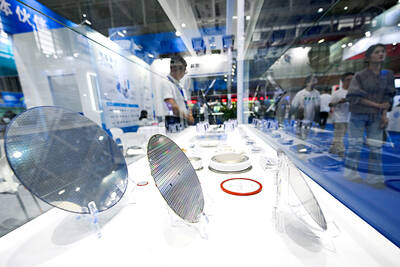
China’s top chipmaker has warned that breakaway spending on artificial intelligence (AI) chips is bringing forward years of future demand, raising the risk that some data centers could sit idle. “Companies would love to build 10 years’ worth of data center capacity within one or two years,” Semiconductor Manufacturing International Corp (SMIC, 中芯) cochief executive officer Zhao Haijun (趙海軍) said yesterday on a call with analysts. “As for what exactly these data centers will do, that hasn’t been fully thought through.” Moody’s Ratings projects that AI-related infrastructure investment would exceed US$3 trillion over the next five years, as developers pour eye-watering sums
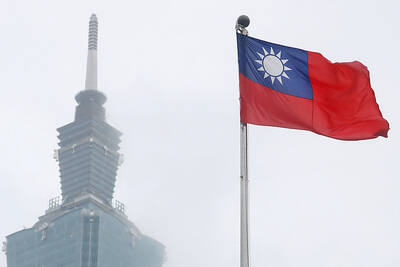
Bank of America Corp nearly doubled its forecast for the nation’s economic growth this year, adding to a slew of upgrades even after a rip-roaring last year propelled by demand for artificial intelligence (AI). The firm lifted its projection to 8 percent from 4.5 percent on “relentless global demand” for the hardware that Taiwanese companies make, according to a note dated yesterday by analysts including Xiaoqing Pi (皮曉青). Taiwan’s GDP expanded 8.63 percent last year, the fastest pace since 2010. The increase “reflects our sustained optimism over Taiwan’s technology driven expansion and is reinforced by several recent developments,” including a more stable currency,

COLLABORATION: Taiwan and the US could jointly find solutions to weaknesses in supply chain resilience for critical materials, focusing on mining and initial refinement Taiwan is likely to purchase rare earths from the US in the future, and is also in talks with Australia and Canada to strengthen global rare earth supply chain security, Minister of Economic Affairs Kung Ming-hsin (龔明鑫) said yesterday. Taiwan and the US last month concluded the sixth Economic Prosperity Partnership Dialogue, during which both sides signed a joint statement endorsing the principles of the Pax Silica Declaration, pledging to deepen cooperation in areas including critical minerals. At the time, Kung said the two sides would establish working groups to advance cooperation in areas including artificial intelligence, digital infrastructure, critical materials and


 RSS
RSS