


When Australian farmer Tony Knight first saw a purple-flowering plant growing across the bushfire-scarred terrain where his sheep grazed, his first thought was that it looked like “good stock feed.”
However, the “pleasant-looking plant” was far from the nutritious food his livestock needed after their paddocks were razed bare by the fires that swept through the northwest region of New South Wales state last year.
Instead, the native weed known as the “Darling pea” contained a toxin that affected the sheep’s nervous systems, killing hundreds by triggering mental and physical deterioration.

Photo: AFP
“To start with, they will do quite well when they first get on to it and their condition will pick up,” Knight said at his farm near the town of Coonabarabran.
“But once it gets them addicted, it’s just a drug — it goes from becoming their best friend to their worst enemy,” he said.
Knight said he had lost almost 100 merino sheep out of an 800-strong flock to the noxious pea in recent months, while his sister-in-law, Louise, who lives on the farm next door, said 800 of her sheep from a total of 14,000 had died after eating the plant.
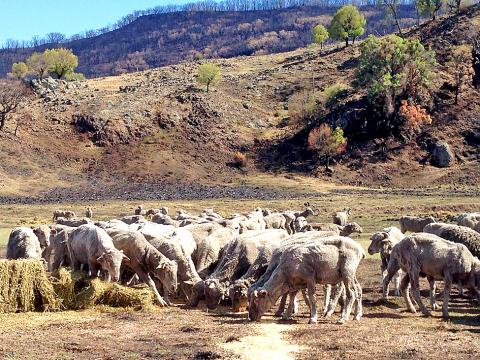
Photo: AFP
A confluence of events enabled the outbreak, with the weed growing in an area where bushfires had wiped out its competition. The destruction of fences during the bushfires, which devastated 54,000 hectares of land, meant it was difficult to rotate the livestock on to non-affected fields as the animals roamed the mountainous terrain, chewing the weed as they went.
Australia’s sheep flock is estimated at 74 million, with about 79 percent of them Merino, bred for their high-quality wool, which is used in top-of-the-range clothing.
Australia is the world’s leading wool producer and exporter, accounting for 24 percent of global production, with annual exports valued at more than A$3 billion (US$2.79 billion). China is its biggest customer.
Knight, whose family has lived on the land beside Warrumbungle National Park for generations, said the affected sheep were easy to spot.
“You will see them in a paddock — usually they are on their own,” Knight said.
“They do a lot of stargazing. They do a lot of trotting around with their heads in the air. The dogs get very confused because [the sheep] don’t behave like they should,” he said.
As the sheep become more affected by the toxin, they lose control of their hind legs.
“They didn’t know which planet they were on. They were all spaced out,” Knight said of several sheep he had to load on a truck during the shearing season as they could not walk.
The Darling pea is mostly perennial, which means it has a life cycle of more than two years. While the weed regularly occurs in small amounts, rain on pastures stripped of their usual covering by droughts or bushfires can encourage it to sprout from its root stocks and infest the area, said Brian Sindel, an expert in weed science at Australia’s University of New England.
Such infestations, which can also affect cows, are uncommon and might occur once every five to 10 years in Australia, usually affecting a small number of livestock. While some sheep can recover from a short period of grazing the pea, those that are too exposed suffer irreversible degenerative changes to their central nervous system.
“Often weeds are the first species that come back after a bushfire as they have higher seed-bank levels. They have more seeds in a dormant state that are awoken,” Sindel said. “With little other feed available, the livestock are more likely to consume large quantities of the weed, which is of course poisonous, containing the alkaloid swainsonine.”
“Some animals appear to develop a liking for the plants and actively select them from the feed available,” Sindel said.
Veterinarian Greg McCann said the toxin attack an enzyme involved in metabolism in the brains of affected animals.
“They lose the ability to judge where their feet are. They become wonky, fall over, appear to be blind, walking into things,” McCann told rural paper the Land.
“They can assume funny postures, like head bent down or head bent back, but the one thing that was seen in the cases associated in the Coonabarabran area were twitching,” he said.
The growth of the weed under trees in bushland over large areas of undulating terrain also made it “impractical or uneconomic” to try eradicating them, Sindel said.
Using weed killers or pestcides to manage the problem is complicated with the pea a native plant and some varieties of it endangered. Permission may be needed from the New South Wales state government under its Native Vegetation Act. Similar acts are also in force elsewhere across Australia.
Knight said so far there appeared to be one solution to weed out most of the pea — by getting the sheep to eat them.
“It’s ironic, but it seems that the best way to control it is with livestock,” he said.
“It’s a perennial plant and if something eats it, it will shoot again. As it shoots, if there is something there to eat those shoots, it won’t take long before they kill a plant,” he said.

The EU and US are nearing an agreement to coordinate on producing and securing critical minerals, part of a push to break reliance on Chinese supplies. The potential deal would create incentives, such as minimum prices, that could advantage non-Chinese suppliers, according to a draft of an “action plan” seen by Bloomberg. The EU and US would also cooperate on standards, investments and joint projects, as well as coordinate on any supply disruptions by countries like China. The two sides are additionally seeking other “like-minded partners” to join a multicountry accord to help create these new critical mineral supply chains, which feed into

For weeks now, the global tech industry has been waiting for a major artificial intelligence (AI) launch from DeepSeek (深度求索), seen as a benchmark for China’s progress in the fast-moving field. More than a year has passed since the start-up put Chinese AI on the map in early last year with a low-cost chatbot that performed at a similar level to US rivals. However, despite reports and rumors about its imminent release, DeepSeek’s next-generation “V4” model is nowhere in sight. Speculation is also swirling over the geopolitical implications of which computer chips were chosen to train and power the new

Elon Musk’s lieutenants have reached out to chip industry suppliers, including Applied Materials Inc, Tokyo Electron Ltd and Lam Research Corp, for his envisioned Terafab, early steps in an audacious and likely arduous attempt to break into the production of cutting-edge chips. Staff working for the joint venture between Tesla Inc and Space Exploration Technologies Corp (SpaceX) have sought price quotes and delivery times for an array of chipmaking gear, people familiar with the matter said. In past weeks, they’ve contacted makers of photomasks, substrates, etchers, depositors, cleaning devices, testers and other tools, according to the people, who asked not to

Japan approved ¥631.5 billion (US$3.97 billion) in additional subsidies to hasten Rapidus Corp’s entry into the high-stakes artificial intelligence (AI) chipmaking arena, ramping up support for a project widely regarded as a long shot. The capital is intended to bankroll Rapidus’ work for information technology firm Fujitsu Ltd, one of the initial customers that Tokyo hopes would get the signature endeavor off the ground. The new money raises the fees and investments that the government is injecting into the start-up to ¥2.6 trillion by the end of the current fiscal year to March next year, the Japanese Ministry of Economy, Trade and


 RSS
RSS