


The US central bank is probably going to end its massive bond-buying program this fall and could start raising interest rates around six months later, US Federal Reserve Chair Janet Yellen said on Wednesday, in a comment which sent stocks and bonds tumbling.
The Dow Jones Industrial Average fell 114.02 points, or 0.7 percent, to 16,222.17, the S&P 500 lost 11.48 points, or 0.61 percent, to 1,860.77, and the NASDAQ Composite dropped 25.711 points, or 0.59 percent, to 4,307.602.
In Asia trading yesterday, Tokyo dropped 1.65 percent, or 238.29 points, to 14,224.23, Sydney gave up 1.15 percent, or 61.6 points, to 5,294 and Seoul fell 0.94 percent, or 18.16 points, to close at 1,919.52.
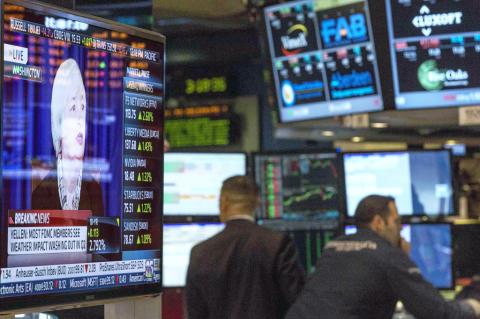
Photo: Reuters
Shanghai closed 1.4 percent lower, giving up 28.26 points to 1993.48, while Taipei closed 1.06 percent, or 92.13 points, lower at 8,597.33.
Yellen’s remarks at her first press conference as the head of the central bank pointed to a more aggressive path toward higher interest rates than many had anticipated and bets in financial markets shifted accordingly.
The comments came after a two-day meeting in which Fed officials made another reduction in their bond-buying stimulus and decided to jettison a set of guideposts they were using to help the public anticipate when they would finally raise interest rates.
The Fed said the change in its rate increase guidance did not mark a shift in its intentions and that it would wait a “considerable time” after shuttering its asset-purchase program before pushing borrowing costs higher.
Yellen, who had fielded numerous questions without a hitch, hesitated when asked what the Fed meant by “considerable.”
“I, I, you know, this is the kind of term it’s hard to define, but, you know, it probably means something on the order of around six months or that type of thing, but, you know, it depends — what the statement is saying is it depends what conditions are like,” Yellen said.
Several analysts wondered whether her answer was an unintended slip, given the deliberately vague language of the Fed’s statement.
“The forecast change could be interpreted as a relatively hawkish shift... and as such the general market reaction seems well-founded,” JPMorgan economist Michael Feroli said.
However, most top Wall Street economists continued to see the first rate increase in the second half of next year, according to a poll.
Yellen sought to use her press conference to emphasize that rates would stay low for a while and rise only gradually. She also said they could end up staying lower than normal “for some time,” even after the unemployment rate drops to a healthy level.
The Fed would look not only at how close inflation and unemployment are to its goals, but how fast, or slowly, those measures are approaching those goals, she said.
At 6.7 percent, the unemployment rate is well above the 5.2 percent to 5.6 percent range Fed officials see as in keeping with full employment. The central bank’s favored inflation gauge is barely more than half of its 2 percent target.
The Fed has held interest rates near zero since late 2008 and has pumped more than US$3 trillion into the economy with its bond purchases to try to foster a stronger recovery.
Of the Federal Reserve’s 16 policymakers, only one believes it will be appropriate to raise interest rates this year, 13 expect a first rate increase next year and two others see the first rate increase coming in 2016, according to the new forecasts.
However, once rate increases start, Fed officials see slightly sharper increases than they did in December last year, when they last issued forecasts. They now see rates ending 2016 at 2.25 percent, a half percentage point above their previous projections.
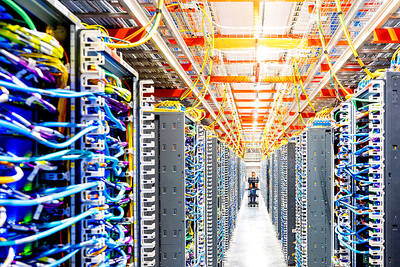
AI SPLURGE: The four major US tech companies have lost more than US$950 billion in value since releasing earnings and outlooks, while equipment makers were gaining Four of the biggest US technology companies together have forecast capital expenditures that would reach about US$650 billion this year — a flood of cash earmarked for new data centers and all the gear within them. The spending planned by Alphabet Inc, Amazon.com Inc, Meta Platforms Inc and Microsoft Corp, all in pursuit of dominance in the still-nascent market for artificial intelligence (AI) tools, is a boom without a parallel this century. Each of the companies’ estimates for this year is expected either near or surpass their budgets for the past three years combined. They would set a high-watermark for capital spending

China’s top chipmaker has warned that breakaway spending on artificial intelligence (AI) chips is bringing forward years of future demand, raising the risk that some data centers could sit idle. “Companies would love to build 10 years’ worth of data center capacity within one or two years,” Semiconductor Manufacturing International Corp (SMIC, 中芯) cochief executive officer Zhao Haijun (趙海軍) said yesterday on a call with analysts. “As for what exactly these data centers will do, that hasn’t been fully thought through.” Moody’s Ratings projects that AI-related infrastructure investment would exceed US$3 trillion over the next five years, as developers pour eye-watering sums

Bank of America Corp nearly doubled its forecast for the nation’s economic growth this year, adding to a slew of upgrades even after a rip-roaring last year propelled by demand for artificial intelligence (AI). The firm lifted its projection to 8 percent from 4.5 percent on “relentless global demand” for the hardware that Taiwanese companies make, according to a note dated yesterday by analysts including Xiaoqing Pi (皮曉青). Taiwan’s GDP expanded 8.63 percent last year, the fastest pace since 2010. The increase “reflects our sustained optimism over Taiwan’s technology driven expansion and is reinforced by several recent developments,” including a more stable currency,

COLLABORATION: Taiwan and the US could jointly find solutions to weaknesses in supply chain resilience for critical materials, focusing on mining and initial refinement Taiwan is likely to purchase rare earths from the US in the future, and is also in talks with Australia and Canada to strengthen global rare earth supply chain security, Minister of Economic Affairs Kung Ming-hsin (龔明鑫) said yesterday. Taiwan and the US last month concluded the sixth Economic Prosperity Partnership Dialogue, during which both sides signed a joint statement endorsing the principles of the Pax Silica Declaration, pledging to deepen cooperation in areas including critical minerals. At the time, Kung said the two sides would establish working groups to advance cooperation in areas including artificial intelligence, digital infrastructure, critical materials and


 RSS
RSS