

With cars that park themselves, radar-guided safety sensors and infotainment systems with Web access, automakers are competing for customers who now expect constant innovation.
The speed at which the new features are migrating from premium models downward and spreading among brands is accelerating as automakers jostle for attention in an increasingly crowded market.
“The hottest new technology in cars today is voice-to-text functionality that reads a driver’s e-mails or texts as they come in and allows the driver to dictate a response without looking away from the road,” Kelley Blue Book senior analyst Karl Brauer said.
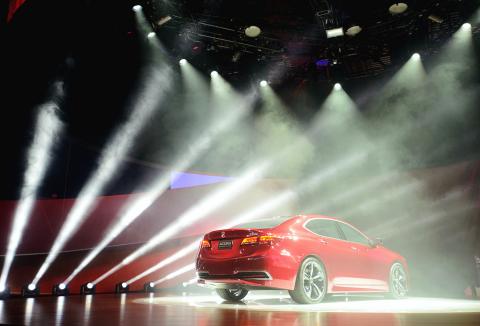
Photo: Bloomberg
Automakers have aligned themselves with tech giants to lure customers with increasingly complex — but hopefully still intuitive — systems to transform their consoles into souped-up smartphones.
Navigation has been upgraded to integrate online consumer reviews from Web sites and guide motorists to roadside businesses.
Touch screens reminiscent of Apple Inc’s iPad have been added to consoles outfitted with apps like Pandora music streaming.
Then there are the proprietary apps aimed at fixing life’s little problems.
Touch a button on a phone and a lost car will pop up on a map. Still cannot find it in the parking lot? Tap again and the phone will honk the car’s horn. Locked the keys inside? Another button opens the door.
If a parent is worried that their teenager is driving too fast or hanging out with the wrong crowd, there is an app that will send them a text message if the driver surpass a chosen speed or leave a designated area.
The real challenge for automakers is to make sure all of this technology does not become a dangerous distraction, said Art St Cyr, head of product planning at American Honda Motor Co.
Keeping it out of the car simply is not possible, people are too attached to their smartphones and “don’t want to be disconnected,” he said.
“The key is to reduce the cognitive load,” St Cyr told reporters on the sidelines of the North American International Auto Show in Detroit, Michigan.
Voice activation certainly helps, but automakers have also invested in developing safety systems that can compensate for distracted or sleepy drivers.
Initially available only in luxury cars and then premium models, complex collision-avoidance technology is being introduced to the mass market.
Chrysler Group LLC is decking out a new mid-sized 200 sedan unveiled in Detroit on Monday with an entry price of just US$21,700 with a full spectrum of safety features previously only available in pricier models.
Video cameras mounted onto the windshield detect lines in the road to warn drivers if they are straying out of a lane and electrical steering wheels will even kick the car back into position.
Radars mounted under the grill can see through fog to measure the distance to the nearest vehicle, register a change in speed and slow down or stop the car if a driver does not notice looming brake lights.
Also, a blind spot monitor will sound an alert if a driver misses a blinking light in the side view mirror and flips the turn signal.
Rear view cameras are becoming standard features even on entry-level models like Honda’s new compact Fit, while Kia Motors Corp is stepping up the game by adding front and side views to the K900 which was unveiled in Detroit.
Plenty of premium models are helping drivers with pesky parking problems by measuring distances and controlling the steering wheel for the perfect parallel — or even perpendicular — parking job.
BMW AG takes it a step further in its new electric i3 model, which hits showrooms in a few months. Not only does it help to search for parking spots big enough to squeeze into, it will then completely take over the job by controlling the steering, braking and acceleration.
Automakers are also competing with simpler features like a vacuum cleaner in Honda’s top-selling Odyssey minivan, a sensor that will pop the trunk of a Mercedes, Ford or Cadillac when your hands are full, and “EZ-lift” tailgates on the new GMC pickup.
However, the biggest innovations are under the hood, said Bob Carter, head of automotive operations at Toyota Motor Sales USA.
Complex hybrid engines have become commonplace and people are even getting used to seeing purely electric cars like Nissan Motor Co Ltd’s Leaf on the road.
The holy grail of “green” cars — hydrogen fuel-cell engines that emit nothing but water vapor — is already on the road in test markets and will be hitting Toyota showrooms next year. Rivals Ford Motro Co, Honda, BMW, Daimler AG and the Renault-Nissan Alliance will not be far behind.
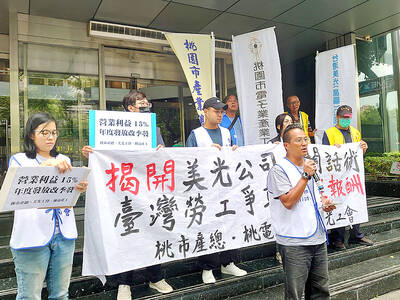
UNION DETERMINATION: Rejecting an offer for a one-time payout as an attempt to influence opinion, the union said a strike at the memory chip manufacturer is possible The Micron Taiwan workers’ union yesterday rejected a one-time payout unveiled by US-based Micron Technology Inc last week, saying it wants a long-term mechanism under which employees would share 15 percent of the company’s operating profits. While the union and the company are still in talks over the dispute, the reward package was proposed unilaterally by the employer without reaching an agreement with the union, union head Jerry Lin (林哲瑞) told reporters. Lin said he suspected the company was seeking to influence public opinion with the move. On Friday last week, Micron announced a reward package under which employees in Taiwan would receive
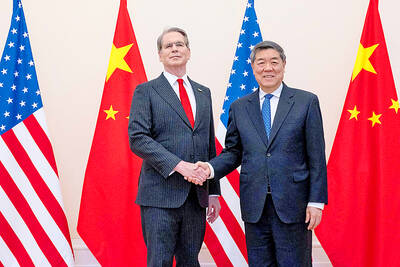
MINIMAL EXPECTATIONS: Analysts think that the two sides are likely to aim for ‘status quo’-level agreements, maintaining civility, without major trade breakthroughs US Secretary of the Treasury Scott Bessent and Chinese Vice Premier He Lifeng (何立峰) were set to meet yesterday to try to set up potential agreements on artificial intelligence (AI), tariffs and critical minerals for a summit in Washington this week between US President Donald Trump and Chinese President Xi Jinping (習近平). The meetings at JPMorgan Chase & Co’s headquarters in Manhattan, which included US Trade Representative Jamieson Greer, were due to start at about 10:30am on Sunday morning and were expected to run all day. Key topics would be the status of a US-China trade truce that is set to expire

BUILDER’s RITES: The topping out ceremony is held when a project being built has its highest point laid out, a sure sign that TSMC’s European project is making solid progress A “topping out” ceremony was held on Monday at a plant under construction in Germany by Taiwan Semiconductor Manufacturing Co (TSMC, 台積電), indicating that the fab is progressing as planned and within budget, the head of a joint-venture company in charge of the project said. A topping out ceremony is the construction milestone of laying the final beam or structural piece at the highest point of a building, and it honors the construction crew, architects and engineers. European Semiconductor Manufacturing Co (ESMC) president Christian Koitzsch said that about 2,000 workers from 106 countries are working around the clock at the site in
APPEAL: Any agreement to produce advanced memory such as HBM or DRAM could run into opposition from Seoul as those technologies are sensitive, sources said South Korea’s SK Hynix Inc is in talks with Intel Corp about a deal that would see it manufacture memory chips on US soil for the first time, three people familiar with the discussions said. Under one potential scenario, SK Hynix would lease part of Intel’s long-planned chipmaking facility in Ohio, they said. Under another scenario, it could form a venture with Intel and major cloud firms that are keen to lock in memory supplies, two of the people said. A deal would relieve pressure on Intel, which has been struggling, and mark a big win for US President Donald


 RSS
RSS