

Japan neglected carrying out safety checks on at least 40 percent of nuclear reactor parts exported over a decade, a report said yesterday, in the latest controversy to strike its troubled nuclear industry.
Nuclear reactor parts — including pressure vessels which contain the fuel in power plants — worth about ¥51.1 billion (US$520 million) were shipped to 17 countries, including Taiwan, without undergoing safety checks, the Mainichi Shimbun reported.
Britain, Germany, Australia, Russia and Italy were among the countries that took delivery of the potentially unsafe equipment, the daily said, citing manufacturers and an industrial body among its sources.
Japan exported nuclear reactor parts worth ¥124.8 billion to more than 20 countries from 2003 to last year, the Mainichi Shimbun said, citing official trade figures.
However, safety checks, entailing simple examinations of documents, were only required for exports tied to loans from the state-run Japan Bank for International Cooperation or guarantees by the public agency Nippon Export and Investment Insurance, the daily said.
The unchecked parts included reactor pressure vessels shipped to Taiwan in 2004 and control rod drives, which regulate the rate of nuclear fission, supplied to Sweden and Brazil, Mainichi said.
The rest of the exports are thought to have undergone government safety checks before being shipped to China, France, Belgium, Finland and the US, the daily said, citing the country’s Agency for Natural Resources and Energy.
However, much of the data disclosed by the agency was blacked out, raising the possibility that those exports may too have been shipped without being checked, Mainichi said.
Safety has been a huge concern for Japan’s nuclear industry since a massive earthquake and tsunami ravaged the country’s northeast coast and triggered a meltdown at the Fukushima Dai-ichi nuclear power plant in March 2011.
The country has continued overseas sales of nuclear reactor technology, with Japanese Prime Minister Shinzo Abe assuring buyers the industry is among the world’s safest.
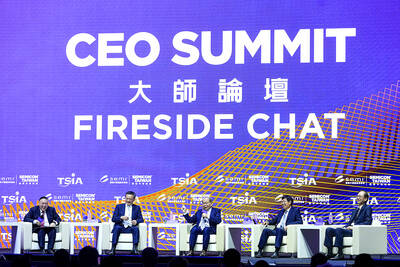
Taiwan Semiconductor Manufacturing Co (TSMC, 台積電) is accelerating capacity expansion fivefold this year, but it is still unable to keep up with the booming demand for artificial intelligence (AI), TSMC deputy cochief operating officer Cliff Hou (侯永清) said yesterday. This year alone, the company is building 25 chip manufacturing fabs and advanced packaging facilities worldwide, including 13 plants in Taiwan, which is unprecedented, Hou said at a CEO Summit fireside chat at Semicon Taiwan in Taipei. In the past, the company was able to build five or six factories a year, said Hou, who is also chairman of the Taiwan Semiconductor Industry
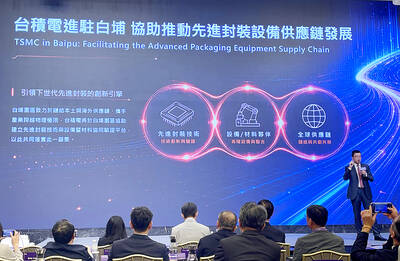
EXPANSION: The 3-hectare site would include small clean rooms and laboratories as well as a world-class training base for advanced packaging talent, the company said Taiwan Semiconductor Manufacturing Co (TSMC, 台積電) is to establish a presence in the Baipu Industrial Park (白埔產業園區) in Kaohsiung to accelerate the testing and validation of semiconductor materials and equipment, a company executive said on Tuesday. The company is working with the Ministry of Economic Affairs and the Kaohsiung City Government on the plan, which is expected to improve validation efficiency by 25 to 50 percent, TSMC vice president of advanced packaging technology and service Jun He (何軍) said at a 3D IC global summit held ahead of the Semicon Taiwan trade show, which opened in Taipei yesterday. TSMC would also conduct
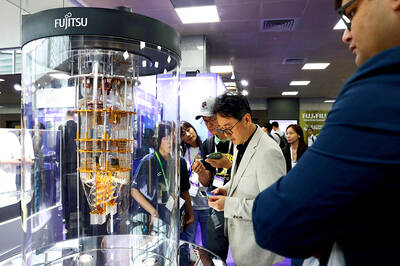
Visitors look at a 64-qubit superconducting quantum computer on display at the Fujitsu booth at the Semicon Taiwan trade show in Taipei yesterday.

Silicon photonics would play a dominant role next year and make chip-level co-packaged optics (CPO) packaging possible, Taiwan Semiconductor Manufacturing Co (TSMC, 台積電) said yesterday. “For years, critics questioned the reliability of CPO. The doubts are being thoroughly dismantled by real-world data and market validation,” TSMC vice president of advanced packaging technology development K.C. Hsu (徐國晉) said at a SEMI forum in Taipei. The company is on track to enter production of CPO later this year, Hsu said in another forum arranged by Imec in Taipei yesterday, about four months after TSMC announced its progress in CPO development in May.


 RSS
RSS