


After a long drive from across the border in China, the white truck arrived in Nepal’s capital at dawn with a seemingly innocuous cargo of Chinese-made clothes. However, hidden in a cylinder inside the vehicle’s front bumper was the latest haul of gold smuggled from Tibet — bars weighing about 35kg and worth millions of US dollars on the black market.
Nepal’s police were waiting for the truck and its 24-year-old driver just inside the city, after tracking them for several days along the highway that connects Nepal with China.
“We had been informed from our reliable source that a consignment of gold was on its way from Khasa [a border town in Tibet],” said Uttam Kumar Karkee, a senior superintendent who led the operation in July.
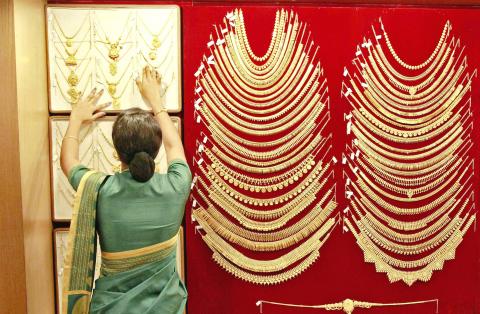
Photo: Reuters
Nepal’s police and inland revenue department say the illegal shipment was ultimately destined for neighboring India, where seizures of smuggled gold, including from its closest neighbors, have reportedly soared this year.
The seizures in India coincide with the government’s campaign in recent months to deter legal imports of the precious metal — including by raising import duties.
Under pressure over a faltering economy, the government is trying to break the country’s obsession with gold. Imported in vast quantities, it is partly blamed for blowing out the current account deficit and pushing down the rupee to record lows.
In Nepal, police have seized far more illegal shipments bound for India this year compared with last year. Its organized crime unit cannot say whether Indian consumers and traders are turning to the cross-border black market as a direct result of efforts to discourage legal imports.
However, making it harder and more expensive to import gold certainly presents smugglers with opportunities.
“There is a growing demand for gold in India. So the smugglers are cashing in on that,” department’s deputy director-general Anand Raj Dhakal said.
A total of 69kg of smuggled gold was seized in Nepal in the past six months, most of it from Tibet, compared with 18kg for the whole of last year.
However, that is only the tip of the iceberg, says Nepal Police spokesman Nawaraj Silwal, who estimates only 10 percent of all smuggled gold is confiscated.
The seizure in July, which led to the arrest of several Kathmandu businessmen, came hot on the heels of another police bust in the middle of May. Four men were arrested on Kathmandu’s outskirts, each with four bars of gold (16kg in total) in the soles of their shoes. This stash was also bound for India, police deputy superintendent Chakra Bahadur Singh said.
In a typical smuggling run, trucks transport the hidden gold overland from Tibet into Kathmandu, where the stash is shifted to freight trucks that ply the roads between Nepal and India, says Silwal, who singles out the Indian border town of Raxaul as a smuggling hub.
“The gold smugglers and peddlers use land routes with Nepal due to the open border with India,” Silwal said.
“Now, the gold mostly comes [overland] from China after we tightened security at Kathmandu’s airport,” he said.
“There is a huge demand for gold in India. We have learned that Indian men and women travel to the Nepalese border towns to buy gold when prices are cheaper in Nepal,” he added.
Some of it is probably bound for the Nepal market, where demand peaks during the local wedding season and Hindu festivals of Dashain and Tihar, according to gold traders.
“It [smuggled gold] might be destined for Nepal rather than India because our country too doesn’t have sufficient gold especially during wedding seasons when the demand grows,” Nepal Gold and Silver Dealers’ Association president Mani Ratna Shakya said.
Still, demand in India far outstrips tiny Nepal. India is the world’s biggest consumer of gold, followed closely by China. Millions of Indians buy gold in the form of jewelry, bars and coins as a traditional gift for brides and during Hindu festivals. For many, gold is also a hedge against inflation, as it is traditionally regarded as an asset that is expected to maintain or increase its value.
Almost all of India’s gold is imported, making it the second-biggest contributor after oil to the current account deficit. The widening deficit has caused alarm among credit ratings agencies and contributed to India’s slowing economic growth.
India must sell rupees to buy the gold in largely US dollar-denominated trades, which is putting downward pressure on the ailing local currency, the worst-performing in Asia this year.
The government, desperate to kick-start the economy ahead of elections next year, has announced a series of measures, including raising duties on bullion imports last month to a record 10 percent, the third hike this year.
Even with the duty increases, gold imports in July rose to US$2.9 billion from US$2.45 billion a month earlier, although the amount is still down from last year.
Smugglers say such an insatiable demand keeps them busy. One arrested near the Nepal-China border in December reportedly boasted to police that it was the fourth time in three months he had smuggled gold into the Himalayan nation.
According to the Kathmandu Post, he was arrested in Dhulikhel, a resort town 30km north of Kathmandu that lies along the border highway, with 9kg of gold in his truck.

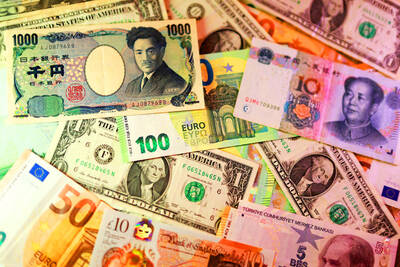
Taiwan’s foreign exchange reserves fell below the US$600 billion mark at the end of last month, with the central bank reporting a total of US$596.89 billion — a decline of US$8.6 billion from February — ending a three-month streak of increases. The central bank attributed the drop to a combination of factors such as outflows by foreign institutional investors, currency fluctuations and its own market interventions. “The large-scale outflows disrupted the balance of supply and demand in the foreign exchange market, prompting the central bank to intervene repeatedly by selling US dollars to stabilize the local currency,” Department of Foreign

Intel Corp is joining Elon Musk’s long-shot effort to develop semiconductors for Tesla Inc, Space Exploration Technologies Corp and xAI, marking a surprising twist in the chipmaker’s comeback bid. Intel would help the Terafab project “refactor” the technology in a chip factory, the company said on Tuesday in a post on X, Musk’s social media platform. That is a stage in the development process that typically helps make chips more powerful or reliable. The chipmaker’s shares jumped 4.2 percent to US$52.91 in New York trading on Tuesday. The Terafab project is a grand plan by Musk to eventually manufacture his own chips for
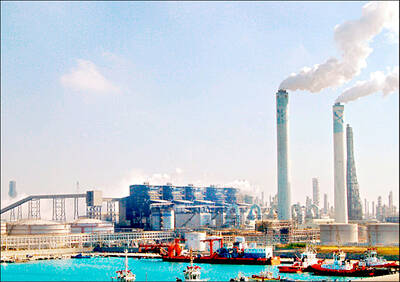
Taiwan Power Co (Taipower, 台電) yesterday said it plans to resume operations at two coal-fired power generators for three months to boost security of electricity supply as liquefied natural gas (LNG) supply risks are running high due to the Middle East conflict. The two coal-fired power generators are at Mailiao Power Plant in Yunlin County’s Mailiao Township (麥寮). The plant, operated by Formosa Plastics Group (台塑集團), supplied electricity to Taipower’s power grid until the end of last year. Taipower’s decision came about one month after Minister of Economic Affairs Kung Ming-hsin (龔明鑫) on March 10 said that the nation had no imminent

Some robotaxi passengers were left stranded in the middle of fast-moving traffic in a major Chinese city after their driverless vehicles stopped running, according to police and media reports on Wednesday. A preliminary investigation indicates more than 100 robotaxis came to a halt because of a “system malfunction,” police in the city of Wuhan said in a statement, without elaborating. No injuries were reported. One passenger told Chinese media that their robotaxi stopped after turning a corner. An instruction on a screen read: “Driving system malfunction. Staff are expected to arrive in 5 minutes.” After no one showed up, the passenger pushed


 RSS
RSS