


Spain created an emergency fund to protect regional governments from defaulting and warned that pensions will be overhauled as protesters rallied on Friday against deep spending cuts needed to dodge an international bailout.
After a weekly Cabinet meeting, the government gave details of the 65 billion euro (US$80 billion) austerity package Spanish Prime Minister Mariano Rajoy announced on Wednesday.
Spain — which enjoyed 30 years of almost uninterrupted economic growth until 2007 — is on the front line of the two-and-a-half-year eurozone debt crisis, weighed down by crippled banks, indebted regions and a deep economic downturn.

Photo: Reuters
Ministers approved a reform of city and regional governments, wage cuts for public workers and cuts in unemployment benefits. The government confirmed it would enforce reforms this month of the energy sector, and rail, road and air transport.
Workers blocked streets and railways in Madrid, protesting against cuts that they said hurt ordinary people more than the bankers and politicians blamed for the country’s economic crisis. Unions called for a September strike.
In the evening, about 2,000 people gathered in central Madrid, chanting and jeering. Police fired rubber bullets to disperse the crowds, injuring two, emergency services said. Six people were arrested, police said.
Civil servants gathered outside the presidential palace, booing the ministers’ convoy of cars as Rajoy’s Cabinet convened under pressure from eurozone leaders and financial markets to approve its new budget plan.
“Spaniards are living today one of the most difficult and traumatic moments of our history,” Spanish Deputy Prime Minister Soraya Saenz de Santamaria told a news conference after the meeting.
Spain’s borrowing costs have soared in recent months and many investors believe that after seeking up to 100 billion euros for its banks, the government could soon follow Greece, Ireland and Portugal in seeking a state bailout.
As expected, the government approved on Friday a new mechanism to help Spain’s 17 autonomous regions — now shut out of international financial markets — to fund themselves and repay their debts.
The instrument, which will have a maximum capacity of 18 billion euros, will be funded through a 6 billion euro loan from the state lottery and by the Spanish Treasury.
However, the regions will retain full responsibility to repay any loan they obtain from the fund and they will have to meet conditions including more work on cutting their public deficits.
Spanish Economy Minister Luis de Guindos said the Spanish Treasury, whose credit rating is already on the verge of junk territory and could be affected by this new burden, would not change its debt issuance calendar.
Among other expected measures, the government said increases in value-added tax (VAT) rates would take effect on Sept. 1, after the end of the tourism season.
The general VAT rate will be raised to 21 percent from 18 percent and the reduced rate for the leisure industry to 10 per cent from 8 percent. Tax breaks on properties will be eliminated.
Saenz de Santamaria said the government would discuss a bill to overhaul the pension system with other political parties. Such a reform — which would break one of the last campaign pledges Rajoy has so far managed to keep — is a longstanding demand of the IMF and European Commission.
Rajoy said on Wednesday the discussion would be based on recommendations from the EU to establish a stronger link between the pension schemes and life expectancy.
Analysts believe this latest austerity package, although it may have won Spain time with markets and praise from Europe, could deepen the country’s economic woes rather than solve them.
Spain’s government has few cards left to play to avoid a state bailout, analysts say. Falling revenues will make it hard to control spiraling debt and meet deficit targets, even after they were eased this week.
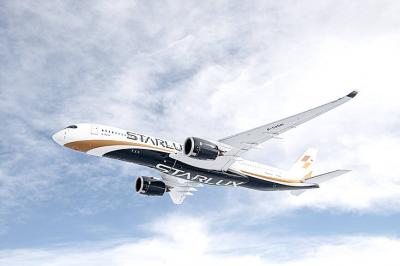
Starlux Airlines Co (星宇航空) today unveiled a long-haul network expansion plan at a shareholders’ meeting in Taipei, including direct flights to Barcelona, Spain, and Zurich, Switzerland, as well as a service connecting Taipei, Sydney and New Zealand. Starlux is to become the first Taiwanese carrier to offer non-stop services to the two European cities, while the inaugural oceanic route is expected to expand transit opportunities within the Australia-New Zealand market, Starlux said. Flight services to Chicago, Dallas, Washington and New York are under evaluation, the airline added. Prior to the shareholders’ meeting, the airline earlier this year announced that it would be

Netherlands-based semiconductor equipment supplier ASML Holding NV yesterday said that it is planning to hire an additional 1,000 people in Taiwan this year in response to growing demand from clients. ASML had previously planned to recruit 600 people this year, but that the plan has been adjusted upward, ASML vice president and ASML Taiwan general manager Grace Wang (汪佳慧) told reporters. ASML has a workforce of more than 4,500 in Taiwan, accounting for about 10 percent of its global total, Wang said. This year’s recruitment campaign would focus on adding people in the customer support, manufacturing and supply chain domains to assist ASML

UNDER MICROSCOPE: Taiwan detained three people who allegedly conspired to buy servers in Taiwan and export them using fraudulent documentation, prosecutors said Nvidia Corp chief executive officer Jensen Huang (黃仁勳) on Saturday urged Super Micro Computer Inc to tighten up on compliance after Taiwan detained three people this week for allegedly making fraudulent declarations about artificial intelligence (AI) servers made by its US partner. The development marked the nation’s first crackdown on semiconductor smuggling, which grew after the US slapped restrictions on exports of high-end chips such as Nvidia AI accelerators to China. Nvidia is “rigorous” in explaining regulations to all of its partners, Huang told reporters after arriving in Taipei. “Ultimately Super Micro has to run their own company,” he said in response to

Nvidia Corp yesterday announced that CEO Jensen Huang (黃仁勳) would attend an employee meeting in Taipei tomorrow to celebrate the launch of the company’s Taiwan headquarters project. Huang would attend a gathering at the site of Nvidia’s planned headquarters in Beitou Shilin Technology Park (北投士林科技園區), the company said in a statement. After arriving in Taiwan on Saturday last week, Huang told reporters that he plans to meet with Quanta Computer Inc (廣達) chairman Barry Lam (林百里) and Taiwan Semiconductor Manufacturing Co (TSMC, 台積電) chairman C.C. Wei (魏哲家), and would attend the groundbreaking ceremony for Nvidia’s Taiwan headquarters tomorrow. Nvidia has not yet applied


 RSS
RSS