


Powertech Technology Inc (力成), which provides packaging and testing services for memory chipmakers, said yesterday it planned to halve its cash dividend payout this year, after its board decided to book a loss of NT$1.89 billion (US$63.8 million) in relation to Elpida Memory Inc’s financial restructuring.
The company’s board also approved a plan to dispose of its stake in Rexchip Electronics Inc (瑞晶), a DRAM joint venture between Tokyo-based Elpida and Taiwan’s Powerchip Technology Corp (力晶).
Elpida, the sole PC DRAM chipmaker in Japan, is one of Powertech’s customers. The world’s third-largest DRAM chipmaker after South Korea’s Samsung Electronics Co and Hynix Semiconductor Inc filed for bankruptcy protection with the Tokyo District Court earlier this month.
Powertech, whose customers also include Japan’s Toshiba Corp and Kingston Technology Co of the US, said in a stock exchange filing that its board had approved a plan to distribute a cash dividend of NT$2 per share based on last year’s earnings.
In the previous year, the Hsinchu-based company paid shareholders a cash dividend of NT$4 per share and a stock dividend of 0.1 percent based on 2010 earnings.
With the company’s stock price closing at NT$59.5 yesterday on the Taiwan Stock Exchange, the proposed cash dividend of NT$2 per share translates into a dividend yield of 3.36 percent, higher than the interest rates on fixed-term deposits offered by local banks.
The company said in the filing the proposed cut in dividend payout this year came as the board revised downward its net income for last year to NT$4.74 billion, from the NT$6.4 billion estimated last month, to reflect the impact of Elpida’s financial restructuring.
The revised net income was 37.96 percent lower than the NT$7.64 billion the company posted for 2010, according to company data.
Last year’s earnings per share were also adjusted downward to NT$5.93, from the NT$8.01 estimated previously, the company said. That compares with earnings of NT$10.53 per share for 2010.
Consolidated revenues totaled NT$39.45 billion last year, up 4.3 percent year-on-year, according to the filing.
Meanwhile, Powertech said the board was considering selling the NT$3.85 billion of Rexchip shares it acquired from Powerchip to Kingston Technology for the same amount.
On Feb. 29, Powerchip sold 274.4 million shares of Rexchip at NT$14.03 each to Powertech to offset some of the accounts payable it owed Powertech. The NT$3.85 billion Rexchip shares account for 6.24 percent of the total assets of Powertech.
Rexchip’s stock price ended 2.07 percent higher at NT$8.4 on the Emerging Stock Market yesterday.
“Kingston will buy all Rexchip shares held by Powertech, once the two sides sign the contract and after both Elpida and Powerchip renounce their preemptive right on those shares,” Powertech said in the statement.
The proposed dividend payout and the plan to sell Rexchip shares outlined in yesterday’s board meeting still have to be approved by shareholders at the company’s annual general meeting on June 15.
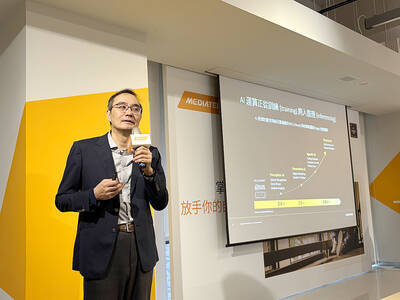
MediaTek Inc (聯發科), the world’s biggest smartphone chip supplier, yesterday said it plans to double investment in data center-related technologies, including advanced packaging and high-speed interconnect technologies, to broaden the new business’ customer and service portfolios. The chip designer is redirecting its resources to data centers, mainly designing application-specific integrated circuits (ASIC) with artificial intelligence (AI) capabilities for cloud service providers. The data center business is forecast to lead growth in the next three years and become the company’s second-biggest revenue source, replacing chips used in smart devices, MediaTek president Joe Chen (陳冠州) told a media event in Taipei. “Three or four years

Until US President Donald Trump’s return a year ago, when the EU talked about cutting economic dependency on foreign powers — it was understood to mean China, but now Brussels has US tech in its sights. As Trump ramps up his threats — from strong-arming Europe on trade to pushing to seize Greenland — concern has grown that the unpredictable leader could, should he so wish, plunge the bloc into digital darkness. Since Trump’s Greenland climbdown, top officials have stepped up warnings that the EU is dangerously exposed to geopolitical shocks and must work toward strategic independence — in defense, energy and

Motorists ride past a mural along a street in Varanasi, India, yesterday.

For the second year in a row, a Brazilian movie has wowed international audiences and critics, securing multiple Oscar nominations and drawing fresh interest in the Latin American giant’s film industry. Experts say the success of The Secret Agent, which has won four Oscar nominations, a year after I Am Still Here won Brazil its first Oscar, is no fluke, with a bit of a push from the country’s political climate. “This is neither a coincidence nor a miracle. It is the result of a lot of work, consistent policies, and, of course, talent,” Ilda Santiago, director of the Rio International Film


 RSS
RSS