


Until US President Donald Trump’s return a year ago, when the EU talked about cutting economic dependency on foreign powers — it was understood to mean China, but now Brussels has US tech in its sights.
As Trump ramps up his threats — from strong-arming Europe on trade to pushing to seize Greenland — concern has grown that the unpredictable leader could, should he so wish, plunge the bloc into digital darkness.
Since Trump’s Greenland climbdown, top officials have stepped up warnings that the EU is dangerously exposed to geopolitical shocks and must work toward strategic independence — in defense, energy and tech alike.
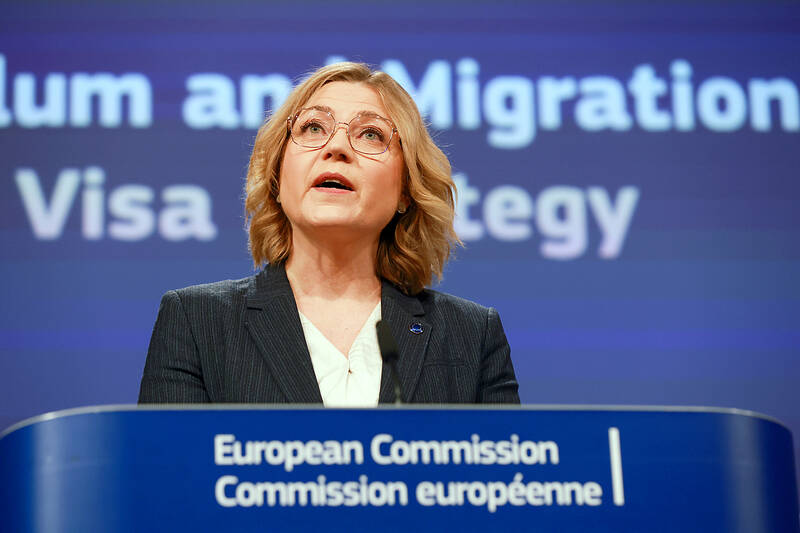
Photo: EPA
The 27-country bloc relies on foreign countries for more than 80 percent of digital products, services, infrastructure and intellectual property, according to a 2023 EU report.
Europe has already begun chipping away at its reliance on US tech.
The latest step came last week when France told state employees they would soon be required to use a domestic alternative to tools like Zoom or Microsoft Teams.
Brussels’ wake-up call came last year when Washington sanctioned judges at the International Criminal Court, cutting them off from US tech such as Amazon.com Inc or Google LLC.
The move laid bare the US stranglehold over many tools that underpin European lives.
“During the last year everybody has really realized how important it is that we are not dependent on one country or one company when it comes to some very critical technologies,” European Commissioner for Digital and Frontier Technologies Henna Virkkunen said.
“Dependencies ... can be weaponized against us,” she added.
Virkkunen is in March to unveil a major “tech sovereignty” package covering cloud, artificial intelligence and chips — areas where the EU hopes to build greater autonomy.
“Digital technologies are no longer neutral tools,” European Digital SME Alliance’s secretary general, Sebastiano Toffaletti, told reporters. “When core infrastructures like cloud, AI [artificial intelligence] or platforms are controlled from outside Europe, so are the rules, the data and ultimately the leverage.”
Among EU member states, France and Germany have been leading the charge.
The northern German state of Schleswig-Holstein became a poster child for digital sovereignty last year by ditching Microsoft Corp’s software in favor of open-source alternatives.
Schleswig-Holstein Minister of Digitalization Dirk Schroedter said the move was economically-driven at first, before “political tensions” shifted the focus.
“Dominance of a few tech corporations in public infrastructure limits ... our flexibility, threatens our security and inflates our software costs,” Schroedter said.
Over six months, the state migrated more than 40,000 mailboxes from Microsoft Exchange and Outlook to open-source solutions Open-Xchange and Thunderbird.
There were challenging areas during the transition — for example in document-sharing with other federal states and the national government — but Schroedter said the state showed “digital independence is possible.”
Meanwhile, the European Parliament is reviewing its reliance on Microsoft among other tools after a cross-party group of lawmakers urged it to adopt European alternatives.
Moves are also under way at the EU level.
French firm Mistral AI SAS and German giant SAP SE agreed to work on a European AI-driven cloud solution at a Franco-German digital sovereignty summit in November last year.
France, Germany, Italy and the Netherlands teamed up last year in a push to create common European digital infrastructure, steered by the European Commission.
Much of EU policymaking is now being viewed through the prism of sovereignty.
The bloc has long been working on a digital euro, which dozens of economists — including Thomas Piketty — called an “essential safeguard of European sovereignty” in an open letter last month.
That follows the 2024 launch of Wero, a European payments alternative to Mastercard, Visa and PayPal backed by several major banks.
Zach Meyers of CERRE, a Brussels-based think tank, warns the EU must be clear about what “tech sovereignty” is meant to achieve.
If the goal is to withstand political pressure, the EU might be better off focusing on gaining “more leverage against” the US, Meyers said.
To that end, he said the most effective strategy is not to cut back on US tech in Europe, but “rather to double down on parts of the tech value chain where the US is dependent on Europe” — from chip-building machinery to corporate software or telecoms equipment.
SECOND-RATE: Models distilled from US products do not perform the same as the original and undo measures that ensure the systems are neutral, the US’ cable said The US Department of State has ordered a global push to bring attention to what it said are widespread efforts by Chinese companies, including artificial intelligence (AI) start-up DeepSeek (深度求索), to steal intellectual property from US AI labs, according to a diplomatic cable. The cable, dated Friday and sent to diplomatic and consular posts around the world, instructs diplomatic staff to speak to their foreign counterparts about “concerns over adversaries’ extraction and distillation of US AI models.” Distillation is the process of training smaller AI models using output from larger, more expensive ones to lower the costs of training a powerful new

Singapore-based ride-hailing and delivery giant Grab Holdings’ planned acquisition of Foodpanda’s Taiwan operations has yet to enter the formal review stage, as regulators await supplementary documents, the Fair Trade Commission (FTC) said yesterday. Acting FTC Chairman Chen Chih-min (陳志民) told the legislature’s Economics Committee that although Grab submitted its application on March 27, the case has not been officially accepted because required materials remain incomplete. Once the filing is finalized, the FTC would launch a formal probe into the deal, focusing on issues such as cross-shareholding and potential restrictions on market competition, Chen told lawmakers. Grab last month announced that it would acquire

The artificial intelligence (AI) boom has triggered a seismic reshuffling of global equity markets, with Taiwan and South Korea muscling past European nations one by one. With its stock market now valued at nearly US$4.3 trillion, Taiwan surpassed the UK, Europe’s biggest market, earlier this month, data compiled by Bloomberg showed. South Korea is about US$140 billion away from doing the same. The tech-heavy Asian markets have shot past Germany and France in the past seven months. The shift is largely down to massive gains in shares of three companies that provide essential hardware for AI: Taiwan Semiconductor Manufacturing Co (TSMC, 台積電),
Shares of Taiwan Semiconductor Manufacturing Co (TSMC, 台積電) have repeatedly hit new highs, but an equity analyst said the stock’s valuation remains within a reasonable range and any pullback would likely be technical. The contract chipmaker’s historical price-to-earnings (P/E) ratio has ranged between 20 and 30, Cathay Futures Consultant Co (國泰證期) analyst Tsai Ming-han (蔡明翰) told Central News Agency. With market consensus projecting that TSMC would post earnings per share of about NT$100 (US$3.17) this year, supported by strong global demand for artificial intelligence (AI) applications, and the stock currently trading at a P/E ratio of below 25, Tsai said the valuation


 RSS
RSS