


Olympus Corp’s former president Michael Woodford pledged to work with the Japanese camera maker’s board to try to avoid delisting after three executives implicated in a scheme to hide losses resigned.
The company’s priority is to produce accounts by the Dec. 14 deadline set by regulators to avoid being removed from public trading, Woodford told reporters in Tokyo yesterday after his first board meeting since being axed.
The stock jumped as much as 25 percent as investors bet the scandal would be contained and after Olympus on Thursday night promised to put a rescue plan to shareholders and revamp management.
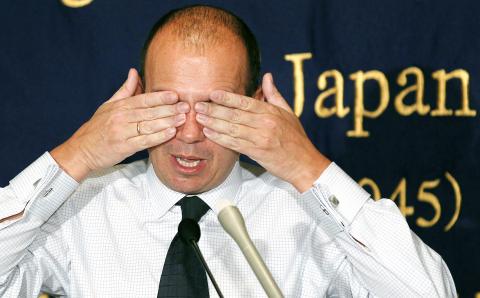
Photo: Reuters
The resignation of former Olympus chairman Tsuyoshi Kikukawa and two senior aides gives the company an opportunity to add board members untainted by the scandal.
Woodford’s exposure of US$687 million in fees paid by Olympus to a now-defunct Cayman Islands-based fund rattled investors, prompting Japanese Prime Minister Yoshihiko Noda to say the payments could damage the country’s international reputation.
While Olympus shareholders, including Southeastern Asset Management Inc, have called for the 51-year-old Briton to be reinstated, the matter was not discussed at yesterday’s meeting, Woodford told reporters.
He has said he would return to the company if shareholders request it, though he added at a later press conference in Tokyo that “he isn’t begging to come back.”
The board meeting was “constructive,” Woodford said, adding that there was a desire to “be civilized.”
“Japan does need people to challenge, scrutinize,” said Woodford, in white shirt and tie and watched by hundreds of journalists at the Foreign Correspondents Club of Japan.
“In Japan, even the meetings were pre-decided,” he said.
Shares of the 92-year-old camera and endoscope maker closed 8.6 percent higher at ¥1,107 in Tokyo yesterday, a fourth straight daily advance.
Woodford’s return to Japan is the first since he left the country on the same day as his dismissal, saying he felt unsafe following reports that the payments made by Olympus could be linked to organized--crime groups.
He was escorted by armed police to meetings with investigators on Thursday.
Woodford said he was confident prosecutors would fully investigate Olympus.
“I’m very happy with how things went,” he told reporters after visiting police in Tokyo.
The police will decide if the company was involved in organized crime, Woodford said, adding there has been no evidence of any links so far.

DAMAGE REPORT: Global central banks are assessing war-driven inflation risks as the law of unintended consequences careens around the world, spiking oil prices Central banks from Washington to London and from Jakarta to Taipei are about to make their first assessments of economic damage after more than two weeks of conflict between the US and Iran. Decisions this week encompassing every member of the G7 and eight of the world’s 10 most-traded currency jurisdictions are likely to confirm to investors that the specter of a new inflation shock is already worrying enough to prompt heightened caution. The US Federal Reserve is widely expected to do exactly what everyone anticipated weeks ahead of its March 17-18 policy gathering: hold rates steady. The narrative surrounding that
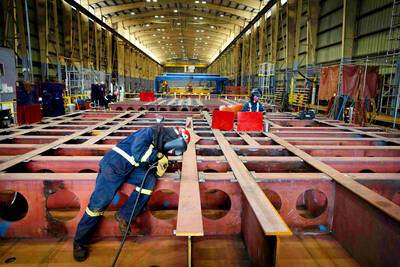
At a massive shipyard in North Vancouver, Canadian workers grind metal beams for a powerful new icebreaker crucial to cementing the country’s presence in the increasingly contested arctic. Icebreakers are specialized, expensive vessels able to navigate in the frozen far north. And “this is the crown jewel,” said Eddie Schehr, vice president of production at the Seaspan shipyard. For Canadian Prime Minister Mark Carney, who heads to Norway next Friday to observe arctic defense drills involving troops from 14 NATO states, Canada’s extreme north has emerged as a strategic priority. “Canada is and forever will be an Arctic nation,” he said ahead of

Chinese entrepreneur Frank Gao used to spend long hours running his social media accounts but now outsources the chore to artificial intelligence (AI) agent tool OpenClaw, which is taking China by storm despite official warnings over cybersecurity. OpenClaw, created in November by an Austrian coder, differs from bots such as ChatGPT because it can execute real-life tasks such as sending e-mails, organizing files or even booking flight tickets. “Since January, I’ve spent hours on the lobster every day,” Gao said in an interview, referring to OpenClaw’s red crustacean mascot. “We’re family.” After downloading OpenClaw, users connect it to artificial intelligence models of their
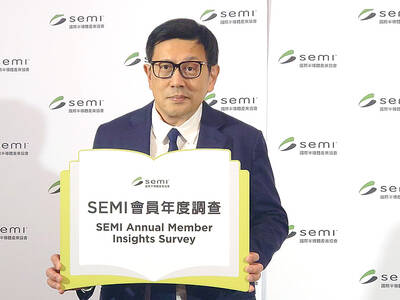
PRICE HIKES: The war in the Middle East would not significantly disrupt supply in the short term, but semiconductor companies are facing price surges for materials Taiwan’s semiconductor companies are not facing imminent supply disruptions of essential chemicals or raw materials due to the war in the Middle East, but surges in material costs loom large, industry association SEMI Taiwan said yesterday. The association’s comments came amid growing concerns that supplies of helium and other key raw materials used in semiconductor production could become a choke point after Qatar shut down its liquefied natural gas (LNG) production and helium output earlier this month due to the conflict. Qatar is the second-largest LNG supplier in the world and accounts for about 33 percent of global helium output. Helium is


 RSS
RSS