

The government is planning to authorize a low-cost housing program that would be constructed by the private sector on government-owned land, Council for Economic Planning and Development Minister Christina Liu (劉憶如) said yesterday. This project targets low-income families to assist them in getting their own homes instead of being lifelong renters, she said.
These homes, called “modern housing” by the council, will be constructed as “green” buildings close to MRT stations, with utilities such as energy-conserving facilities and broadband network access.
“The concept of ‘modern housing’ is different from social housing, as the former is constructed to be sold instead of being rented out, for which social housing is intended,” Liu told a press briefing.
The government would open the bidding to private-sector developers interested in constructing these homes, while providing leasing rights for up to 70 years, rather than selling the land to developers, she said.
“The government owns land, but has no money to construct homes. This program solves this problem, as the private sector has enough capital for this,” Liu said.
The program could also help curb rising home prices in urban regions, one of the major complaints among the public, since high land values are the main reason behind excessive housing prices, she added.
The council will set a standard for people qualified to purchase “modern housing,” such as low-income families and those who have never owned a house.
“For families that have to pay rent every month, it is better to use the same money to buy a home to call their own, which they could sell at any time,” Liu said.
The government will also coordinate banks to provide long-term preferential loans to prospective homebuyers, she added.
The council’s project is borrowing a concept from Singapore’s experience of constructing public housing, which has proven to be successful.
“I believe ‘modern housing’ would not be opposed by nearby residents, as they are not only fancy, but also offer people who might be too young to afford a change in home ownership,” Liu said.
Currently, the government has settled on several lots owned by the Ministry of Finance, but Liu refused to specify the possible locations as these details are still under discussion among various agencies.
A National Property Administration officer said on condition of anonymity yesterday that the agency has not heard of the program.
“But we will fully cooperate with this program if it becomes a formal case,” the officer said by telephone.
The relevant government agencies have reached an initial consensus on the program, which will be submitted to the Cabinet for approval soon.
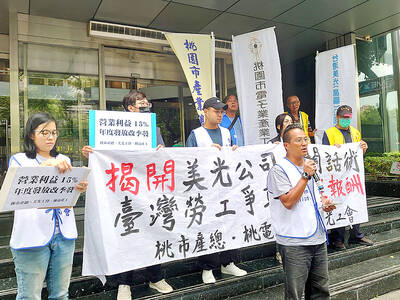
UNION DETERMINATION: Rejecting an offer for a one-time payout as an attempt to influence opinion, the union said a strike at the memory chip manufacturer is possible The Micron Taiwan workers’ union yesterday rejected a one-time payout unveiled by US-based Micron Technology Inc last week, saying it wants a long-term mechanism under which employees would share 15 percent of the company’s operating profits. While the union and the company are still in talks over the dispute, the reward package was proposed unilaterally by the employer without reaching an agreement with the union, union head Jerry Lin (林哲瑞) told reporters. Lin said he suspected the company was seeking to influence public opinion with the move. On Friday last week, Micron announced a reward package under which employees in Taiwan would receive
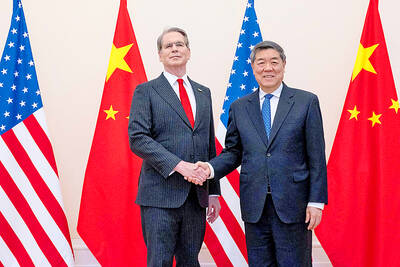
MINIMAL EXPECTATIONS: Analysts think that the two sides are likely to aim for ‘status quo’-level agreements, maintaining civility, without major trade breakthroughs US Secretary of the Treasury Scott Bessent and Chinese Vice Premier He Lifeng (何立峰) were set to meet yesterday to try to set up potential agreements on artificial intelligence (AI), tariffs and critical minerals for a summit in Washington this week between US President Donald Trump and Chinese President Xi Jinping (習近平). The meetings at JPMorgan Chase & Co’s headquarters in Manhattan, which included US Trade Representative Jamieson Greer, were due to start at about 10:30am on Sunday morning and were expected to run all day. Key topics would be the status of a US-China trade truce that is set to expire

BUILDER’s RITES: The topping out ceremony is held when a project being built has its highest point laid out, a sure sign that TSMC’s European project is making solid progress A “topping out” ceremony was held on Monday at a plant under construction in Germany by Taiwan Semiconductor Manufacturing Co (TSMC, 台積電), indicating that the fab is progressing as planned and within budget, the head of a joint-venture company in charge of the project said. A topping out ceremony is the construction milestone of laying the final beam or structural piece at the highest point of a building, and it honors the construction crew, architects and engineers. European Semiconductor Manufacturing Co (ESMC) president Christian Koitzsch said that about 2,000 workers from 106 countries are working around the clock at the site in

APPEAL: Any agreement to produce advanced memory such as HBM or DRAM could run into opposition from Seoul as those technologies are sensitive, sources said South Korea’s SK Hynix Inc is in talks with Intel Corp about a deal that would see it manufacture memory chips on US soil for the first time, three people familiar with the discussions said. Under one potential scenario, SK Hynix would lease part of Intel’s long-planned chipmaking facility in Ohio, they said. Under another scenario, it could form a venture with Intel and major cloud firms that are keen to lock in memory supplies, two of the people said. A deal would relieve pressure on Intel, which has been struggling, and mark a big win for US President Donald


 RSS
RSS