

Hewlett-Packard Co (HP) and Yahoo Inc’s tenancy in Taipei’s Nangang Software Park (南港軟體園區) has sparked interest from local and overseas companies, the manager of the government-owned development says.
“Foreign companies, especially from the US and Japan, are now becoming more interested in this project, helped by having major tenants already here,” said Hoyt Tillman, marketing director for Century Development Corp (世正開發). “It’s becoming a hub for the industry.”
HP, the world’s largest computer maker, officially opened its new Taiwan headquarters on Oct. 11, taking 33,058m2 in Phase III of the Nangang property. Yahoo will take more than 30,000m2 when it moves to the site in December, raising the foreign tenancy in the latest of three buildings in the project to 68 percent, Tillman said.
HP and Yahoo are the biggest tenants in the Nangang Software Park.
HP’s new office will host 1,000 employees from its research and development, sales and procurement divisions, Felix See (施志國), Taiwan managing director of the Palo Alto, California-based company, said at the opening ceremony on Monday. Its previous headquarters in Taipei’s Xinyi District (信義) had 11,900m2, according to an Oct. 11 press release.
Phase III of the development, which opened last year, has 171,500m2 of office space. Phase I, opened in 1999, has 187,000m2 and Phase II, opened in 2003, has 252,525m2, Tillman said. Combined, the first two phases are 31 percent occupied by foreign tenants.
Yahoo will move “due to the insufficient capacity in our existing office for over 1,000 employees, convenience of management and cost considerations,” Minyi Huang, a Taipei-based spokeswoman for the Sunnyvale, California-based company, said in an e-mailed response to questions.
Nangang Software Park is part of the government’s long-term plan to develop the eastern outskirts of Taipei by luring employers out of the downtown area where rents are higher. Two mass rapid transit lines and an upcoming high-speed rail station add to the transport options for employees at the site.
The Taiwan External Trade Development Council, the government’s trade promotion body and organizer of the Computex Trade Show, opened a new site for its World Trade Center opposite the Nangang Software Park in 2008.

Bankers in Hong Kong skipped the summer break as an artificial intelligence (AI)-fueled rush for capital sent share sales to a record, defying a bruising selloff in the city’s stocks. Initial public offerings (IPOs), placements and block trades raised US$47.5 billion in July to last month, the biggest haul ever for the period, data compiled by Bloomberg showed. That pushed fundraising this year above US$92 billion and within reach of the US$112.5 billion record set in 2021. AI has been at the heart of Hong Kong’s deal revival, but this summer brought a new level of intensity. Chinese companies raised ever-larger sums
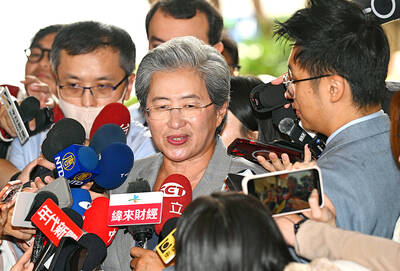
SILICON ISLAND: When asked about geopolitical tensions, Lisa Su said that ‘Taiwan is absolutely critical to the semiconductor supply chain, and very, very critical for AMD’ Advanced Micro Devices Inc (AMD) CEO Lisa Su (蘇姿丰) yesterday said the company plans to “substantially” increase manufacturing capacity next year through its Taiwanese supply chain, particularly with Taiwan Semiconductor Manufacturing Co (TSMC, 台積電), as surging demand for artificial intelligence (AI)-related processors continues to outstrip supply. “It is a very exciting time right now for all kinds of compute, and especially on the CPU [central processing unit] side,” Su said during a visit to Taiwan. “The overall market has increased a lot in 2026, and so we have also increased our own supply and capacity in 2026, but I can
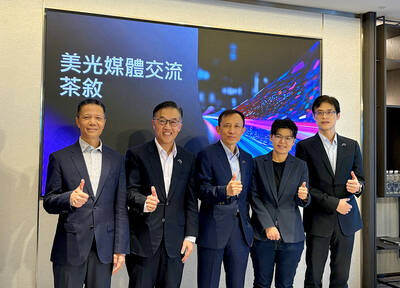
BOOMING BUSINESS: Memory supply constraints would be even more severe in 2027 and 2028, prompting customers to sign long-term supply agreements, Micron said Micron Memory Taiwan Co (台灣美光) yesterday said it is accelerating memorychip capacity expansion amid growing artificial intelligence (AI)-driven demand, with its accumulated investment in Taiwan reaching NT$1.6 trillion (US$50.2 billion) as of June. The company’s investment in Taiwan has surged over the past four years, with recent spending equaling the total invested over the past 25 years, Micron Taiwan chairman Donghui Lu (盧東暉) told a media briefing in Taipei. “The launch of ChatGPT and the outbreak of COVID triggered increasing demand for memory chips. Since then, demand has gathered pace rapidly, with only a brief pause in 2023 when a major downturn”
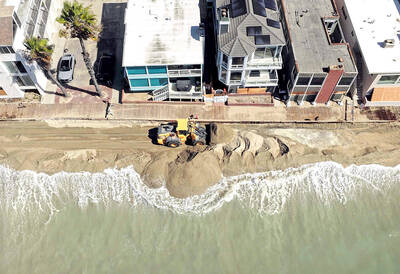
Sea levels in California are set to rise by as much as a foot (30cm) in the coming days as an enormous wave washes up the US West Coast. The huge surge of energy, known as a “coastal trapped wave” or a “Kelvin wave,” is part of El Nino, a months-long phenomenon in the Pacific Ocean that scientists say could generate powerful storms and floods in some parts of the world, while leaving others in drought. The Kelvin wave is not anything like a tsunami; nor does it crash on beaches. Rather it is a sustained bulge of excess water up to


 RSS
RSS